
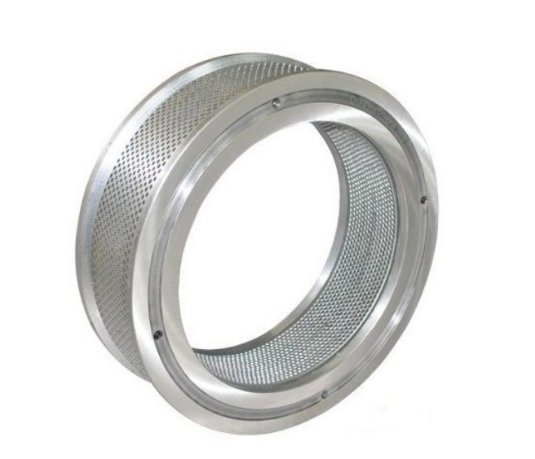
Description
Engineering & Specifications: Beyond Basic Steel
A ring die’s efficacy is determined by its internal geometry and material science. It is a thick-walled steel cylinder pierced by thousands of precisely machined holes.
1. Critical Die Parameters:
-
L/D Ratio (Length-to-Diameter Ratio of Holes): This is the most critical specification. A higher L/D ratio (e.g., 10:1) creates more friction and compression, resulting in harder, more durable pellets but requires more power. A lower L/D ratio (e.g., 6:1) is for less dense materials or lower power constraints.
-
Die Thickness: Directly related to the L/D ratio and necessary to withstand immense internal pressure, often exceeding 20,000 psi.
-
Bore Pattern & Hole Count: The arrangement and number of holes affect wear uniformity and overall output. A higher hole count increases production capacity for a given die diameter.
-
Inlet & Outlet Geometry: The inlet is typically conical (chamfered) to guide material in, while the outlet may be countersunk or straight, affecting pellet release and durability.
2. Material & Heat Treatment:
-
Standard Alloy Steel (e.g., 20MnCr5): A cost-effective choice for standard feed applications. Through carburizing and heat treatment, a hard, wear-resistant surface (58-62 HRC) is achieved with a tough, shock-absorbing core.
-
Premium Stainless Steel (e.g., 420/440 modified): Offers superior corrosion resistance for high-salinity or high-moisture recipes (e.g., aquaculture feed, biomass with high chlorine content). This extends life significantly in corrosive environments.
-
Bimetal/TwinCast Technology: The advanced solution for highly abrasive materials like wood or mineral feeds. The die body is made from a tough alloy steel, while the inner working surface is a fused layer of an extreme-wear material like high-chromium carbide. This can triple service life over standard dies.
Standard Sizing & Configuration Table:
| Die Bore Diameter (mm) | Typical Die Width/Thickness (mm) | Effective Hole Area (cm²) | Suitable Power Range (kW) |
|---|---|---|---|
| 450 | 140 – 180 | 350 – 550 | 90 – 132 |
| 560 | 160 – 200 | 600 – 900 | 160 – 250 |
| 700 | 180 – 220 | 1000 – 1500 | 250 – 355 |
| 800 | 200 – 250 | 1500 – 2200 | 355 – 450 |
Application-Specific Die Selection
Animal Feed Production
-
Poultry & Livestock: Standard L/D ratios of 8-10 are common. Hole sizes range from 3.0mm to 8.0mm. The key is consistent hole tolerance to ensure uniform pellet hardness.
-
Aquaculture (Fish Feed): Requires smaller holes (1.5mm – 4.0mm) and often a higher L/D ratio (12:1 or more) to create water-stable, sinking pellets. Corrosion-resistant materials are often mandatory.
Biomass Pellet Production
-
Wood Pellets: This is the most abrasive application. Dies require the hardest, most wear-resistant materials, typically bimetal construction with a carbide layer. L/D ratios are typically 6-8 to manage power consumption with dense hardwood fibers.
Industrial & Chemical Pelletizing
-
Fertilizer, Minerals, Chemicals: Material composition dictates the choice. Highly corrosive salts demand stainless steel, while mineral mixes require extreme abrasion resistance. Specific release angles and hole geometries are often customized.
Procurement & Operational Economics
Total Cost of Ownership (TCO) Calculation:
Distributors should guide clients away from upfront cost and toward TCO.
TCO = (Die Cost) / (Tons Produced over Die Life)
Example:
-
Die A (Standard): $5,000, produces 15,000 tons. TCO = $0.33/ton
-
Die B (Premium Bimetal): $12,000, produces 50,000 tons. TCO = $0.24/ton
Despite the higher initial cost, Die B offers a 27% lower cost per ton.
Lead Times & Logistics:
Standard die lead times are 8-12 weeks. Custom configurations (special hole sizes, bimetal) can extend to 16 weeks. A single 700mm die can weigh over 800 kg, requiring robust logistics planning.
Key Supplier Vetting Questions:
-
“Can you provide the material certification and hardness test report (HRC) for the die working surface?”
-
“What is the tolerance on the hole diameter (±0.05mm is standard for precision dies)?”
-
“Do you offer a reconditioning (re-boring) service to extend the die’s life?”
Expert Q&A for Pellet Mill Operators
Q1: What are the definitive signs that a ring die needs to be replaced or serviced?
A: The primary indicators are: 1) A consistent drop in production throughput at the same amperage, 2) A visible increase in fines generation (reduced pellet quality), and 3) A significant increase in power consumption (kWh/ton). Visually, worn inlet chamfers and polished, enlarged holes are clear signs.
Q2: Can a ring die be re-bored, and when is it economically viable?
A: Yes, a die can be re-bored by machining out the worn holes to a larger diameter. This is viable only if there is sufficient base metal thickness to maintain structural integrity and achieve an effective L/D ratio after boring. It is typically a cost-effective option for high-quality, thick dies that are only partially worn.
Q3: How does the choice of roller shell interact with ring die life?
A: They are a matched set. Using overly hard or improperly profiled roller shells will cause accelerated and uneven wear on the die’s working surface. The goal is for the shell and die to wear at a similar rate. The roller’s diameter should always be maintained at 90-95% of the die’s bore diameter for optimal nip and efficiency.
Q4: What is the impact of a “blocked” or “partially blinded” die?
A: Blinded holes (where material is compressed but does not exit) create massive pressure imbalances within the die. This leads to catastrophic failure, including crack propagation from the blocked hole back into the die body. Regular, proper cleaning with specialized non-metallic brushes is essential to prevent this.
Reviews
There are no reviews yet.