
Description
Core Equipment Categories & Technical Specifications
Pre-Processing Systems: Raw Material Preparation
Hammer Mills & Grinders
-
Throughput capacity: 1-50 tons/hour
-
Power requirements: 15-400 HP
-
Screen sizes: 1/16″ to 2″ depending on application
-
Key features: Heavy-duty bearings, reversible rotors, quick-screen change systems
Sieves & Screeners
-
Capacity: 5-100 tons/hour
-
Mesh sizes: 4-400 mesh
-
Construction: Stainless steel for food/pharma, carbon steel for industrial
-
Applications: Scalping, grading, dedusting, and quality control
Conditioning Systems: Process Optimization
Mixers & Blenders
-
Ribbon mixers: 50-5,000 liter capacity, 3-15 minute cycle times
-
Paddle mixers: 100-10,000 liter capacity, high-speed mixing
-
Batch vs continuous systems based on production requirements
-
Liquid addition systems: 1-10% addition capability with precision meters
Dryers & Coolers
-
Counter-flow coolers: 5-100 ton/hour capacity, 5-15 minute residence time
-
Rotary dryers: 1-50 ton/hour evaporation capacity
-
Fluid bed systems: Gentle handling for delicate materials
-
Temperature control: ±2°C precision for sensitive products
Material Handling & Automation
Bucket Elevators & Feed Systems
-
Capacity range: 10-500 cubic feet/hour
-
Leg heights: 10-150 feet
-
Construction: Carbon or stainless steel with USDA-approved options
-
Safety features: Motion sensors, belt alignment monitors, explosion-proof motors
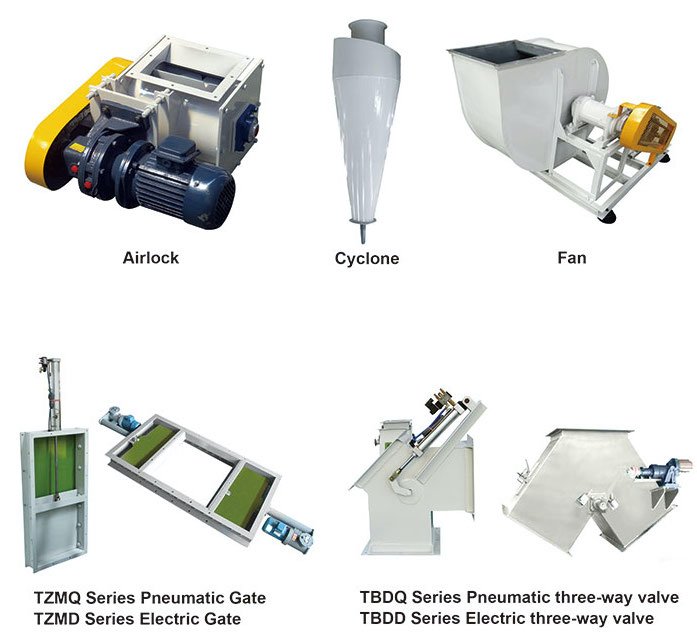
Gates & Diverters
-
Air-operated slide gates: 4-12 inch diameters
-
Rotary valves: 6-24 inch sizes with 0.5-200 cubic feet/revolution capacity
-
Diverter valves: Manual, electric, or pneumatic actuation
Performance Metrics & Selection Criteria
| Equipment Type | Key Performance Indicators | Efficiency Targets | Maintenance Intervals |
|---|---|---|---|
| Hammer Mills | Tons/kWh, Particle size consistency | 85-92% operational efficiency | Screen replacement: 200-800 hours |
| Mixers | Coefficient of variation (<7% target), Cycle time | 95%+ batch consistency | Bearing lubrication: 500 hours |
| Bucket Elevators | Capacity (CFH), Power consumption | 90%+ mechanical efficiency | Belt inspection: 250 hours |
| Coolers | Temperature reduction per minute, Moisture removal | 15-20°C temperature drop | Screen replacement: 1,000 hours |
Integration Requirements:
-
Control system compatibility (PLC, SCADA interfaces)
-
Mechanical interfaces with primary equipment
-
Safety system integration (emergency stops, guards)
-
Utility requirements (air, water, power specifications)
Industry-Specific Applications & ROI Analysis
Feed Mill Operations
A typical 20-ton/hour feed mill requires $500,000-$800,000 in auxiliary equipment. The ROI justification includes:
-
Mixer efficiency: Reducing coefficient of variation from 10% to 7% improves feed conversion ratio by 1.5%
-
Cooler performance: Proper cooling reduces pellet spoilage by 3-5%
-
Elevator reliability: Preventing one day of downtime saves $8,000-$15,000 in lost production
Biomass Pellet Production
Auxiliary systems account for 35% of total plant cost in biomass facilities. Critical components include:
-
Dryers: Reduce moisture from 50% to 12% with energy consumption of 1,200-1,500 kWh/ton evaporated water
-
Screening systems: Remove oversize and fines to improve pellet quality and reduce die wear
-
Dust collection: Baghouse systems handling 10,000-50,000 CFM to meet environmental regulations
Food Processing Facilities
Sanitary auxiliary equipment commands 30-50% premium over industrial-grade equivalents but delivers:
-
Reduced cleaning time: 40-60% faster changeover with CIP (Clean-in-Place) systems
-
Improved quality: Metal detection and screening prevents contamination claims
-
Regulatory compliance: USDA, FDA, and 3-A certifications for dairy and meat applications
Chemical & Pharmaceutical
High-purity auxiliary systems feature:
-
GMP compliance: Documented material traceability and validation packages
-
Containment systems: Protects operators from exposure to active ingredients
-
Precision control: ±1% accuracy in weighing and batching operations
Procurement & Implementation Strategy
Lead Times & Supply Chain Considerations
-
Standard equipment: 8-16 weeks
-
Custom-engineered solutions: 16-28 weeks
-
Replacement parts: 2-6 weeks (critical spares should be stocked on-site)
Total Cost of Ownership Factors
-
Energy consumption: 25-35% of operational cost
-
Preventive maintenance: 3-5% of equipment value annually
-
Spare parts inventory: 8-12% of initial equipment cost
-
Training requirements: 40-80 hours per operator
Integration Best Practices
-
Conduct factory acceptance tests (FAT) before shipment
-
Require 3D models for interference checking
-
Implement predictive maintenance programs from day one
-
Establish clear performance guarantees with penalty clauses
Expert Q&A for System Integrators
Q1: What’s the single most overlooked auxiliary component that causes system failures?
A: Slide gates and diverters are frequently underspecified. Operators choose manual or light-duty electric actuators when heavy-duty pneumatic systems are needed, leading to material buildup, flow interruptions, and eventual system shutdown. Proper specification includes considering material characteristics, cycle frequency, and fail-safe requirements.
Q2: How do we calculate the ROI for upgrading auxiliary equipment?
A: Use this formula: ROI = (Annual Savings / Investment Cost) × 100%. Key savings include labor reduction (hours saved × labor rate), yield improvement (percentage reduction in waste × material value), energy savings (kWh reduction × electricity cost), and downtime avoidance (hours saved × production value per hour).
Q3: What are the current smart technology trends in auxiliary equipment?
A: The top three trends are: 1) Vibration monitoring sensors on rotating equipment that predict failures 2-4 weeks in advance, 2) Wireless load cells on bins and hoppers providing real-time inventory data, and 3) AI-powered optimization systems that automatically adjust mixer times and dryer temperatures based on material characteristics.
Q4: How critical is proper equipment sequencing in integrated systems?
A: Extremely critical. Improper sequencing causes material backups, equipment jams, and quality variations. The golden rule: Always start systems from the discharge end backward to the intake. Modern PLC systems should include automatic sequence control with sensor verification at each transfer point.
Q5: What maintenance frequency provides optimal equipment life?
A: Follow this hierarchy: Daily (visual inspections, lubrication check), Weekly (belt tension verification, bolt tightening), Monthly (bearing inspection, wear component measurement), Quarterly (alignment checks, comprehensive lubrication), Annually (complete teardown inspection, replacement of wear components at 80% of rated life).

Reviews
There are no reviews yet.