
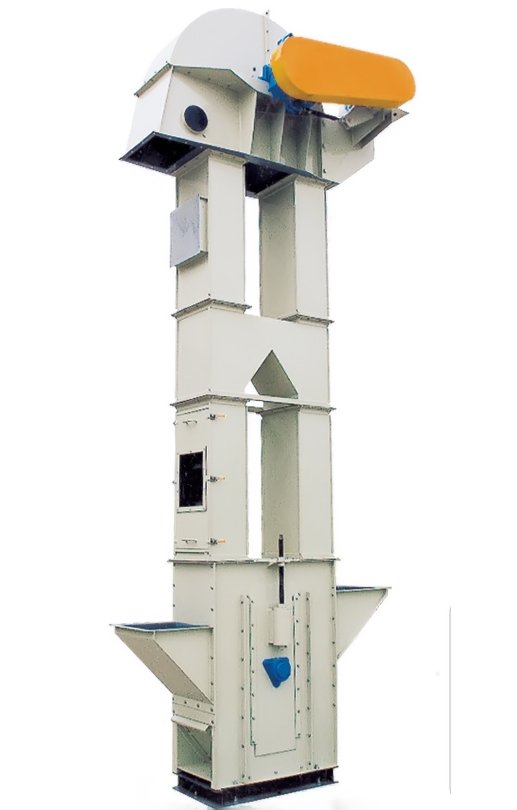
Description
Technical Specifications & Design Configurations
Capacity & Dimensional Standards
-
Throughput Range: 10-500 cubic meters/hour depending on bucket size and speed
-
Lift Heights: 10-150 feet with custom engineering available for extreme applications
-
Bucket Sizes: 1-50 liters capacity with standard widths from 4-24 inches
-
Operating Speed: 20-200 feet/minute with variable frequency drive control
Component Engineering & Materials
-
Bucket Types: CC-style (centrifugal discharge), continuous (super-capacity), V-style (precision discharge)
-
Traction Elements: Steel roller chain, polyester-reinforced belt, or combination chain/belt systems
-
Casing Construction: 12-10 gauge carbon steel, 304/316 stainless, or aluminum with dust-tight seals
-
Drive Systems: 5-150 HP gear motors with torque-limiting couplings and backstop devices
Performance & Efficiency Metrics
-
Mechanical Efficiency: 85-95% energy transfer from motor to material lift
-
Fill Factor: 75-85% achievable with proper boot design and feed conditions
-
Power Consumption: 0.5-2.0 kWh per ton lifted depending on height and material density
-
Noise Levels: 75-85 dBA without additional acoustic treatment
Industry Applications & Configuration Selection
| Industry | Preferred Elevator Type | Typical Capacity | Material Considerations | Special Features |
|---|---|---|---|---|
| Grain & Feed | Centrifugal Discharge | 50-300 m³/h | Abrasive, moderate density | USDA acceptance, quick-clean |
| Minerals & Aggregates | Continuous & Super-Capacity | 100-500 m³/h | Highly abrasive, dense | Wear-resistant liners, heavy chain |
| Chemical & Plastic | Continuous & Precision Discharge | 20-200 m³/h | Corrosive, explosive potential | Stainless construction, explosion-proof |
| Food & Pharmaceutical | Sanitary Continuous | 10-100 m³/h | Hygienic requirements, delicate | CIP/SIP systems, polished surfaces |
Application-Specific Engineering:
-
Cement & Minerals: Hard-faced buckets, manganese steel chains, and impact-resistant boot sections
-
Plastic Pellets: Static-control belts, rounded bucket interiors to prevent pellet damage
-
Food Products: USDA-approved materials, quick-disconnect buckets, and washdown-rated motors
-
Explosive Dust Environments: Explosion venting, motion monitoring, and anti-static components
Operational Economics & Maintenance Planning
Total Cost of Ownership Analysis
-
Capital Investment: $15,000-$150,000 based on height, capacity, and materials
-
Installation Costs: 20-35% of equipment cost for structural support and integration
-
Energy Consumption: $0.40-$1.80 per operating hour depending on load and height
-
Maintenance Costs: 2-4% of initial investment annually for planned maintenance
Preventive Maintenance Schedule
-
Daily: Visual inspection, listen for unusual noises, check boot level
-
Weekly: Lubricate bearings, check belt/chain tension, inspect lagging
-
Monthly: Examine buckets for wear, check alignment, verify discharge pattern
-
Annually: Complete inspection, replace wear components, recalibrate monitoring systems
Performance Optimization Strategies
-
Load Monitoring: Install smart sensors to optimize feed rate and prevent overloading
-
Speed Control: Implement VFDs to match elevator capacity to process demand
-
Preventive Replacement: Schedule bucket and chain replacement at 80% of rated wear life
-
Energy Recovery: Explore regenerative drive systems for descending load applications
Expert Q&A for Plant Engineers
Q1: What are the key indicators that an elevator needs maintenance or replacement?
A: Watch for these warning signs: increasing power consumption without load change, visible bucket or belt misalignment, unusual noise patterns (especially metallic scraping), decreased capacity, and visible wear at bucket lips or chain pins. Modern monitoring systems can detect these issues early through vibration analysis and thermal imaging.
Q2: How do we select between belt and chain drive systems?
A: Belt systems (typically steel-reinforced rubber or polyester) offer smoother operation, less noise, and better corrosion resistance for general applications. Chain systems provide superior strength for heavy, abrasive materials and high-temperature applications. The decision typically comes down to material characteristics, with chains preferred for materials above 180°F or with sharp, abrasive edges.
Q3: What is the typical operational lifespan of a properly maintained bucket elevator?
A: With comprehensive maintenance, expect 15-25 years for the structural casing and 3-7 years for traction elements (belts/chains). Buckets typically last 2-5 years depending on material abrasiveness. Drive systems generally require overhaul or replacement after 7-10 years of continuous operation.
Q4: How can we minimize product degradation in fragile material handling?
A: Implement continuous-style buckets with slower operating speeds (40-80 fpm), use rounded bucket designs without sharp corners, ensure proper boot loading to minimize impact, and consider low-friction liners in the boot section. For extremely fragile products, specially engineered “gentle-handling” elevators can reduce product damage to below 0.5%.
Q5: What safety systems are essential for bucket elevator operation?
A: Modern elevators should include: belt alignment switches, motion monitoring devices, speed sensors, boot level indicators, bearing temperature monitors, and explosion venting where applicable. Backstop devices are critical for preventing reverse rotation on inclined elevators, while emergency stop ropes along the entire length provide operator safety access.
Reviews
There are no reviews yet.