
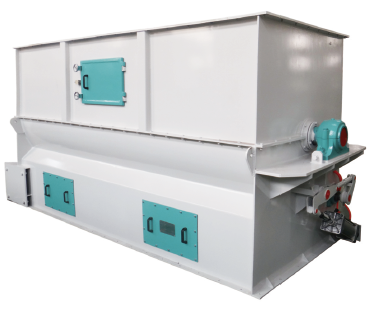
Description
Technical Specifications and Engineering Details
Mechanical Configuration
-
Standard capacity range: 100L to 20,000L
-
Power requirements: 4kW to 110kW based on material density and volume
-
Operating speed: 20-60 rpm (fixed or variable)
-
Agitator clearance: 3-8mm from trough wall
Ribbon Design Variations
-
Single-ribbon: Basic configuration for simple blending tasks
-
Double-ribbon: Standard design for most industrial applications
-
Triple-ribbon: Enhanced mixing for difficult-to-blend materials
-
Specialized ribbons: Cut-flight, paddle-enhanced, or tapered designs
Construction Materials
-
Standard: Carbon steel with industrial finish
-
Food-grade: 304 or 316 stainless steel, polished finishes
-
Specialized: Abrasion-resistant steels, coated surfaces, or exotic alloys
Performance Characteristics and Capabilities
Mixing Efficiency Metrics
-
Typical mixing time: 5-15 minutes depending on material characteristics
-
Homogeneity levels: Achieves CV values of 5-10% for most applications
-
Liquid dispersion: Capable of incorporating 2-8% liquid additives uniformly
-
Heat transfer: Jacketed models provide efficient heating or cooling
Operational Advantages
-
Handles wide range of bulk densities (0.2-2.5 g/cm³)
-
Effective with fragile materials due to gentle mixing action
-
Excellent for cohesive or poorly flowing materials
-
Minimal product degradation during processing
Industry Applications and Performance Data
Chemical Processing
In pigment and filler blending operations:
-
Achieves uniform color distribution in 8-12 minute cycles
-
Handles abrasive materials with minimal wear when properly specified
-
Maintains consistent results with density variations up to 3:1 ratio
-
Documented service life exceeding 20 years in some installations
Food and Pharmaceutical
For powder blending applications:
-
Meets sanitary requirements with polished surfaces and radiused corners
-
Maintains particle integrity in instant beverage and soup mixes
-
Validated cleaning protocols support GMP compliance
-
Allergen control through effective clean-out design
Construction Materials
In dry-mix mortar production:
-
Thoroughly disperses fibers and chemical additives
-
Handles high filler content formulations effectively
-
Robust construction withstands abrasive materials
-
Consistent results across production batches
Economic and Operational Benefits
Cost Analysis
Comparative data shows:
-
Initial investment typically 15-25% lower than comparable paddle mixers
-
Operating costs average $0.50-1.25 per ton of material processed
-
Maintenance costs generally 20-30% of initial equipment cost annually
-
Energy consumption ranges from 0.6-1.0 kWh per ton
Maintenance Advantages
-
Simple mechanical design with minimal moving parts
-
Easy access to seals and bearings for routine service
-
Ribbon replacement possible without major disassembly
-
Long service intervals with proper lubrication
Comparative Analysis with Alternative Technologies
Versus Paddle Mixers
-
Generally slower mixing cycles but gentler action
-
Better suited for cohesive materials
-
Lower shear rates preserve particle integrity
-
More effective with significant density variations
Versus Plow Share Mixers
-
Lower power consumption for similar capacities
-
Less intensive mixing action
-
Lower initial investment
-
Simpler maintenance requirements
Technical Innovations and Modern Improvements
Design Enhancements
-
Improved ribbon geometries for specific material types
-
Advanced sealing technologies for dust containment
-
Quick-disconnect mechanisms for faster cleaning
-
Jacketed designs for temperature-controlled processes
Control System Upgrades
-
PLC-based automation with recipe storage
-
Torque monitoring for process optimization
-
Integration with plant management systems
-
Safety interlocks and overload protection
Material Advancements
-
Wear-resistant coatings extending service life
-
Food-grade composites for specific applications
-
Corrosion-resistant alloys for chemical processing
-
Specialized surface treatments for sticky materials
Selection Guidelines and Application Considerations
Ideal Applications
-
Dry powder blending with minor liquid additions
-
Materials with significant density variations
-
Fragile products requiring gentle handling
-
Processes where reliability outweighs speed requirements
Limitations to Consider
-
Not ideal for high-shear applications
-
Limited effectiveness with very high liquid additions
-
Longer mixing times compared to intensive mixers
-
Potential dead zones in very large units
Sizing and Specification
-
Calculate working volume at 40-60% of total capacity
-
Consider material characteristics when selecting ribbon design
-
Evaluate cleaning requirements for sanitary applications
-
Assess available utilities and installation constraints
The ribbon mixer remains a fundamental component in industrial processing, offering proven reliability and consistent performance across numerous applications. Its straightforward mechanical design, combined with modern improvements in materials and controls, ensures its continued relevance in today’s sophisticated manufacturing environments.

Reviews
There are no reviews yet.