
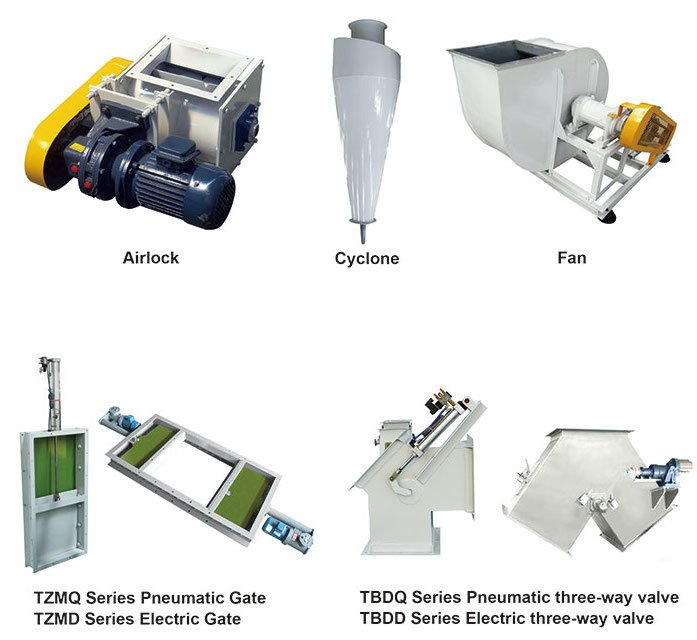
Description
Core Equipment Categories & Technical Specifications
Material Handling & Conveying Systems
-
Bucket Elevators: Capacity 5-200 m³/h, heights to 60m
-
Screw Conveyors: 10-500 m³/h, lengths to 60m
-
Pneumatic Conveyors: 1-100 tons/h, distances to 500m
-
Belt Conveyors: 20-5000 tons/h, widths 400-2400mm
Feeding & Metering Equipment
-
Volumetric Feeders: Accuracy ±1-2%, capacity 0.1-500 m³/h
-
Gravimetric Feeders: Accuracy ±0.25-1%, capacity 0.5-400 tons/h
-
Rotary Valves: 0.5-450 m³/h, pressure differential to 1.0 bar
-
Vibratory Feeders: 1-1000 tons/h, variable speed control
Size Reduction & Screening
-
Hammer Mills: 1-50 tons/h, power 15-400 kW
-
Roller Mills: 2-100 tons/h, power 11-250 kW
-
Vibratory Screens: 5-500 tons/h, 1-6 decks
-
Rotary Screens: 3-200 tons/h, sizes 0.5-3.0m diameter
Mixing & Blending Systems
-
Ribbon Mixers: 0.5-50 m³, mixing time 5-15 minutes
-
Paddle Mixers: 1-30 m³, mixing time 3-8 minutes
-
Plow Share Mixers: 0.1-20 m³, mixing time 2-6 minutes
-
Continuous Mixers: 1-100 tons/h, residence time 30-180 seconds
Performance Specifications by Application
| Equipment Type | Primary Function | Efficiency Metrics | Power Requirements | Maintenance Interval |
|---|---|---|---|---|
| Magnetic Separators | Metal contamination removal | 99.5-99.9% efficiency | 0.5-5 kW | 6-12 months |
| Dust Collectors | Air quality management | 99.9% filtration | 2-75 kW | 1-3 months |
| Heat Exchangers | Temperature control | 80-95% efficiency | N/A | 12-24 months |
| Cooling Systems | Product temperature reduction | 15-25°C temperature drop | 5-150 kW | 3-6 months |
| Metal Detectors | Contaminant detection | Sensitivity to 0.5-2.0mm | 0.2-1.5 kW | 1-6 months |
Operational Parameters:
-
Energy Consumption: 15-35% of total plant energy usage
-
Uptime Performance: 92-98% availability in optimized systems
-
Integration Capability: Multiple communication protocols supported
-
Automation Level: PLC control with HMI interfaces standard
Industry-Specific Applications & Benefits
Feed Mill Operations
In animal feed production, auxiliary equipment accounts for approximately 40% of total plant investment but enables 300% higher productivity than manual operations. A modern 30-ton/hour feed mill typically incorporates:
-
8-12 bucket elevators with total vertical lift exceeding 200m
-
15-25 screw conveyors totaling 400-600m in length
-
6-10 magnetic separators protecting processing equipment
-
3-5 dust collection systems handling 20,000-50,000 m³/h
Food Processing Facilities
Sanitary auxiliary equipment in food processing demonstrates measurable quality impacts:
-
Metal detection systems reducing contamination incidents by 99.8%
-
Precision feeders improving recipe accuracy to ±0.5%
-
Advanced cooling systems increasing shelf life by 25-40%
-
Automated conveying reducing product damage by 60-80%
Chemical & Pharmaceutical
GMP-compliant auxiliary equipment ensures regulatory compliance:
-
Validation packages supporting FDA/EMA requirements
-
Clean-in-Place (CIP) systems reducing cleaning time by 70%
-
Containment systems maintaining operator safety
-
Data integrity supporting batch traceability
Economic Impact & Operational Advantages
Total Cost of Ownership Analysis
-
Initial Investment: 25-45% of total plant equipment cost
-
Installation & Commissioning: 15-25% of equipment value
-
Operating Costs: $5-25 per operating hour depending on scale
-
Maintenance Costs: 3-6% of initial investment annually
Return on Investment Metrics
-
Productivity Improvement: 20-35% through automation
-
Labor Efficiency: 50-80% reduction in manual handling
-
Quality Enhancement: 30-60% reduction in rejects
-
Energy Optimization: 15-25% savings through efficient design
Case Study – Integrated Feed Mill:
After auxiliary equipment optimization, a 25-ton/hour facility documented:
-
Overall equipment effectiveness increased from 68% to 86%
-
Energy consumption reduced by 22% per ton of production
-
Maintenance downtime decreased from 12% to 4%
-
Product quality consistency improved from 88% to 96%
Technological Innovations & Future Trends
Smart Technology Integration
-
IoT Sensors: Real-time performance monitoring
-
Predictive Maintenance: AI-driven component life forecasting
-
Digital Twins: Virtual system optimization
-
Cloud Analytics: Performance benchmarking and optimization
Advanced Material Science
-
Wear-Resistant Alloys: Extending component life 3-5x
-
Composite Materials: Reducing weight and corrosion
-
Specialized Coatings: Enhancing sanitation and durability
-
Nanotechnology: Improving surface properties and efficiency
Sustainability Features
-
Energy Recovery Systems: Capturing waste heat and energy
-
Water Recycling: Closed-loop cooling and cleaning systems
-
Noise Reduction: Advanced acoustic engineering
-
Emissions Control: Integrated environmental compliance
Selection Guidelines & Implementation Strategy
Critical Selection Criteria
-
Capacity Matching: Proper sizing for current and future needs
-
Integration Capability: Compatibility with existing systems
-
Maintenance Requirements: Service accessibility and parts availability
-
Regulatory Compliance: Meeting industry-specific standards
Implementation Best Practices
-
Phased Approach: Systematic integration minimizing disruption
-
Training Programs: Comprehensive operator and maintenance training
-
Documentation Systems: Complete technical and operational records
-
Performance Validation: Rigorous testing and acceptance protocols
Lifecycle Management
-
Preventive Maintenance: Scheduled inspections and component replacement
-
Spare Parts Strategy: Critical inventory optimization
-
Upgrade Planning: Technology refreshment scheduling
-
Performance Monitoring: Continuous improvement implementation
Operational Excellence & Maintenance Optimization
Performance Monitoring Systems
-
Vibration analysis for rotating equipment
-
Thermal imaging for electrical and mechanical systems
-
Power quality monitoring for electrical efficiency
-
Production data integration for overall effectiveness
Maintenance Optimization
-
Condition-based maintenance replacing fixed schedules
-
Remote monitoring reducing service requirements
-
Modular design facilitating quick component replacement
-
Standardized components reducing inventory complexity
Safety & Compliance
-
Integrated safety systems meeting international standards
-
Environmental compliance monitoring and reporting
-
Ergonomics optimization reducing operator strain
-
Emergency response systems ensuring rapid shutdown
Auxiliary equipment continues to evolve from simple support machinery to sophisticated, integrated systems that directly determine manufacturing competitiveness. The strategic selection, proper integration, and optimal maintenance of these essential components represent one of the most significant opportunities for operational improvement in modern industrial facilities. As manufacturing becomes increasingly automated and digitally connected, the role of auxiliary equipment in achieving operational excellence will only continue to grow in importance and sophistication.


Reviews
There are no reviews yet.