
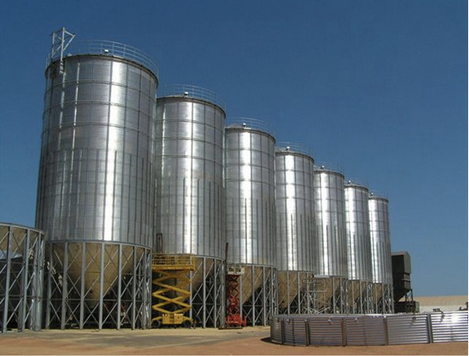
Description
Technical Specifications & Flow Dynamics
The performance of a conic bottom silo is dictated by the precise geometry and finish of its hopper section. Understanding these parameters is essential for matching the silo to the material’s flow properties.
1. Hopper Geometry & Flow Patterns:
-
Mass Flow vs. Funnel Flow: A properly designed conical silo promotes mass flow, where all material moves simultaneously whenever discharge occurs. This is opposed to funnel flow, where a central channel forms, leaving stagnant material at the periphery.
-
Critical Hopper Angle: The hopper wall must be steep enough to overcome the material’s wall friction. For most grains and pellets, this angle is 55°-65° from the horizontal. For more cohesive materials like flour or titanium dioxide, angles exceeding 70° may be required.
-
Outlet Size: The diameter must be large enough to prevent arching. For free-flowing grains, a minimum of 6-8 inches is standard. For cohesive powders, outlets of 12 inches or more are often necessary, sometimes with the aid of mechanical dischargers.
Standard Configurations & Capacities (for Free-Flowing Granulars):
| Cylinder Diameter (m) | Cone Angle (from horizontal) | Approx. Capacity (m³) | Typical Application |
|---|---|---|---|
| 3.0m | 60° | 30 m³ | Food Additives, Seed Treatment |
| 4.5m | 55° | 80 m³ | Plastic Pellets, Specialty Grains |
| 6.0m | 60° | 180 m³ | Malt, Sugar, Industrial Powders |
| 8.0m | 65° | 400 m³ | Mineral Feedstock, Soybean Meal |
2. Construction & Material Finishes:
-
Material: Typically constructed from 304 or 316 stainless steel for food and pharmaceutical use, or hot-dip galvanized steel for industrial applications.
-
Internal Finish: A low-friction internal surface, such as a #4 sanitary polish on stainless steel or a specialized epoxy coating, is often critical to ensure reliable flow.
Target Industries & Critical Applications
Food & Pharmaceutical Processing
This is the primary domain for conical silos. They are indispensable for storing ingredients where hygiene and batch integrity are legal requirements. The smooth, uninterrupted surface of a conical hopper is easy to clean and validate, supporting compliance with FDA, USDA, and GMP standards. Examples include storing flour for a bakery (preventing old material from contaminating new batches) or holding active pharmaceutical ingredients (APIs).
Plastics & Chemical Manufacturing
In extrusion and compounding plants, conic bottom silos provide a consistent, reliable feed of plastic resin or chemical powder to the process line. Any interruption or bridging in the silo can shut down a multi-million-dollar production line, making the reliability of mass flow a critical economic safeguard.
Specialty Agriculture & Seed
For high-value seeds or treated grains, complete discharge is essential to maintain genetic purity or ensure the correct dosage of treatment chemicals. Conical silos prevent the segregation of different particle sizes, which is a common problem in flat-bottom storage.
Procurement & Integration Guide
Discharge Aids & Accessories:
While gravity is the primary driver, many systems require assistance to initiate or maintain flow.
-
Vibrators: Pneumatic or electric units mounted on the hopper wall to break up minor arches.
-
Air Fluidizers: Porous pads installed in the hopper that introduce low-pressure air, effectively turning the material into a fluid-like state for extreme powders.
-
Mechanical Dischargers: Screw feeders or rotary valves that actively meter material out of the silo outlet.
Total Cost Analysis:
-
Higher Initial Cost: Conical silos have a higher cost per cubic meter of storage than flat-bottom silos due to the complex fabrication of the cone section.
-
Lower Operational Risk: This initial premium is offset by vastly reduced operational risks: no cleaning crew entry into a confined flat bottom, no spoiled product, and no production downtime due to flow blockages.
Key Supplier Questions:
-
“Can you provide a wall friction test report for my specific material to validate the hopper angle?”
-
“What is the internal surface roughness (Ra) of the hopper section?”
-
“What is the design standard used for the hopper (e.g., Jenike’s method)?”
Expert Q&A for Engineers & Specifiers
Q1: When is a conical silo absolutely necessary over a flat-bottom alternative?
A: It is mandatory for cohesive powders, materials that degrade over time, products where cross-contamination between batches is unacceptable, and any application where a “rat-holing” or bridging flow pattern would pose a safety or quality risk.
Q2: What are the common mistakes in specifying a conical silo outlet?
A: The most frequent error is undersizing the outlet for the material’s cohesive strength. Another is placing the discharge valve too far from the outlet, creating a new, smaller chamber that can itself bridge. The valve should be flanged directly to the silo outlet.
Q3: How does the cost of a stainless steel conical silo compare to a galvanized flat-bottom?
A: For the same storage volume, a sanitary stainless steel conical silo can be 2x to 3x the cost of a galvanized flat-bottom silo. This cost reflects the more complex fabrication, higher-grade materials, and polished finishes required for critical flow and hygiene.
Q4: Can existing flat-bottom silos be retrofitted with a conical bottom?
A: It is structurally complex and often not cost-effective. It involves cutting out the existing floor, designing and fabricating a cone section that interfaces correctly, and reinforcing the support structure to handle the new load paths. It is usually more economical to install a new, purpose-built conical silo.
Reviews
There are no reviews yet.