
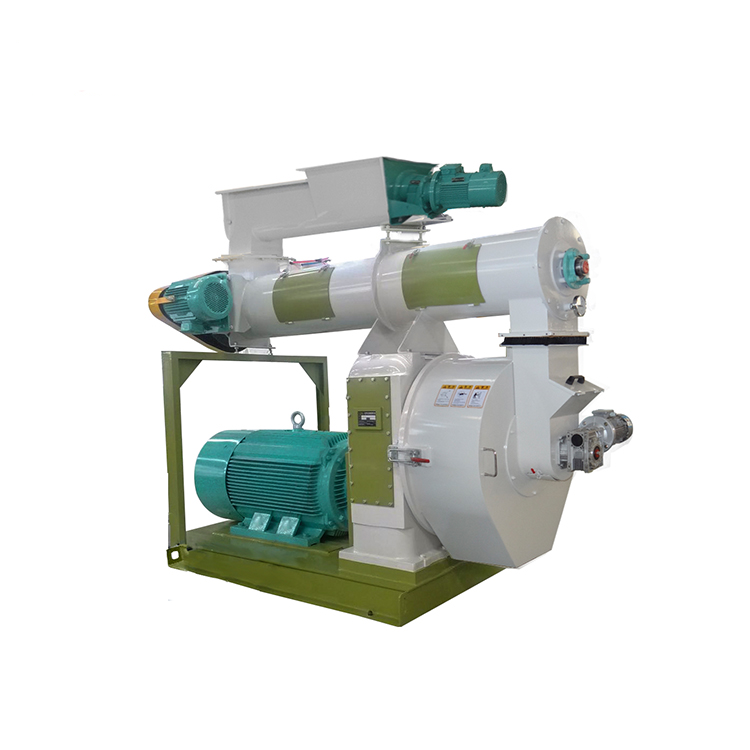
Descrição
Technical Specifications & System Configuration
Pellet Mill Drive System
-
Main Motor Power: 90-400 kW (120-550 HP) for industrial models
-
Feeder Motor: 1.5-5.5 kW variable frequency drive
-
Motor do Condicionador: 7.5-37 kW with speed control
-
Gear Reducer: Hardened spiral bevel gears, torque capacity 30,000-180,000 Nm
Conditioning System Specifications
-
Conditioner Types: Single-shaft, double-shaft, or triple-shaft configurations
-
Tempo de retenção: 30-240 seconds (adjustable via variable speed and baffle control)
-
Adição de vapor: 3-8% dry saturated steam at 2-6 bar pressure
-
Adição de Líquidos: 1-5% capability with precision metering pumps
Pelletizing Components
-
Diâmetro da Matriz: 420-1000 mm (standard sizes)
-
Espessura da Matriz: 40-100 mm (L/D ratios 1:6 to 1:12)
-
Configuração dos Rolos: 2 or 3 rollers with tungsten carbide overlay
-
Die Speed: 120-300 RPM (application optimized)
Especificações de desempenho por aplicação
| Application | Optimal Conditioning Temperature | Moisture Addition | Typical Production Rate | Pellet Durability (PDI) |
|---|---|---|---|---|
| Animal Feed | 80-85°C | 15-17% | 5-15 t/h | 95-97% |
| Biomass Pellets | 75-90°C | 12-15% | 3-10 t/h | 94-96% |
| Aqua Feed | 85-95°C | 18-22% | 2-8 t/h | 96-98% |
| Specialty Products | 70-110°C | 10-25% | 1-6 t/h | 92-98% |
Key Conditioning Parameters:
-
Gelatinização do Amido: 25-40% for standard feed applications
-
Protein Denaturation: Controlled for nutritional preservation
-
Lignin Plasticization: Critical for biomass pellet binding
-
Microbial Reduction: Pasteurization effect at higher temperatures
Advanced Conditioning Technology
Steam Injection Systems
-
Steam Quality: Dry saturated steam with <5% moisture content
-
Injection Nozzles: Multiple injection points for uniform distribution
-
Pressure Control: Precise regulation for consistent conditioning
-
Condensate Management: Automatic removal for optimal heat transfer
Liquid Addition Capabilities
-
Multiple Liquid Lines: Fat, molasses, binders, or additives
-
Precision Metering: Mass flow meters with ±1% accuracy
-
Atomization Systems: High-pressure nozzles for uniform distribution
-
Recipe Control: Automatic adjustment based on formulation
Retention Time Optimization
-
Variable Speed Drives: Adjustable paddle speed for retention control
-
Baffle Systems: Adjustable weirs and internal configurations
-
Mixing Intensity: Controlled shear for homogeneous conditioning
-
Thermal Management: Insulated housings with minimal heat loss
Industry Applications & Operational Benefits
Commercial Feed Manufacturing
Conditioned pellet mills enable feed manufacturers to produce highly durable pellets with improved nutritional availability. The controlled thermal treatment enhances starch digestibility while maintaining heat-sensitive nutrient integrity. One major feed company documented a 25% reduction in pellet fines and 15% improvement in feed conversion ratios after implementing advanced conditioning technology.
Produção de Pellets de Biomassa
For biomass applications, proper conditioning is essential for activating natural binders and creating durable pellets without synthetic additives. The precise moisture and temperature control enables consistent pellet quality from variable biomass feedstocks. A biomass producer achieved 96% pellet durability with 40% lower power consumption through optimized conditioning parameters.
Aquaculture Feed Production
The conditioner enables the high moisture and thermal treatment required for water-stable aqua feed pellets. Extended retention times and precise temperature control create highly digestible, water-resistant pellets. An aqua feed manufacturer increased pellet water stability from 2 to 6 hours while improving feed conversion ratios by 18%.
Specialty Pellet Applications
For specialized products including pet food, laboratory animal feed, and industrial pellets, the conditioning system provides the precise control needed for unique product specifications. A specialty manufacturer developed pellets with specific dissolution rates and functional characteristics through customized conditioning protocols.
Economia Operacional e Manutenção
Análise do custo total de propriedade
-
Investimento em Equipamento: $120,000-$400,000 (capacity and features dependent)
-
Custos de Instalação: 20-35% of equipment cost (utilities and foundations)
-
Energy Consumption: $12-$30 per ton (steam, power, and compressed air)
-
Wear Components: $6-$15 per ton for dies, rollers, and conditioner parts
Efficiency & Productivity Metrics
-
Eficiência de Produção: 85-95% of theoretical maximum capacity
-
Pellet Quality Consistency: 95-98% within specification
-
Energy Utilization: 30-50% reduction vs unconditioned systems
-
Raw Material Flexibility: Ability to process challenging formulations
Otimização da Manutenção
-
Conditioner Maintenance: Regular inspection of paddles, shafts, and liners
-
Steam System Service: Trap maintenance and condensate management
-
Liquid System Care: Nozzle cleaning and pump calibration
-
Preventive Schedule: Systematic inspection and component replacement
Process Control & Automation
Sistemas de Controle Inteligentes
-
Recipe Management: Storage for 100+ formulations with automatic parameter adjustment
-
Conditioning Optimization: Automatic adjustment based on raw material characteristics
-
Production Monitoring: Real-time tracking of quality and efficiency parameters
-
Análise de Dados: Historical analysis for continuous improvement
Quality Assurance Features
-
Temperature Profiling: Multiple zone temperature monitoring and control
-
Gestão da umidade: Online moisture measurement and automatic adjustment
-
Pellet Quality Monitoring: Real-time durability and temperature measurement
-
Documentation: Automatic batch records and quality documentation
Safety & Compliance Systems
-
Steam Safety: Pressure relief and automatic shutdown systems
-
Access Safety: Interlocked guards with zero-energy verification
-
Hygiene Systems: CIP capabilities and sanitary design features
-
Environmental Compliance: Emissions monitoring and control
Future Technology Development
Innovation Directions
-
Advanced Process Control: AI-driven optimization of conditioning parameters
-
Energy Integration: Waste heat recovery and energy-efficient steam generation
-
Smart Wear Monitoring: IoT sensors for predictive component replacement
-
Hybrid Conditioning: Combination of steam, microwave, and other thermal technologies
Evolução do mercado
-
Foco na sustentabilidade: Reduced energy and water consumption
-
Integração digital: Enhanced connectivity and data exchange
-
Flexibility Demands: Quick changeover between diverse products
-
Global Standards: Harmonization of safety and quality requirements
Avaliações
Ainda não há avaliações.