
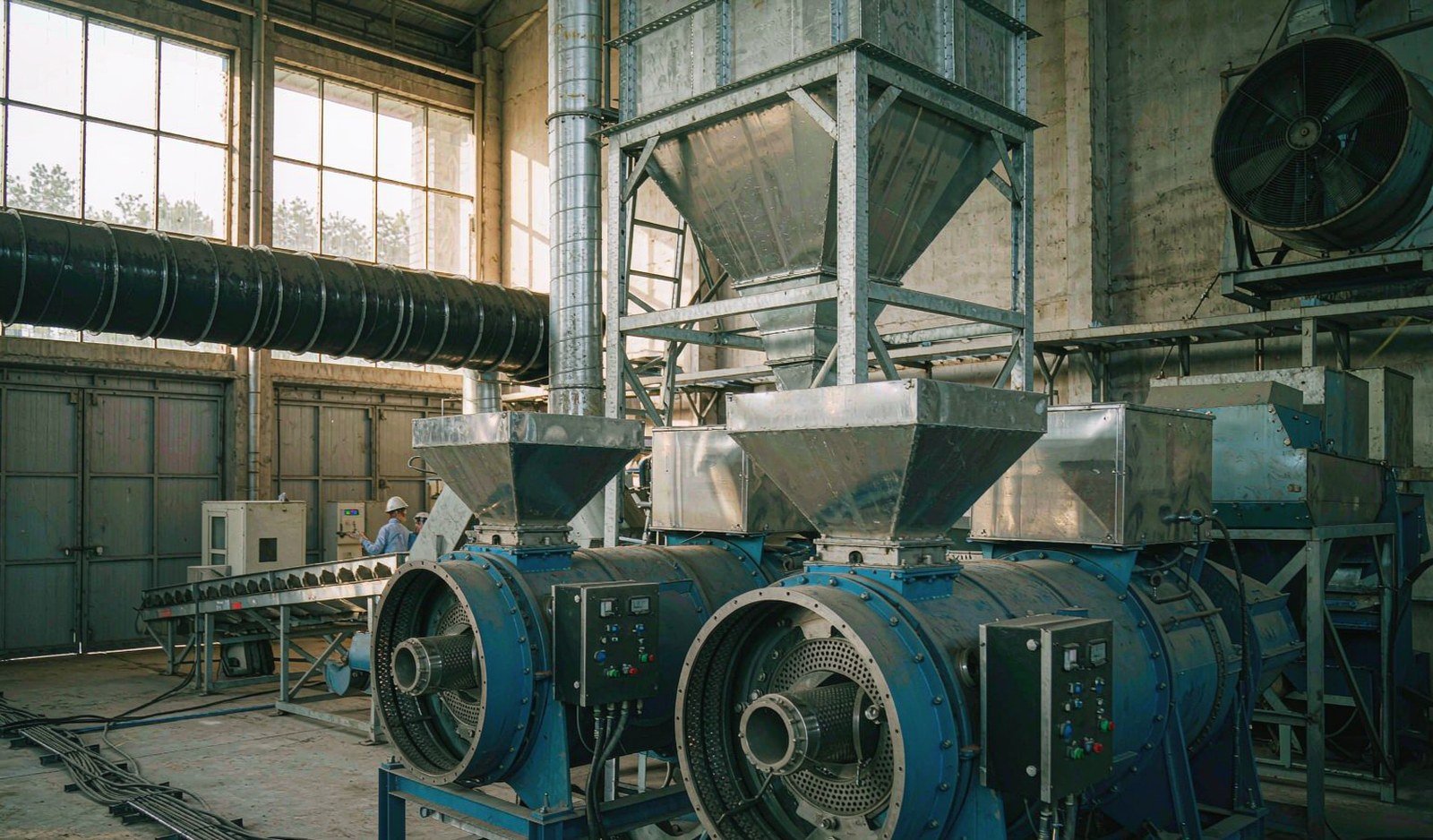
The 5 t/h feed mill is the workhorse size of the compound feed industry. In Alltech’s 2026 Agri-Food Outlook, built from a survey of 38,837 feed mills in 142 countries, global feed production reached 1.44 billion tonnes in 2025, and broiler feed alone accounted for just over 400 million tonnes of it — the largest single species segment on the planet. A large share of that tonnage is made in plants exactly this size, one or two pellet lines running a broiler or layer formula for an integrated farm group or a regional feed brand.
Most of the problems we get called into on projects of this size are not machine failures. They are sizing failures: a mill specified from a catalogue tonnage that assumed a different formula, a different moisture, or a different number of operating hours than the buyer actually runs. This article walks through how a 5 t/h poultry feed mill is actually put together — the capacity balance, the equipment decisions, the layout, and the running costs — the way we size it when a project comes through our own engineering department.
Start from the sales contract, not the machine list
The first mistake in feed mill projects is buying “a 5 t/h pellet mill” and treating everything else as an accessory. The right starting point is a tonnage target you can defend on paper, and it comes from three numbers you should know before you talk to any supplier:
How much feed you must produce per year. If you supply your own farms, multiply flock size, mortality-adjusted placement, feed conversion and days on feed. If you sell commercially, it is your contracted volume plus the growth you expect within two years — because adding a second pellet mill later is far more disruptive than buying the right silos and elevators on day one.
How many hours per day the plant will actually run. A 5 t/h line on one eight-hour shift produces roughly 40 tonnes a day and about 12,000 tonnes on 300 working days. The same equipment on a 20-hour double-shift schedule produces around 30,000 tonnes of nameplate output, and something close to 25,000–26,000 tonnes once you take normal availability into account. That difference decides whether the plant pays for itself on your own farm consumption or needs outside sales to reach break-even.
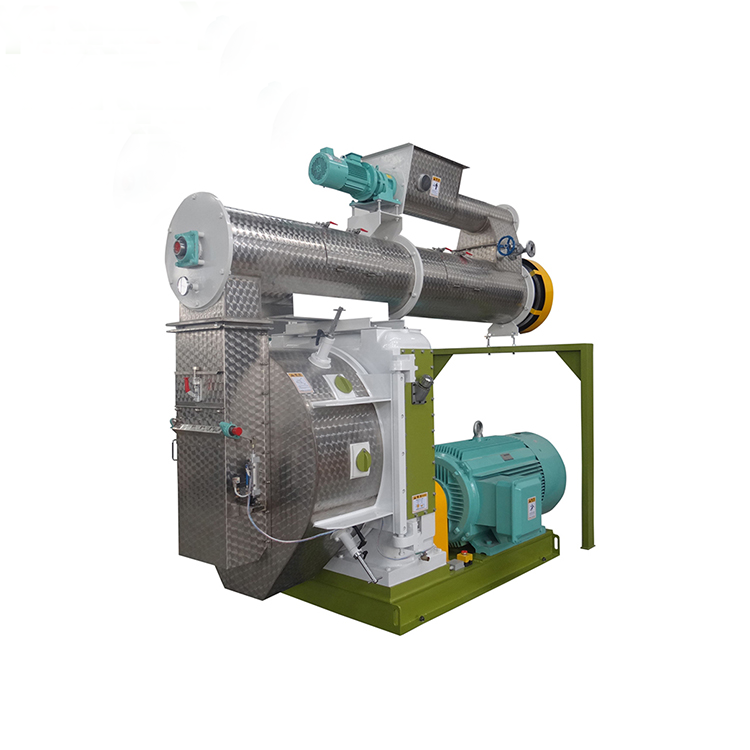
What “5 t/h” is measured against. A pellet mill rated at 5 t/h is rated on a specific die diameter and hole size, a specific formula, a specific conditioning temperature, and usually a specific mash moisture. Our own poultry and livestock feed pellet mill datasheet quotes broiler output at 8–25 t/h across the frame range on 3.0–4.5 mm dies at 15–17% mash moisture — a range, not a promise, because the formula moves the number. A high-fibre layer formula with little added fat can cut output on the same die by a third. When you compare quotations, ask every supplier which die and which formula their number assumes. If they cannot answer, their number is a catalogue figure.
The capacity balance from receiving to bagging
A feed mill is a chain of machines, and the chain runs at the speed of its slowest link under its worst material. So the design exercise is to size every stage to pass 5 tonnes per hour continuously — with headroom where the material is difficult. The table below shows the sizing basis we use on a typical 5 t/h broiler line, and the reason each stage is not simply “5 t/h”.
| Этап | Design basis on a 5 t/h line | Why it is not simply “5 t/h” |
|---|---|---|
| Receiving and cleaning | 10–15 t/h intake capacity | Trucks arrive in batches; the pit and cleaner must swallow a delivery fast enough that the next vehicle does not queue on the road |
| Измельчение | Sized for the finest screen you will actually run, not the average one | Throughput falls steeply as the grind gets finer; see the particle size data below |
| Batching and mixing | 500 kg batches on a 3.5–4 minute full cycle, roughly 7–8 t/h | The mixer works in batches against a continuous press, so a surge bin above the pellet mill absorbs the difference |
| Pelleting | 5 t/h on the specified die and formula | Die-specific; a finer hole or a harder formula moves the number, which is why the die belongs in the purchase contract |
| Cooling and screening | Matched to or above pelleting capacity | Hot pellets must be cooled to near ambient before storage; an undersized cooler throttles the press no matter how large it is |
| Bagging | Sized so the bagging line never forces a pellet mill stoppage | A stalled bagger backs up the screener, then the cooler, then the press within minutes |
Two points in that table deserve their own paragraphs, because they are where new projects most often go wrong.
The surge bin between mixing and pelleting is not optional storage — it is the buffer that lets a batch process feed a continuous process. If the bin is small, the mixer’s cycle hammers the pellet mill feeder with alternating flood and famine, and amperage swings shorten die and roller life. If it is large enough to hold ten to fifteen minutes of production, the press settles at a steady load, and everything downstream becomes easier to control.
And the cooler is where many budget quotes quietly save money. Pellets leave the die hot and soft; a противоточный охладитель brings them to near ambient temperature and hardens them by drying the surface moisture the steam added. A cooler sized below the press looks fine on the day of commissioning and becomes the permanent ceiling on the plant within a month.
Grinding sets your electricity bill before pelleting does
Grinding looks like a commodity purchase, and it is anything but. The classic Kansas State University data on corn grinding, published by Wondra and colleagues and summarised in the Iowa State Pork Information Gateway feed processing resource, shows exactly how steep the cost of fineness is:
| Corn particle size | Milling energy | Milling production |
|---|---|---|
| 1,000 µm | 2.42 kWh/t | 3.00 t/h |
| 800 µm | 2.78 kWh/t | 3.00 t/h |
| 600 µm | 3.46 kWh/t | 2.85 t/h |
| 400 µm | 7.35 kWh/t | 1.43 t/h |
Read that table once and the design rule becomes obvious: specify the grind from the nutritionist’s requirement, not from a general instinct that finer is better. The same source notes that grinding coarser than the target costs feed efficiency — roughly 1.2 to 1.4% per 100 µm beyond 700 µm in swine studies — but going finer than the specification burns electricity and throughput with no return. K-State’s later commercial work on roller mill configurations, published in the Kansas State Animal Sciences extension newsletter, found the same pattern from the other direction: the finest grind configuration cost the most electricity per ton and delivered no feed-efficiency benefit in that finishing-pig trial. The target belongs on the drawing, and the hammer mill is sized against the finest screen that target requires.
The lab numbers above measure the mill alone. On an installed machine the picture includes the feeder, the air assist and the idle power, which is why our hammer mill range datasheets quote 9–14 kWh/t in real feed applications across a 5–15 t/h throughput band on the YHM68 frame — with screen openings from 1.0 to 8.0 mm so the same machine can serve both a coarse dairy formula and a fine broiler one. The number to compare between quotations is not the motor kilowatts; it is kilowatt-hours per tonne on a screen size you actually intend to run.
Mixing: coefficient of variation and batch discipline
Mixing quality is invisible in the bag and visible in the flock. The industry measures it as the coefficient of variation (CV) of a tracer across samples from one batch, and the practical targets are well established: single-ingredient additions such as medication, enzymes and vitamins need the tightest uniformity, because a poor CV shows up as part of the flock getting none of the additive and part getting several doses.
Two machine details decide most of the difference between a mixer that holds a low CV and one that drifts. The first is paddle-to-shell clearance: our twin-shaft paddle mixer datasheet quotes a clearance of 2 mm or less and a discharge residual below 0.1%, and both numbers matter — large clearances let unmixed material ride past the paddles, and residual carry-over moves medication from one batch into the next. The second is cycle time discipline: in the documented case on our datasheet, a feed producer’s retrofit brought CV from 12% to 4.5% while cutting batch cycle from six minutes to three and a half, which is the combination that actually pays — uniformity and tonnage from the same machine.
If your formulas include liquid ingredients — molasses, oil, enzymes — the mixer is also where they enter, and the addition system needs its own accuracy specification. A 1% oil addition that wanders between 0.5% and 1.5% is a pellet quality problem, a dust problem and a nutrition problem at once.
Pelleting and cooling: where the nameplate is decided
Everything upstream exists to feed the press, and the press rewards consistency more than any other machine in the line. On our datasheet, feed pelleting consumes 12–25 kWh/t of specific energy across the working range, with 4–10% steam addition at 3–8 bar and mash temperatures of 75–95 °C before the die. Steam is not a luxury on a poultry line: it gelatinises starch, softens the protein matrix and lifts pellet durability, which is why the steam system — boiler, piping, traps and the conditioner itself — deserves the same engineering attention as the press. We covered the mechanism and the temperatures in detail in our steam conditioning guide, so here it is enough to say: quote the steam consumption (45–85 kg/t on our datasheet) into the utility plan, because the boiler is a real running cost that budget quotations tend to leave out.
Pellet quality on a poultry line is measured as the pellet durability index (PDI) and as the fines fraction the birds actually leave in the feeder pan. Our datasheet quotes a working PDI band of 90–97% and fines below 5% at production for correctly set dies and rollers. Both numbers move with the die specification, the roller gap and the cooling, and they drift when any of the three is neglected. The practical advice for a new mill: put the target PDI and the test method into the purchase contract, and put a sieving check into the daily routine, because durability lost at the press cannot be recovered at the bag.
Layout decisions you cannot fix after the concrete is poured
Equipment can be changed in a week; a building cannot. Four layout decisions deserve most of the design time.
Vertical versus horizontal configuration. A tower layout lets material fall by gravity between stages and costs less in conveying energy, but needs headroom and a taller building. A horizontal layout fits a low shed and costs more elevators. On a 5 t/h line either works — what does not work is an unplanned mixture, where material zig-zags through four avoidable lifts. Count the lifts early; each one is a motor, an airlock, a dust point and a maintenance item for the next twenty years. Our bucket elevator sizing guide covers how those legs are specified.
Raw material storage. Corn at 14% moisture stores; corn at 16% cakes and spoils. The silage decision — how many days of consumption the silos hold, and whether they have aeration — is a climate decision, and it belongs in the layout phase. A mill that receives wetter grain than its dryer (or blending) capacity assumed will either dry at extra cost or push wet corn into the press and wonder why the pellets fall apart.
Dust collection points. Aspiration at receiving, at the hammer mill, at the cooler discharge and at bagging is not gold-plating; it is what keeps the mill clean enough to pass a customer audit and the maintenance crew happy. We specify pulse filters at those four points as standard on feed lines, and the ducting routes are drawn before the steel is ordered, not after.
Expansion provision. Leave one bay of floor space and one spare electrical cubicle position. Lines that grow from 5 to 8 t/h almost always do it by adding a second press and upgrading grinding, and the cost of that path halves when the building already allows it.

What the mill costs to run per tonne
Running cost conversations in this industry go wrong because people compare a quote’s capital price and forget the meter. The two dominant electrical consumers are grinding and pelleting, and their arithmetic is straightforward. Using the datasheet bands above: grinding at 9–14 kWh/t and pelleting at 12–25 kWh/t gives roughly 21–39 kWh/t across the two main users, before auxiliaries such as aspiration, compressed air, conveying and lighting — call it 25–40 kWh/t of total plant electricity as a realistic working band.
What that means in money depends entirely on your tariff, and the spread across our customer countries is enormous. At US$0.05/kWh the electricity in one tonne of feed costs $1.25–2.00; at US$0.15/kWh it is $3.75–6.00. On a 25,000 t/yr plant, the difference between a well-matched hammer mill running 10 kWh/t and a badly specified one running 14 kWh/t is 100,000 kWh a year — between $5,000 and $15,000 annually on that one machine alone, every year, for the life of the plant. This is why the specific-energy number belongs in the purchase order, next to the capacity number.
The second variable cost is the boiler fuel behind the steam. At 45–85 kg of steam per tonne, boiler efficiency and local fuel price move the cost per tonne more than most people expect, and the fuel decision (husk, wood waste, diesel, gas, electric) should be made with the same arithmetic as the electricity tariff above, using prices from your own market rather than the supplier’s assumption.
One more line item that never appears in a quotation but always appears in the ledger: die and roller consumption. Dies are consumables, and their life depends on the formula’s abrasiveness, the conditioning quality and the operator’s habits at shutdown. A supplier who can quote die life under a stated formula — and can supply spare dies at a stated lead time — is worth more than a supplier $2,000 cheaper on the machine.
What to send a supplier before you ask for a price
A quotation is only as good as the information behind it. When buyers send us the items in the table below, the machine list that comes back fits on the first attempt; when they send only “5 t/h poultry feed plant, best price”, the correction cycle eats weeks. Use it as your own pre-quote checklist.
| Information | Why it changes the design |
|---|---|
| Target tonnage per year and shift pattern | Decides utilisation, surge bin sizes and whether one or two presses are economic |
| Formulas: species, phase, raw material percentages | Sets die size, compression ratio, conditioning temperature and grinding target |
| Raw material moisture range through the year | Decides drying or blending provision, silo aeration and cooler sizing |
| Pellet diameter and target durability (PDI) | The die specification and the acceptance test both hang on these two numbers |
| Local power supply (voltage, frequency, stability) | Motor and control cabinet configuration; unstable grids need soft starts or VFDs |
| Site: building dimensions, floor level, altitude | Layout, elevator heights and — above roughly 1,000 m — motor and fan derating |
| Bagging requirement (bags, weight, language on the sewn label) | Decides the packing line and whether a second weigher is needed for retail bags |
| Spare parts expectation | Dies, rollers, screens and belts to hold on site; lead times to your port |
Installation, commissioning and the first three months
Between the purchase contract and a mill running to nameplate sits the phase that project budgets most often underestimate: installation and commissioning. On a 5 t/h line the mechanical scope is a steel structure or a low shed, a concrete plinth per major machine, and several hundred metres of conveying and ducting. Equipment arrives in containers over several weeks, and the site works — plinths, cable trenches, the electrical room, the compressed air line — should be finished before the first container opens, because the installation crew’s calendar is the most expensive calendar on the project.
Plan three roles for the commissioning period even if the plant will later run with fewer people: a mill operator who will own the process, an electrician or instrument technician who will own the control cabinet and the fault log, and a maintenance fitter who will own dies, screens and bearings. Suppliers provide a commissioning engineer, but the people who stay after he leaves are the ones who decide whether the plant holds 5 t/h or drifts back to 4.2.
The first three months have their own rhythm, and it is worth writing it into the project plan. The first weeks run at reduced tonnage while dies bed in, formulas are trialled and the steam system is tuned; chasing nameplate output in week one is how new dies are ruined. Then comes the first die change, which is where the crew learns the real changeover time and where the spare die on the shelf earns its place. And around month three, the plant produces its first honest numbers: tonnes per shift, kWh per tonne on your own meter, steam per tonne on your own boiler, PDI on your own tester. Record them. They become the baseline for every maintenance and efficiency decision afterwards, and they are the numbers to compare against the datasheet bands in the tables above — not to catch the supplier out, but to see which stage of your own line is drifting first.
One final commissioning item that feed mills in hot, humid climates should plan deliberately: condensation and mould in the silos and on the cooler air intake during the wet season. The plant that ran beautifully in the dry season commissioning can grow mould between the cooler and the bag in August. If your climate has a monsoon, ask for the ventilation and aeration provisions to be sized for the wet month, not the commissioning month.
Главный вывод
A 5 t/h poultry feed mill is a straightforward, well-understood plant type — which is exactly why the failures are so avoidable. The projects that run to nameplate share four habits.
They size from a tonnage target and a formula, not from a catalogue number, and they put the die specification and the acceptance test in the contract. They balance the line stage by stage, accepting that the hammer mill, the mixer cycle, the press and the cooler each have their own sizing logic. They treat grinding and steam as running costs with numbers attached — 9–14 kWh/t and 45–85 kg/t on our datasheets, worth checking against your own meter from the first week. And they make the unchangeable decisions — lifts, dust points, silo capacity, expansion space — while the layout is still a drawing.
If you are preparing a project at this scale, send us the checklist items above and we will return a machine list with the capacity balance worked through for your formula and your shift pattern, rather than a generic catalogue page.