
Every feed mill buys one of these two machines, and a surprising number of buyers buy the wrong one for their program. The hammer mill and the roller mill both turn a kernel of corn into smaller particles, but they do it with different physics, different maintenance habits and a different relationship between particle size and cost. The differences are not marginal: on the same grain, the two machines can sit several kilowatt-hours per tonne apart, and the gap changes direction depending on how fine you grind.
This article compares them the way a buyer should — by mechanism, by the published energy and throughput data, and by the feed program they each suit — and ends with a recap table you can use in a procurement meeting.
Two ways to break a kernel
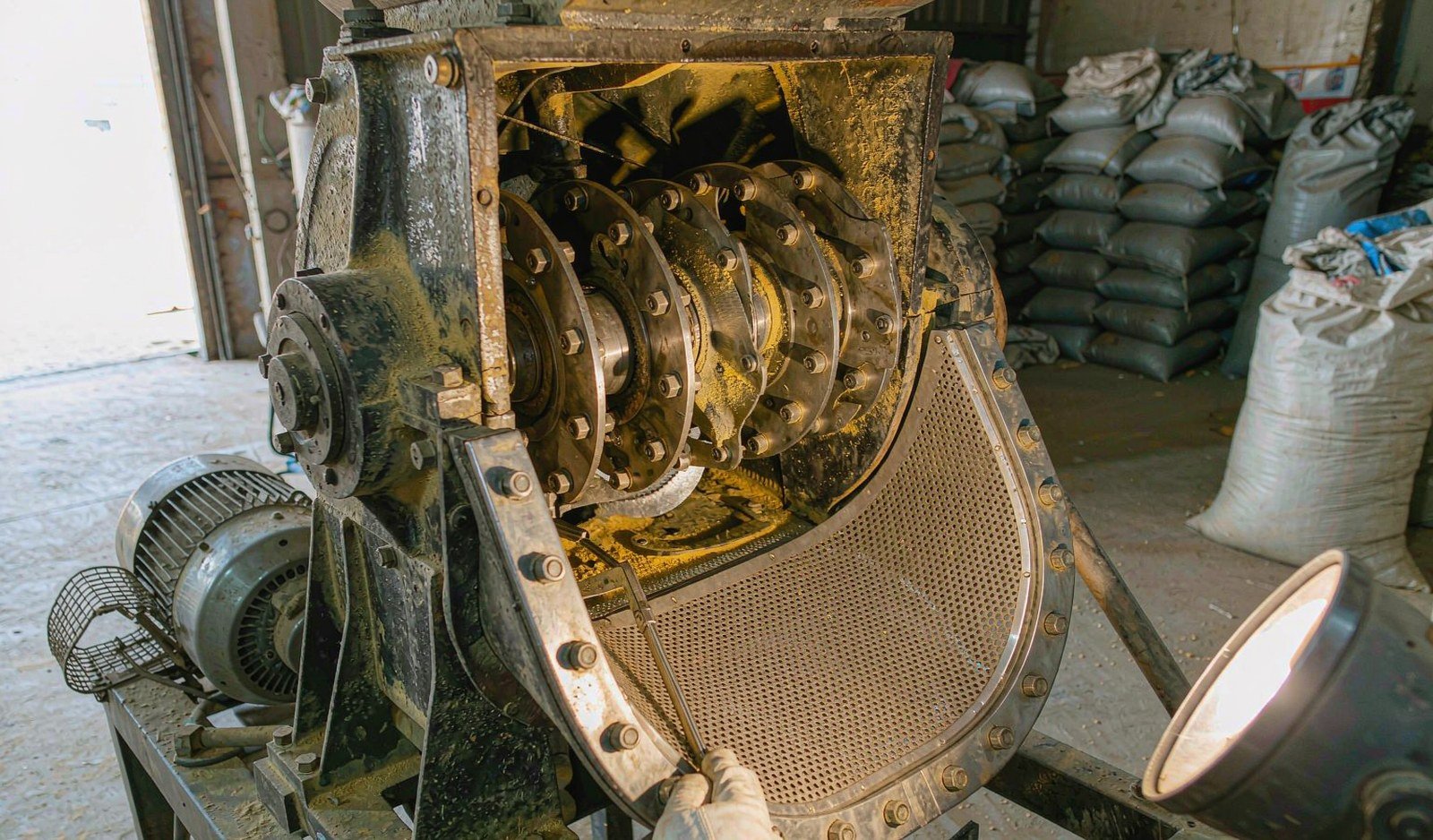
A hammer mill accelerates steel hammers at the tip speed of a fast rotor; the kernel shatters on impact, and the screen under the rotor decides which particles have been broken small enough to leave the grinding chamber. Size control is indirect — you choose a screen, and the physics of the rotor and the material decide the distribution that screen produces.
A roller mill pulls the kernel into a gap between corrugated rolls running at different speeds; compression and shear crack the kernel along its natural fracture lines. Size control is direct — the roll gap and the corrugation pattern decide the particle size, and there is no screen in the machine at all.
Everything that follows — energy, uniformity, maintenance, dust — follows from that one difference: impact fragmentation versus controlled fracture.
What the data says about energy and throughput
The most-cited dataset on grain grinding energy is the Kansas State University work on corn, published by Wondra and colleagues and summarised in the Iowa State Pork Information Gateway feed processing resource. Hammer-milled corn behaves like this:
| Corn particle size | Milling energy | Milling production |
|---|---|---|
| 1,000 µm | 2.42 kWh/t | 3.00 t/h |
| 800 µm | 2.78 kWh/t | 3.00 t/h |
| 600 µm | 3.46 kWh/t | 2.85 t/h |
| 400 µm | 7.35 kWh/t | 1.43 t/h |
The lesson in that table is not about hammer mills alone; it is about fineness. Between 1,000 and 400 µm, energy triples and throughput halves. Any grinder comparison that does not state the particle size it is comparing is comparing nothing.
Against that baseline, roller mills earn their place on coarse and medium grinds. The same Iowa State resource reports that roller mills can produce 15–40% more pounds of ground grain for the same energy input compared with hammer mills, with the advantage shrinking as the target gets finer and largely disappearing below around 700 µm. K-State’s own later work on commercial roller mill configurations, published in the Kansas State Animal Sciences extension newsletter, adds a nuance practitioners recognise immediately: the same roller mill set up with two, three or four roll pairs produces different particle sizes (from about 685 µm on the coarse two-high configuration down to 360 µm with four rolls in a fine configuration), and electricity cost per ton tracked the configuration — the finest grind cost the most per ton and delivered no feed-efficiency benefit in that finishing-pig trial.
For installed machines rather than lab units, the working bands widen. Our own YHM68 hammer mill datasheet quotes 9–14 kWh/t in feed applications at 5–15 t/h, with screen openings from 1.0 to 8.0 mm — a band that includes the feeder, the air system and everything that makes a production grinder a production grinder rather than a lab instrument. Compare grinders on kilowatt-hours per tonne at the screen size you actually intend to run, never on motor kilowatts.
Particle size distribution, not just the average
Two feeds can both average 700 µm and behave completely differently, because the distribution around that average differs. Impact grinding produces a wide spread: some dust-fine particles, some oversized pieces, with a geometric standard deviation noticeably higher than compression grinding. Roller mills produce a narrower, more uniform distribution with fewer fines.
Which distribution is “better” depends entirely on the next process step. A narrower distribution flows better through bins and augers, throws less dust and gives the nutritionist tighter control over what the animal actually eats. A wider distribution — with its fraction of fine particles — is an advantage upstream of a pellet mill, where fines fill the die holes and help the press hold capacity. This is one of the quiet reasons pellet lines default to hammer mills: the “messier” grind is exactly what the press wants.

Where the hammer mill wins
Four situations keep the hammer mill in the building, and in most commercial mills they add up to a clear verdict.
Fine grinding targets. Below roughly 700 µm the roller mill’s energy advantage disappears, and reaching fine targets on rolls means more roll pairs, more passes and more roller dressing. For fine broiler grinds and for aqua or premix work — where our SWFL superfine grinder operates well below the range any roll configuration reaches — impact grinding is the practical route.
Fibrous and off-specification ingredients. Rolls need the material to enter the nip as discrete kernels. Straw, husk, sunflower meal, bran patches and wet grain do not behave, and they go straight through a roller mill’s gap unbroken. A hammer mill grinds almost anything you put in front of it, which for a commercial mill buying whatever the local market offers is a flexibility worth paying for.
Formula changes. Screens change in minutes and cost little; roll corrugations are re-cut in a workshop and roll gaps must be reset when grain quality shifts. The Iowa State resource makes the same point from the maintenance side: roller mills “require more vigilance to maintain a gap width that will produce the targeted particle size”, while hammer mills need less monitoring.
Capital cost and spares. A hammer mill and a shelf of screens cost less than an equivalent roller mill line, and a screen is a stock item any workshop can hold. In markets where import lead times matter, that difference in the spare parts bill is real.
Where the roller mill wins
Three situations justify the extra capital and the extra attention.
Coarse cracking and rolling. Cattle feedlots rolling corn, layer operations wanting a structured coarse particle, and any program adding rolled grain post-pelleting want fracture, not shatter. Here the roller mill’s 15–40% energy advantage applies in full, and the uniformity keeps the big particles big on purpose.
Dust, heat and moisture loss. Impact grinding heats the material and drives moisture off; compression grinding runs cooler, throws less dust into the aspiration system and keeps the grain’s moisture in the feed. In a hot, dry climate this difference shows up in the dust collector load and in the condition of the mash reaching the conditioner.
Flowability. The fewer fines a mash carries, the better it bridges and ratholes less in bins and bulk tanks. Mills that fight bridging in finished-goods silos often find part of the answer in the grinder, not in the silo.
A worked decision: match the grinder to the program
The choice becomes mechanical once you write down what you actually grind. A broiler pellet line running 600–700 µm corn through a conditioner and press: hammer mill, because the fines feed the die and the flexibility absorbs formula changes — and the grind target feeds directly into the conditioning temperatures we describe in our steam conditioning guide. A feedlot rolling corn for a total mixed ration: roller mill, full stop. A layer mash with cracked grain structure: roller mill. A commercial mill producing mixed species on one grinder — broiler today, dairy tomorrow, aqua next quarter — hammer mill, because the screen rack covers more ground than any roll configuration.
Grain moisture matters too. Grain arriving above roughly 15% moisture needs more grinding energy and clogs screens faster — a relationship practitioners document across mills (see, for one example, this feed grinding energy guide from a fellow equipment maker); wet grain is one more vote for the machine that tolerates abuse — and one more reason to fix moisture at receiving, in the silos, before the grinder sees it at all.
Comparison Recap
| العامل | Hammer mill | Roller mill |
|---|---|---|
| Breakage mechanism | High-speed impact against hammers; screen sets exit size | Compression and shear between differential-speed rolls |
| Energy at coarse/medium grind | Baseline; 2.4–2.8 kWh/t at 800–1,000 µm (KSU lab data) | 15–40% less per tonne vs hammer mill (Iowa State) |
| Energy at fine grind | Energy climbs steeply: 7.35 kWh/t at 400 µm, throughput halves | Advantage largely disappears below ~700 µm |
| Particle distribution | Wider spread, more fines — feeds a pellet die well | Narrower, more uniform, fewer fines — better flow, less dust |
| Fibrous / irregular material | Handles nearly anything | Struggles; material must enter the roll nip as kernels |
| الصيانة | Quick screen changes; hammer replacement; less monitoring | Roll dressing off-site; gap resets as rolls and grain change |
| Typical program fit | Pellet feed lines, mixed-species commercial mills, fine grinding | Cattle rations, layer coarse mash, grain rolling, energy-sensitive mills |
Neither machine replaces the other. The expensive mistake is not choosing the “wrong” technology — it is buying either one without stating the grind target, the ingredient list and the program mix in the purchase order, because those three lines of text decide which machine’s strengths you will actually use.