
A wood chipper is the cheapest machine in a pellet line and the one most often bought carelessly. Buyers spend weeks on ring die specifications and then order whatever chipper the supplier bundles in, on the assumption that chipping is chipping. The assumption costs more downstream than the chipper itself: an oversized machine idles through the feedstock budget, an undersized one throttles the whole line, and the wrong screen or worn knives deliver chips that overload the hammer mill, blind the dryer and shorten everything after them.
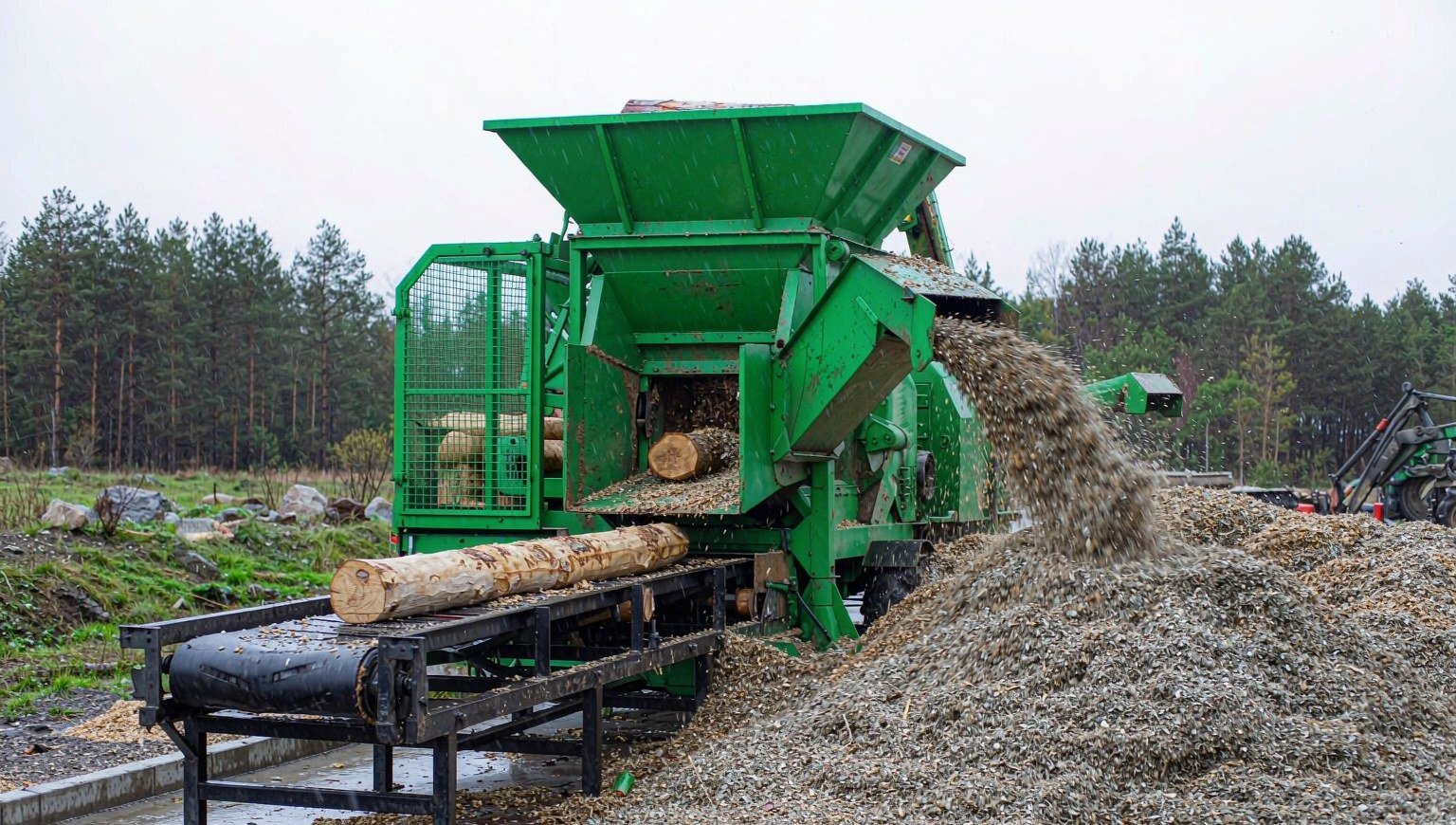
This guide works backwards from the pellet line: how much material the chipper actually has to deliver, in what size class and at what consistency, and how to translate that into a machine specification you can put in a purchase order.
Start From the Pellet Line, Not the Chipper Catalogue
The first number is a mass balance. Published supply-chain models for conventional wood pelletisation — the same basis behind IRENA’s solid biomass supply brief — assume roughly two tonnes of wet woody input at 50% moisture to produce one tonne of finished pellets. A 5 t/h pellet line therefore consumes about 10 t/h of green wood while it runs, and the chipper, if it is on the line, must match that flow as an average with enough margin to tolerate surges and knife changes.
Tonnes are only half the sizing story, because chippers are fed and conveyed by volume. Wood chips are light for their bulk: FAO’s bioenergy handbook lists typical bulk densities of about 195 kg/m³ for softwood chips and 260 kg/m³ for hardwood chips, with sawdust near 170. Ten tonnes per hour of softwood chips is therefore around 50 loose cubic metres per hour of material that has to move through hoppers, conveyors and screens. Plants that size handling equipment by weight alone find out at commissioning that their 10 t/h chipper delivery needs the airflow of a 50 m³/h system.
Work both numbers before you read a single brochure, because they answer different questions: tonnes per hour size the cutting chamber, cubic metres per hour size everything that feeds and removes it.
Drum or Disc: the Trade in Numbers
Two cutting geometries dominate industrial chipping, and the choice between them is a genuine engineering trade rather than a brand question. In a disc chipper, knives are mounted on a rotating flat disc and cut against an anvil in a slicing action; in a drum chipper, knives sit in a cylindrical rotor that cuts continuously around the circumference.
The best-controlled comparison comes from a study of two similar-sized chippers run on four feedstock types (chestnut logs, poplar logs, poplar branches and poplar sawmill residues), recorded in FAO’s AGRIS database (Facello, Cavallo and Spinelli, 2013). The disc tool consumed 12 to 18% less fuel per unit of material processed and 12 to 16% less specific energy, with the largest advantage on branches and the smallest on logs. The drum tool, however, delivered about 8% higher productivity. The engineering reading: a disc cuts more efficiently per tonne, a drum moves more tonnes per hour and tolerates a dirtier, more variable diet — which is why most stationary pellet-plant installations and most of the wood chipper designs in our range are drum machines, while disc chippers persist where fuel cost per tonne dominates and the feedstock is clean and uniform.
Knife count matters as much as geometry. More knives on the drum shorten the theoretical chip length for the same feed speed and spread the wear across more edges; fewer knives with a longer infeed stroke suit larger, cleaner logs. What is non-negotiable is knife steel and knife access — a chipper that takes two hours to change knives is a chipper that will be run on dull knives.
Chip Size: Read the Classes, Not the Adjectives
Chip specifications fail when they are written in adjectives. “Small chips”, “uniform chips” and “high-quality chips” mean nothing in a contract. The international standard system for graded wood chips, EN ISO 17225-4, defines particle classes by sieve fractions, and the Canadian forest service publishes a practical summary of the classes. The essential ones for pellet plants:
| Class | Main fraction (min. 60% by weight) | Fines ≤3.15 mm | Coarse fraction | Max particle length |
|---|---|---|---|---|
| P16S | 3.15–16 mm | ≤15% | ≤6% (>31.5 mm) | ≤45 mm |
| P31S | 3.15–31.5 mm | ≤10% | ≤6% (>45 mm) | ≤150 mm |
| P45S | 3.15–45 mm | ≤10% | ≤10% (>63 mm) | ≤200 mm |
Moisture and ash classes ride on top of the particle class: Grade A1 requires moisture ≤10% (M10) and ash ≤1.0% dry basis, Grade A2 allows M25 with ash ≤1.5%, and Grade B extends to M35 and A3.0, per the same CAN/CSA-ISO 17225-4 summary (Natural Resources Canada, Solid Biofuels Bulletin No. 6). A complete specification reads like “P31S, M35, A1.5” — measurable, testable, disputable.
For a pellet plant the target class depends on what sits between the chipper and the die. Chips going straight to a hammer mill before pelletising can sit at P45; the hammer mill does the fine work. Chips fed to a dryer and then ground benefit from P31, because oversize slivers survive drying and shock-load the mill. Whatever the target, write the class into the chipper supply contract and verify it with the standard sieve method (ISO 17827) on commissioning and periodically after knife changes.
Knife Condition Is a Specification, Not a Maintenance Detail
The most instructive chipping experiment of recent years varied nothing but knife sharpness, screen size and infeed speed on a stationary drum chipper across six tree species, published in Biomass & Bioenergy and indexed in AGRIS (Kuptz and Hartmann, 2021). The headline results deserve quoting in any chipper purchase argument:
Specific electrical energy consumption rose from roughly 4.2 kWh per tonne of dry matter with sharp knives to 12.8 kWh/t with blunt knives — a threefold energy penalty for a dull edge. Blunt knives also raised the share of fines, the maximum particle length and the length-to-width ratio of particles. Of 46 samples, about 96% could be classified as graded wood chips, but only chipping with sharp knives and a narrow screen (40 × 40 mm) reliably produced the P31S class. In other words: chip quality is not bought with the machine, it is maintained with the knives.
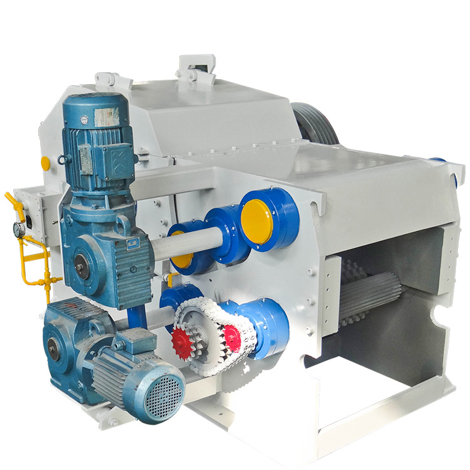
That has two consequences for selection. First, prefer a chipper whose knife change is measured in minutes — hydraulic access, simple clamping, and a knife set you can actually source. Second, budget knife rotation as an operating cost per tonne from day one, because the energy and quality penalties of running dull blades are three to five times the price of the edge itself. Our drum chippers use a patented alloy knife design (patent ZL201420054885) aimed at longer edge life between regrinds, and the YLBX216 chipper page describes the hydraulic feed and knife arrangement in detail.
Sizing the Machine: Tonnes, Volume and Margin
Putting the pieces together, a worked example shows how the numbers stack for a mid-size pellet line. Assume a 5 t/h finished-pellet plant on softwood roundwood at 50% moisture, chips targeted at P31, chips at roughly 200 kg/m³ loose bulk density.
| Step | Arithmetic | Result |
|---|---|---|
| Green wood demand | 5 t/h pellets × ~2 t wet per t dry (IRENA basis) | ≈10 t/h |
| Chip volume flow | 10,000 kg/h ÷ 200 kg/m³ (softwood chips, FAO) | ≈50 m³/h |
| Chipper rated capacity | 10 t/h ÷ 0.75 (margin for surges, knife change, feed gaps) | ≈13–14 t/h rating |
| Chip energy cost | Sharp knives 4.2 kWh/t d.b.; blunt 12.8 (Kuptz) | Knife discipline is worth ~8 kWh/t |
The margin line is the one buyers skip. A chipper rated exactly at demand runs at 100% load, chews through dull-knife weeks at degraded quality, and turns every upstream hiccup into a starved pellet line. Three-quarters loading is a healthier design point, and it is why our YLBX2110 and YLBX216 models sit in a capacity series rather than as single machines: the chipper is chosen to the line’s arithmetic, not to its own headline rating.
Feeding, Log Diameter and Debarking
Feed systems separate the machines more than rotor specifications do. Gravity-fed chippers accept material down a chute and suit short wood, offcuts and slabs; powered horizontal infeed tables with hold-down rollers handle long logs and branches, control the feed rate against motor load, and reverse to clear jams — a feature worth having wherever feedstock quality is uncertain. Check the maximum log diameter the infeed table accepts honestly, because that number decides how much pre-cutting your yard does with a chainsaw crew.
Bark and dirt ride with the chips. A debarker upstream of the chipper removes bark before it becomes ash; without one, ash content climbs toward Grade B territory and the same dirt drives knife wear, which then drives the energy penalty described above. Our wood debarker is normally specified wherever the raw material is roundwood rather than sawmill residue, and the combination is one of the cheapest ash-control measures available. The upstream logic — clean feedstock in, grade-conforming chips out — runs through the whole line, and our article on making pellets from pine sawdust shows how the chip and sawdust fractions interact at the die.
Selection Matrix
| Feedstock / situation | Recommended configuration | Watch for |
|---|---|---|
| Sawmill residues (slabs, edgings, dry offcuts) | Drum chipper, gravity or short infeed, wide screen | Nails and grit from yard storage — magnetic separator ahead of knives |
| Roundwood at 50%+ moisture | Drum chipper, powered horizontal infeed, debarker upstream | Dryer thermal load dominates; chip class secondary |
| Plantation thinnings and branches | Drum chipper, heavy hold-down rollers, reversing feed | Fines and leafy contamination; screen and blow-line design |
| Contract chip production (sold to spec) | Disc chipper where feedstock is clean and uniform | Productivity ceiling; verify against ISO sieve tests, not appearance |
| High-tonnage single-source line (10 t/h+) | Large drum chipper rated to ~75% of line demand | Knife change time becomes a production parameter |
| Mixed residuals, variable quality | Drum chipper plus screen with oversize re-chip loop | Oversize slivers surviving to the hammer mill |
Checklist
Before you sign a chipper purchase order, the following ten points close the gaps that cost pellet plants money most often:
1. Chipper rated throughput covers 130–150% of the pellet line’s average green-t feed demand.
2. Volume arithmetic done: hopper, infeed and conveyors sized on m³/h at your feedstock’s bulk density, not on tonnes alone.
3. Target chip class written as an ISO 17225-4 code (e.g. P31S) in the supply contract, with sieve-test verification on commissioning.
4. Screen size options quoted, and the screen that achieves your class identified — ideally with a test run on your own feedstock.
5. Knife change time demonstrated, with tooling, by the supplier.
6. Knife steel, spare sets and local resharpening provision priced into year-one operating cost.
7. Powered infeed with load control and jam reversal, if feedstock is long, dirty or variable.
8. Maximum log diameter stated against your actual wood length, with pre-cutting requirements calculated if it falls short.
9. Debarking or grit removal addressed if ash class A1/A2 matters to your fuel market.
10. Specific energy per tonne of dry matter agreed as a test criterion, with the metering point named — the difference between 4 and 13 kWh/t is knives and screens, and it should be someone’s contractual problem before it is your operating one.