
A pellet plant can pass every mechanical check and still fail on water. Moisture decides whether the die grips the feed, whether a pellet survives a truck ride, and whether a container arrives with mould on the top layer. It is also the variable that operators measure daily and control loosely — a hand meter at the dryer outlet, another sample at the bagging line, and a number on the whiteboard that nobody connects to a control loop.
This article treats moisture as a plant-wide balance rather than a dryer setting. It covers where water enters a wood pellet line, what the 10% limit in the pellet standards actually refers to, what each tonne of evaporated water costs in fuel, and which stage usually owns the problem when the final number drifts.
The Water Balance Nobody Draws
Every wood pellet line has exactly three ways for water to enter and three ways for it to leave. Water arrives with the feedstock, arrives with rain and ambient humidity on open stockpiles, and arrives as steam or liquid injected at the conditioner. It leaves through the dryer exhaust, through the cooler exhaust, and in the product itself.
Everything else is arithmetic. Take a line producing 5 t/h of finished pellets at 10% moisture as received. Each tonne of product contains 0.5 t of water and 4.5 t of dry wood substance. If the incoming sawdust sits at 45% moisture, each tonne of wet feed carries 0.55 t of dry matter, so 4.5 t of dry matter arrives in 8.18 t of wet feed, carrying 3.68 t of water. Subtract the 0.5 t that leaves inside the product and the line has to evaporate roughly 3.2 t of water every hour.
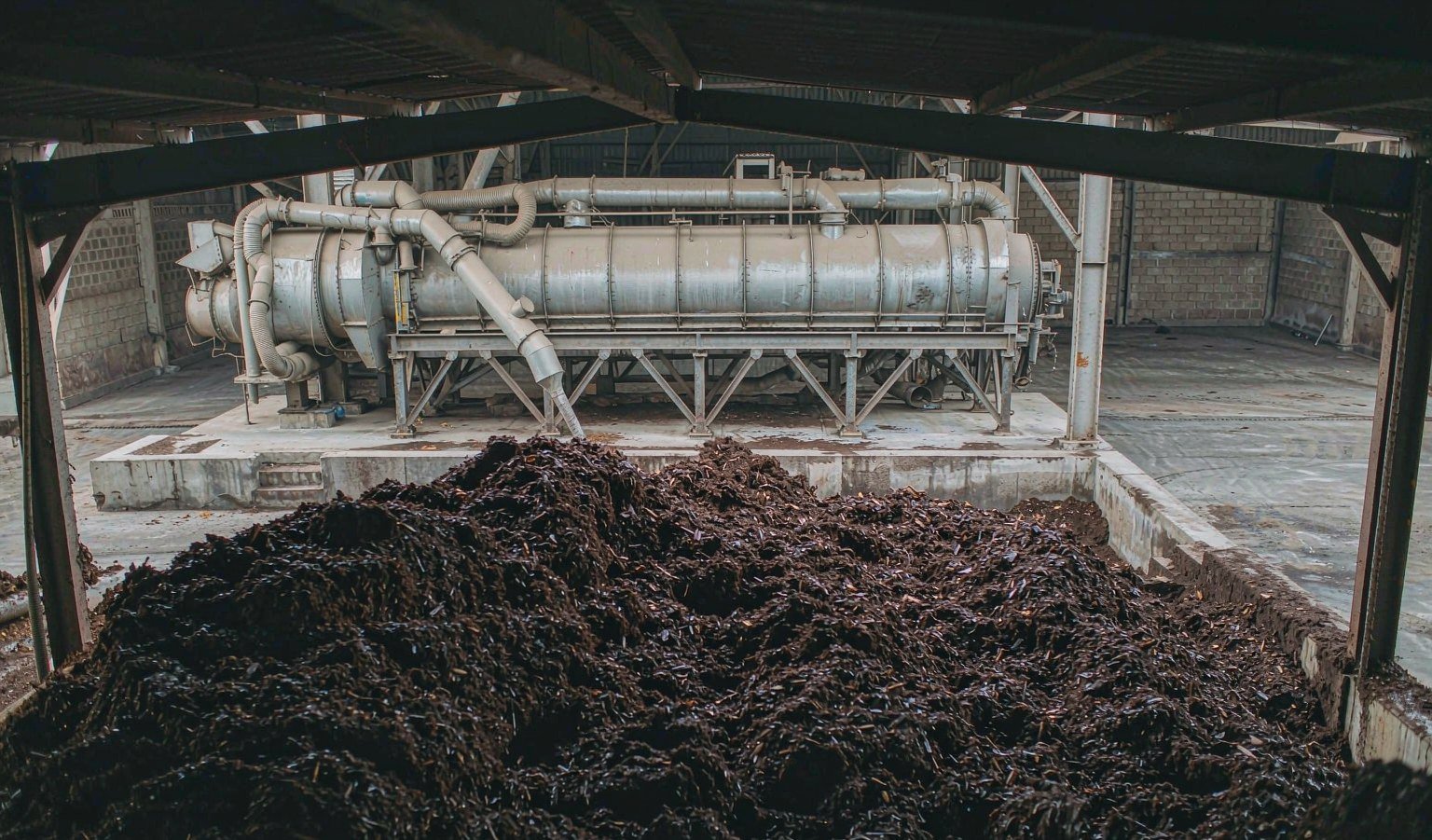
That evaporation number — not the 5 t/h nameplate — sizes the dryer, the burner, the ducting and the dust collection. Plants that quote dryer capacity in tonnes of product per hour are really quoting an assumption about inlet moisture. Our YLHG series drum dryers, for instance, are rated at 1 to 5 t/h with sawdust at 45% inlet moisture and a gas inlet below 500 °C; at 35% inlet moisture the same drum has spare evaporation capacity, and at 55% it does not. Anyone sizing a line from a brochure tonne should first ask what moisture assumption sits behind it.
The balance also explains why a small change upstream lands so hard downstream. Moving the feedstock from 45% to 50% moisture on the same 5 t/h duty raises the evaporation load from about 3.2 t/h to about 4.0 t/h — 0.8 t of extra water per hour, roughly 2.9 GJ/h of additional heat duty, and a shorter margin between rated burner capacity and reality.
What “10% Moisture” Means on a Certificate
The pellet standards — ISO 17225-2 for graded wood pellets and the ENplus certification scheme built on top of it — cap moisture at 10.0% as received for all quality classes, with ENplus A1 also holding ash at or below 0.70% on a dry basis. “As received” means wet basis: the water mass divided by the total mass of the sample, including the water.
Laboratories and some suppliers also quote moisture on a dry basis, which expresses water as a percentage of dry solids instead. The two bases diverge fast as moisture rises, and mixing them up is the most common one-point error in pellet trading.
| Wet basis (as received) | Dry basis equivalent | Status against a 10% as-received limit |
|---|---|---|
| 8.0% | 8.7% | Pass, with margin |
| 9.1% | 10.0% | The same material, described two ways |
| 10.0% | 11.1% | Exactly at the limit |
| 12.0% | 13.6% | Fail for pellets; normal for feedstock |
| 20.0% | 25.0% | Partially dried feedstock |
| 45.0% | 81.8% | Typical fresh sawdust |
Read the middle rows carefully. A load described as 10.0% on a dry basis is 9.1% as received — comfortably inside the limit. A load at 11.1% dry basis is exactly at the 10% as-received limit. The two numbers describe the same material; a contract that does not name the basis invites a dispute that neither side can win after the vessel has sailed.
Method matters as much as basis. The reference method in ISO 18134 dries a sample in an oven at 105 °C to constant mass. Inline and hand-held dielectric meters read something faster but looser — they respond to species, temperature and packing density, so each meter needs calibration against oven results for the actual material, repeated whenever the feedstock mix changes. A meter that is three-tenths optimistic turns a 10.0% product into a 9.7% whiteboard number and nobody notices until a customer’s lab says otherwise.
Two Targets, Not One
The single most useful mental shift for a pellet plant is that there is no one correct moisture. There are two targets, and they are on opposite sides of 10%.
At the pellet mill die, wood wants to be wetter than the shipping spec. Binders in wood — the lignin and soluble extractives that make pellets hold together — activate in a moisture band around 12 to 15% as received for wood residues, which is the window we design around on our biomass pellet mills. Below that band the die slips, fines climb and die wear accelerates; above it the channels choke and pellets come out soft. Between the die and the bag, cooling does the final trimming: evaporative cooling in the counterflow cooler removes heat and one to three points of moisture at the same time.
A plant therefore dries feedstock to roughly 12–13%, conditions and pellets it wetter than the shipping spec, and lets the cooler take the product down through 10% on its way to ambient temperature. The dryer operator who “helps” by drying to 9% is not making the bag spec easier — he is stealing the water that the die needed, and the durability graph will show it within a shift. The full window, stage by stage, reads as follows: receiving at whatever the yard holds; dryer outlet at 11–13% to leave room for conditioning; die inlet at 12–15% for wood residues; 8–10% after the cooler; and in storage, stable only as long as it stays below the local equilibrium moisture.
Stage 1 — Receiving: The Cheapest Control Is Blending
Every tonne of water removed by the dryer costs fuel; every tonne avoided upstream costs nothing. That makes receiving and yard management the cheapest moisture control a plant owns.
Three habits matter. First, covered storage for anything that will be dried — rain wets the surface layer of an open pile, and the loader then delivers that wet slug to a dryer tuned for the pile’s average. Second, blending before the dryer: if half the yard sits at 28% and half at 52%, mixing them evenly gives 40% and a stable dryer, while feeding them alternately gives a dryer that chases its own tail. The blend arithmetic is simple mass fractions — 60 t at 52% mixed with 40 t at 28% gives (31.2 + 11.2) ÷ 100 = 42.4% — but it only works if the loader actually blends layers rather than digging one pile empty before opening the next.
Third, measure at the shovel, not in the office. One moisture reading per incoming truck, taken from the middle of the load, costs a minute and gives the dryer operator tomorrow’s feed average instead of yesterday’s.
Stage 2 — Drying: What One Tonne of Water Costs
Evaporating water takes a fixed amount of energy no matter whose dryer does it. The theoretical minimum is the latent heat of vaporisation, about 2,260 kJ per kg of water. Real dryers add sensible heat and exhaust losses. The most widely used planning figure for drum dryers in the pellet industry comes from Thek and Obernberger’s work on pellet production, which put average heat demand at about 1,000 kWh — 3,600 MJ — per tonne of water evaporated; the same source documents a plant-level assumption of 3,960 MJ/t once 10% conversion losses are included. That study is summarised in an economic assessment of an international wood pellet supply chain hosted by the German National Library, which is also where the fuel-side numbers below come from.
Those figures make the dryer the single largest energy consumer in most pellet plants — larger than the pellet mill itself. Running the earlier 5 t/h example with 3.2 t/h of evaporation:
| Quantity | At 3,600 MJ/t water | At 3,960 MJ/t water (incl. losses) |
|---|---|---|
| Heat duty per hour | 11,520 MJ/h ≈ 3.2 MW | 12,672 MJ/h ≈ 3.5 MW |
| Fuel if burning wet sawdust/bark (LHV ≈ 7,740 MJ/t) | ≈ 1.49 t/h | ≈ 1.64 t/h |
| Share of 8.2 t/h incoming feed | ≈ 18% | ≈ 20% |
| Fuel per tonne of finished pellets | ≈ 0.30 t | ≈ 0.33 t |
Two conclusions follow. First, roughly a fifth of everything a plant receives is burned simply to boil water — which is why feedstock moisture belongs in the fuel price of every pellet cost model, not just in a drying line item. Second, dryer efficiency improvements are worth real money: sealing air leaks, lagging the shell and keeping flights clean each shave points off that 3,600 MJ figure, and a 10% efficiency gain on this line saves about 0.16 t of fuel per hour. We keep the outer drum insulated on our three-layer drum dryers for exactly this reason, and the three-pass arrangement recovers heat that a single-pass drum of the same duty would send up the stack.
Stage 3 — Dryer Control: Chase Outlet Moisture, Not Inlet Temperature
The most common dryer control mistake is holding inlet gas temperature fixed and judging the result by outlet gas temperature. Outlet gas temperature tracks the gas, not the solids — when wetter feed arrives, both shift together, but the pellet that actually leaves the drum can be two points wetter while the thermometer looks busy but normal.
Control on the product instead. The loop that works closes on measured outlet material moisture, adjusting feed rate against a fixed or trimmed inlet temperature. Inlet temperature then becomes a constraint rather than a setpoint: hot enough to finish the job, but below the point where sawdust scorches, colour degrades and fire risk climbs. In practice the constraint matters more than the target — pushing inlet temperature to recover throughput on wet feed is how dryer fires start, because dust and hot particles find each other inside the drum and in dirty ducting. Peer plant write-ups of dryer incidents reach the same conclusion: fires rarely come from one dramatic error, they come from piled-up bad habits such as fouled flights, worn seals and drifting temperature control — a pattern documented in detail in an industrial rotary dryer guide from a dryer manufacturer.
One more habit: keep a dry buffer. A small day bin between dryer and pellet mill, filled from blended dry product, absorbs the minute-to-minute variance that no control loop can follow. Plants without one send dryer wobble straight into the die.
Stage 4 — Conditioning and the Die: Water Goes Back In
Between the dryer and the cooler, moisture rises again on purpose. Steam conditioning adds water and heat in one step, raising mash temperature toward 70–90 °C where lignin softens and pellets form with less power and less die wear. The water added here is real and belongs in the balance — a conditioner adding 1.5% of steam on a 6 t/h mash flow puts 90 kg/h back into the material.
The die then does its own moisture arithmetic. Compression squeezes free water out of the wood; friction heats the pellet above 80 °C; and part of that added water flashes off in the seconds between die and cooler. What leaves the die is hotter and wetter than what entered — which is precisely why the dryer target sits above the shipping spec rather than below it.
When the moisture at the die drifts outside the 12–15% band, the symptoms are unmistakable and they point in opposite directions. Too dry: ammeter climbs, die temperature climbs, fines climb, and the die’s compression work turns into heat instead of pellets. Too wet: the die slips, throughput drops, pellets leave soft, and channels begin to choke. Distinguishing the two from the control room is easy — one shows a hot die, the other shows a cold one.
Stage 5 — Cooling: The Last Two Points
The counterflow cooler finishes the job the dryer started. Pellets enter at die temperature with moisture above the shipping spec; air passes counter to the material flow, and evaporation removes heat and water together. We explain the airflow and residence-time logic in detail in our counterflow cooler working principle article; for the moisture balance, one rule matters most — the cooler can only remove water the air is willing to carry.
Ambient humidity sets that limit. On a dry day the cooler trims two points without effort. In tropical rainy-season air the same machine may trim less than one, and pellets that would have tested 8.5% in February test 10.5% in July. Plants that bag directly off a marginal cooler discover this as a seasonal quality complaint, not as a control-room number. The fixes are unglamorous: longer residence on marginal days, slower discharge, and a hard rule that pellets bag at ambient temperature, not “nearly ambient”.
Stage 6 — Storage: The Product Fights Back
Moisture control does not stop at the bagging scale, because wood keeps exchanging water with air for as long as it exists. The USDA Forest Products Laboratory’s Wood Handbook defines the equilibrium moisture content (EMC) of wood — the level at which it neither gains nor loses water — and publishes the relationship between EMC, relative humidity and temperature in its chapter on moisture relations and physical properties of wood. The same chapter gives the fiber saturation point, about 30% moisture content, above which wood behaves like a wet solid and below which its properties start tracking humidity.
Using the Handbook’s own EMC equation, wood at 20 °C and 65% relative humidity settles near 12% moisture; at 85% relative humidity it settles near 18%. Both numbers sit above the pellet shipping spec. A pellet at 8% stored in humid air is below its equilibrium level and will absorb water until it climbs — slowly through an intact bag, quickly through a torn liner, a silo roof leak or a condensation cycle in a container.
Container shipments deserve special respect. A closed box cycling between tropical days and cool nights condenses water on steel surfaces above the cargo, and the top layer of pellets pays for it. Bag-on-pallet packing with liners, desiccant where routes are long, and ventilated containers all exist because this failure mode repeats across the trade. The IEA Bioenergy Task 40 library on international pellet trade documents how much of the commodity now moves across humid climates and oceans — the logistics standard exists because moisture does not respect a factory gate.
Where Measurement Goes Wrong
Half of the moisture complaints we see trace back to the measurement, not the plant. The recurring errors:
Weighing a hot sample. A sample pulled from the cooler discharge is still losing grams as it cools on the bench; weigh it immediately and every reading drifts wet, then drifts again with wind direction in the lab.
Sampling the surface. Silo tops, bag corners and the first metre of a conveyor carry drier material than the average. Sampling from a falling stream at the bagging scale takes more effort and gives the only number worth writing down.
Uncalibrated meters. Dielectric meters need re-checking against the oven method whenever species mix or temperature shifts. A meter that was true in January on pine can lie by half a point in August on mixed hardwood.
One sample, one number. Moisture in a cooled pellet stream varies ±0.5 points minute to minute even on a good day. Single samples turn that noise into decisions; duplicates and a running average turn it into a trend.
Testing the wrong basis. The wet-basis/dry-basis confusion from earlier in this article reappears here: a plant’s internal lab reporting dry basis while sales quote as received guarantees a two-team argument every quarter.
Six Failure Patterns and What They Point To
| Symptom | Likely stage | First thing to check |
|---|---|---|
| Pellets over 10% at bagging, dryer looks fine | Cooling | Ambient RH; pellet temperature at discharge vs ambient |
| Fines up, durability down, die hot | Dryer over-performance | Outlet moisture; someone trimmed the dryer to “help” |
| Die slips, throughput drops, soft pellets | Conditioner | Steam flow and mash temperature; conditioner leaks |
| Moisture swings ±2 points with no setting change | Receiving | Truck-level moisture log; blend practice at the loader |
| Mould on top layer after weeks in storage | Storage | Roof leak, condensation cycle, silo aeration |
| Dryer fire or scorch colour | Dryer | Inlet temperature trend, flight fouling, duct deposits |
What a Dryer Quote Should Ask For
When a buyer asks us to size the drying section, the useful inputs are always the same, and none of them is “5 t/h”. We ask for: feedstock species and typical moisture range by season, hourly wet feed rate available, target final moisture of the pellets, fuel available for the burner (and whether that fuel is the wet feedstock itself), ambient design conditions, and any existing dryer the new unit must match in elevation and ducting. The moisture answers decide the drum diameter, the burner duty and the dust collector; the tonnage merely tells us how many of those packages to build.
Moisture Control Checklist
Print this, laminate it, and put it where the dryer operator can reach it:
☐ Log truck-level moisture at receiving — one sample per load, middle of the truck, recorded before unloading.
☐ Blend before the dryer — loader works across piles in layers, never empties one before opening the next.
☐ Keep the dryer on a product-moisture loop — outlet moisture sets feed rate; inlet temperature is a constraint, not a setpoint.
☐ Inspect flights and seals monthly — fouling and leaks each add fuel cost before they add moisture problems.
☐ Hold die-inlet moisture in the 12–15% band for wood — steam flow adjusted against dryer output, not against operator feel.
☐ Bag at ambient temperature only — “nearly ambient” is where seasonal moisture complaints are born.
☐ Calibrate meters against the oven method weekly — and after any change in species mix.
☐ Name the basis on every number — wet basis or dry basis, on whiteboards, lab reports and contracts alike.
☐ Watch storage humidity — silo aeration running, bag liners intact, containers ventilated on humid routes.
Moisture is the only plant variable that touches fuel cost, pellet durability, shipping compliance and customer complaints at once. Treat it as a balance that starts at the receiving gate, and the whiteboard number stops being a surprise.