
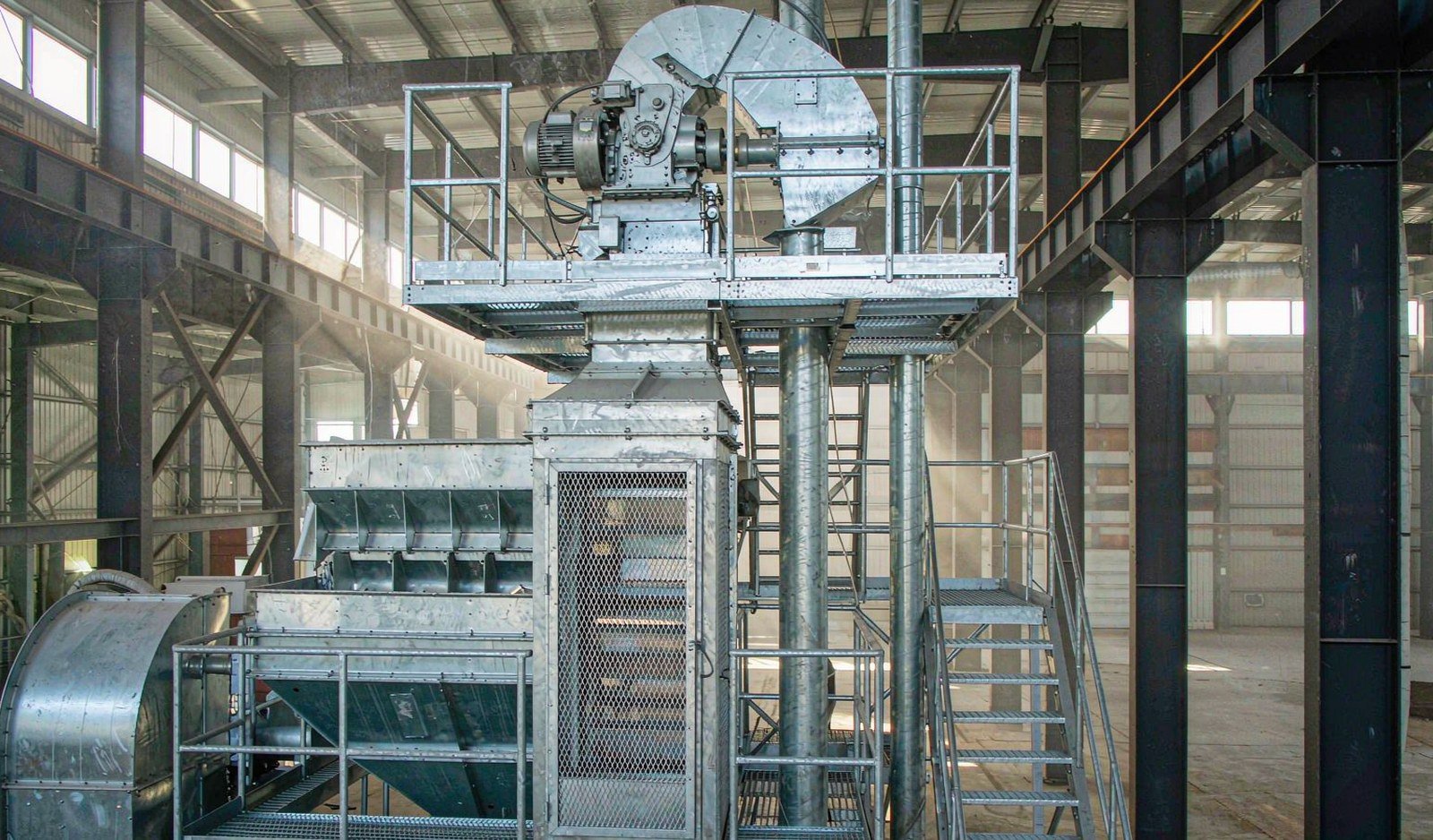
Bucket elevators are bought early in a project, priced per unit, and forgotten until the plant runs. Then the first month of production shows the problem: the leg that was specified at 30 t/h delivers 21 t/h at the density your formula actually has, the boot chokes every time the feed rate drops, and the drive trips on a cold morning. None of that is fixable with a wrench. It is fixable in the sizing calculation, which takes twenty minutes and is usually skipped.
This is a sizing walkthrough for feed mills and biomass plants: how the capacity equation works, where nameplate numbers come from, how discharge type follows from belt speed, and which safety features have to be in the purchase order rather than added afterwards.
The capacity equation, and the one variable buyers get wrong
Volumetric capacity of a bucket elevator is the volume of material carried per metre of belt, multiplied by belt speed:
Q (t/h) = 3.6 × V × φ × v × ρ ÷ s
where V is bucket volume in litres, φ is the fill factor (the fraction of bucket volume actually filled), v is belt speed in m/s, ρ is bulk density in t/m³, and s is bucket spacing in metres. The constant 3.6 converts litres, metres per second and tonnes per cubic metre into tonnes per hour.
The variable that causes most of the trouble is ρ. Bucket elevator catalogues are usually rated on a nominal density, often around 0.7 t/m³. A poultry mash at 0.6 t/m³, a high-fibre ruminant mix at 0.45 t/m³, and a mineral premix at over 1.0 t/m³ will all move through the same leg at very different tonnages. If your formula list runs from light mash to dense pellets, size the leg on the lightest material at the required tonnage, not the average.
Worked example. A 10-litre bucket on 400 mm spacing, running at 1.5 m/s, filled to 80 %, handling a 0.65 t/m³ mash:
Q = 3.6 × 10 × 0.80 × 1.5 × 0.65 ÷ 0.40 = 70 t/h
Now change one number: the same leg on a 0.45 t/m³ fibrous mix delivers 49 t/h. Same machine, same motor, 30 % less feed. That is the entire argument for sizing on density rather than on a catalogue headline.
Four configurations, four different jobs
| Type | Capacità tipica | Max lift | Belt speed | Where it fits |
|---|---|---|---|---|
| Centrifugal discharge | 10–200 m³/h | 50 m | 1.2–2.0 m/s | Free-flowing grain, mash, pellets |
| Continuous discharge | 5–150 m³/h | 100 m | 0.5–1.2 m/s | Fragile or abrasive material, pellets that must not break |
| Super-capacity | 50–500 m³/h | 150 m | 0.8–1.6 m/s | Port terminals, high-volume grain intake |
| Positive discharge | 10–100 m³/h | 30 m | 0.3–0.8 m/s | Sticky, cohesive or very light material |
Our bucket elevator range covers 5 to 500 m³/h and 10 to 150 m of lift, with 1 to 50 litre buckets and drives from 5.5 to 250 kW. Those are the outer limits, not a shopping list. The useful decision is discharge type, and it follows from the material, not from the tonnage.
Discharge type is a belt speed decision
Centrifugal discharge works because the material leaves the bucket on a ballistic path at the head pulley. It needs enough speed for the throw, which is why it runs at 1.2 to 2.0 m/s, and it is hard on fragile product. A pelleted feed at 95 % durability will lose points every time it goes through a centrifugal leg at full speed; the pellets hit the head cover and the chute.
Continuous discharge runs slowly, at 0.5 to 1.2 m/s, and the buckets are pitched so that material tips out rather than being thrown. It handles fragile and abrasive materials with less degradation and less wear, at the cost of capacity per unit width and a taller head section. For a pellet plant feeding a cooler or a bagging line, this is usually the right choice even though it costs more per tonne per hour.
Positive discharge is for the materials that break both rules: sticky, cohesive, or light enough that it will not leave the bucket cleanly at any speed. It runs at 0.3 to 0.8 m/s and relies on gravity and a steep chute.
A practical rule from commissioning: if the material is a finished pellet you intend to sell, specify continuous discharge and accept the size penalty. If it is an intermediate mash or raw grain moving between bins, centrifugal is cheaper and fine.
Boot design, fill factor and the capacity you actually get
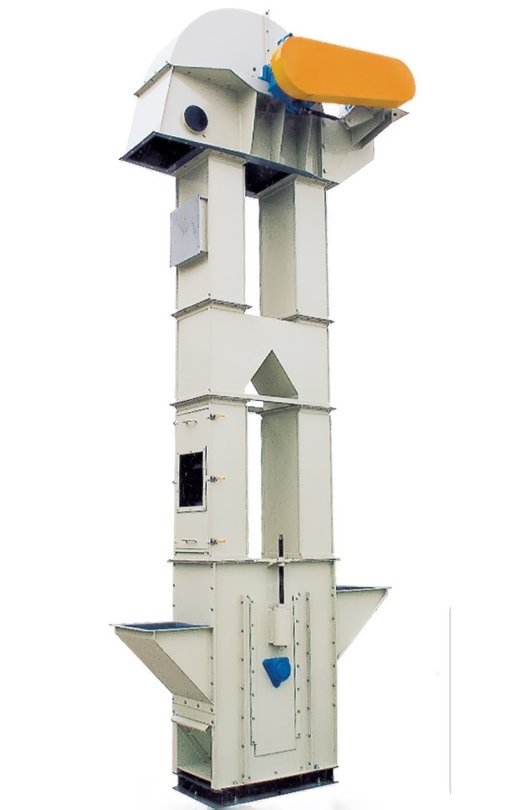
Fill factor is where catalogue capacity and real capacity diverge. A bucket can only be filled to the point where the incoming material stops flowing in, and that depends on the boot inlet, the material’s angle of repose, and how evenly the feed arrives. Our specification range is 75 to 85 % achievable with proper boot design; a badly designed boot will sit at 60 % and choke on transients.
Three boot details matter more than the rest. The inlet should be below the boot pulley centreline so material flows into the buckets rather than being thrown at them. The boot should have a cleanout door and a dredge or drain, because a boot that collects fines will eventually choke. And the take-up should be accessible and adjustable, because belt tension changes with load and temperature and a slack belt slips, wears the pulley lagging and loses capacity.
Choked legs are usually blamed on the material. In our experience they are usually a feed-rate control problem: a screw conveyor or a bin gate delivering surges, so the leg alternates between starved and overloaded. A variable frequency drive on the feeder upstream, or a level sensor in the boot, is cheaper than a bigger leg.
Power, energy and what the motor is really doing
Motor size follows from capacity, lift and material. Our drives run from 5.5 to 250 kW, with mechanical efficiency of 85 to 95 % and specific consumption of 0.8 to 2.5 kWh per vertical tonne lifted. That last figure is the one to use in an operating cost model, because it scales with lift height rather than with tonnage alone. Lifting 20 t/h through 40 m costs far less than lifting 20 t/h through 120 m, and the difference shows up in the electricity bill every day for twenty years.
Two design choices move that number. A taller leg with fewer transfers is more efficient than several short legs in series, because every transfer point adds a re-lift and a dust source. And a direct-coupled geared drive with a backstop is more efficient than a chain transmission, though it costs more and is harder to service in a tight space.
Safety features that belong in the purchase order
Bucket elevators are the ignition point in most grain and feed dust explosions, because the boot and head are where a dust cloud, a hot bearing and a spark can meet inside a confined casing. In the United States, 29 CFR 1910.272 sets specific requirements for inside bucket elevators in grain handling facilities, and the requirements are detailed enough to write straight into a specification.
| Requirement | What it means in practice |
|---|---|
| Conductive belting | Belts installed after 30 March 1988 must be conductive, with surface resistance not exceeding 300 megohms, to prevent static discharge in the casing |
| Motion detection | A device that shuts the leg down when belt speed drops by no more than 20 % of normal, catching slip and choking before friction heats the casing |
| Bearing monitoring | Bearings mounted outside the leg casing, or vibration or temperature monitoring if they are inside or partly inside |
| Inspection openings | Access to the head pulley section and the boot for inspection, maintenance and cleaning |
| Housekeeping zones | Floors within 35 ft (about 10.7 m) of inside legs are priority housekeeping areas, with dust accumulation limited to 1/8 inch (about 3 mm) |
The regulatory detail comes from OSHA’s grain handling facilities standard and the agency’s grain handling guidance. On the design side, explosion protection for inside legs now falls under NFPA 660, the consolidated combustible dust standard that replaced the former NFPA 61 in the 2025 edition. If you are buying for a plant in a jurisdiction that follows NFPA, ask the supplier for the venting or suppression basis, not just a certificate for the motor.
Two items are frequently left out because they are not “machine” features. First, the leg needs local exhaust ventilation at the inlet and discharge to keep dust concentration down at the transfer points. Second, the leg needs a dust collection connection that is designed with the collector, not added later; our pulse jet filters are sized on the total aspiration load of the conveying system, and a leg with no aspiration allowance will pressurise its casing and leak dust at every joint.
Installation mistakes that cost capacity for years
Misalignment is the first. A leg that is out of plumb by more than a few millimetres over its height will track to one side, wear the casing, and shed buckets. Check plumb before grouting, not after.
The second is insufficient headroom. Continuous discharge head sections are taller than centrifugal ones, and a leg squeezed under a low roof ends up with a chute angle that is too shallow for the material, so product backs up and the leg chokes on every start. Decide the discharge arrangement before the steel is ordered.
The third is a boot that sits on the floor rather than on a foundation with a cleanout pit. The result is a permanent 100 mm layer of fines around the boot and a maintenance job that nobody does.
For lines that also handle mash and pellets, the elevator is one machine in a chain that has to be matched stage by stage; the same matching logic we set out in the conditioning guide applies here, and the horizontal runs between legs are a separate decision covered under belt conveyors.
Checklist before you send the enquiry
Material and bulk density range, in t/m³, for the lightest and heaviest product you will ever run.
Required tonnage at the lightest density, not the average, plus the surge allowance your batching system needs.
Lift height from boot inlet to discharge chute, measured on the layout, not estimated from the building height.
Discharge type, decided from product fragility: centrifugal for mash and raw grain, continuous for finished pellets, positive for sticky material.
Bucket volume and spacing from the supplier’s table, checked against your own calculation rather than accepted as a rating.
Boot inlet arrangement, cleanout, dredge and take-up access, with a foundation detail that keeps the boot off the floor.
Drive: motor kW, geared or chain, backstop, and whether a VFD is needed for surge control.
Safety package: conductive belt, motion detection at 20 % speed drop, external or monitored bearings, head and boot inspection openings, explosion protection basis, and aspiration connection size.
Spare parts list with the first order: one set of buckets, a length of belt, a head pulley lagging kit and a boot pulley. These are the parts that stop a plant for a week if they are not on the shelf.