
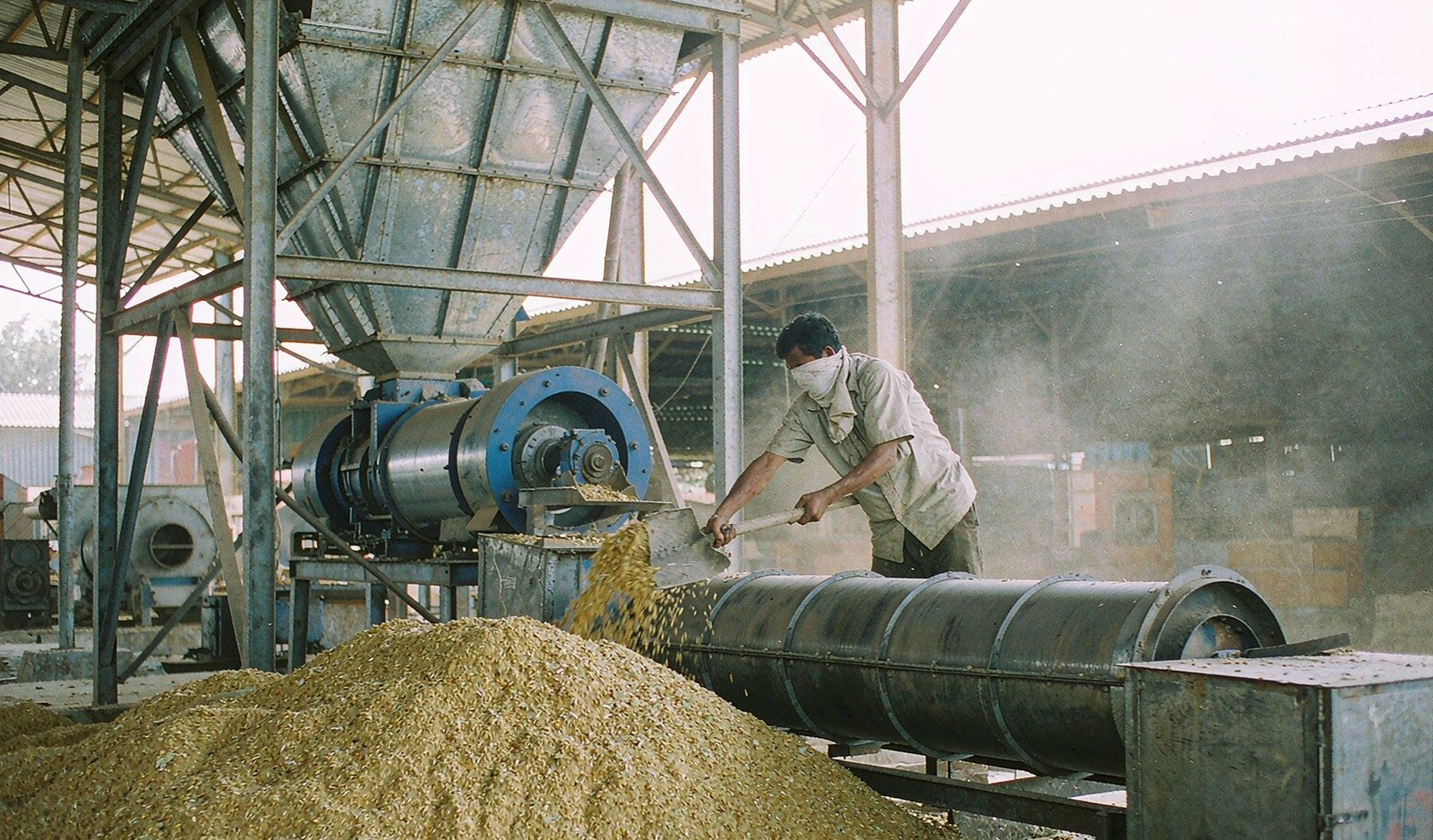
Rice husk is one of the largest agricultural residues on earth and one of the least used. A recent review in Rice Science, indexed in the FAO AGRIS database, puts annual worldwide rice production at more than 750 million tonnes of paddy, which leaves roughly 150 million tonnes of husk — about a fifth of the paddy by weight. An earlier review in Waste Management, also indexed in FAO AGRIS, estimated about 134 million tonnes of rice husk produced annually, with over 90% of it burned in the open air or dumped into rivers. Against that backdrop, pressing husk into a dense, storable, transportable fuel pellet looks like an obvious win for rice mills with surplus boiler fuel demand and for pellet traders within trucking distance of large rice mills.
It is a win — but only for buyers who understand what husk does to a pellet mill. Rice husk is not “cheap sawdust with more ash”. It is a silica-reinforced abrasive, and a pellet line specified for wood will eat dies, choke on fines and disappoint its owner within months unless the design assumptions change. This article explains why, and what we change in a rice husk pellet line to make the economics hold.
What is actually inside a rice husk
The numbers that matter come from compositional studies rather than from marketing sheets. In a characterisation study of rice husk varieties published in the Journal of Bioresources and Bioproducts and available through FAO AGRIS, the ash content of the raw husk ranged from 18.3% to 28.6% on a dry basis, and 89–96% of that ash was silica. Compare that with clean softwood, whose ash sits well under one percent, and the scale of the difference is clear: roughly a quarter of the material passing through the die is mineral.
Silica — quartz in practical terms — is harder than the hardened steel surfaces of a die and roller assembly. When the roller forces a bed of husk against the die face and drags it through the holes, every silica particle in that bed behaves like grinding grit. The wear is not an accident or a defect; it is the expected behaviour of the material, and the design question is how to manage a consumable rather than how to avoid one.
The second consequence is chemical rather than mechanical. That 18–29% ash follows the pellet all the way to the customer’s boiler. Rice husk pellets cannot qualify under the ENplus wood pellet scheme — ENplus certifies wood pellets, as our ENplus A1 requirements article explains, and its ash ceiling sits at 0.70% for A1 — so husk pellets sell into the industrial combustion market under different specifications (non-woody pellets have their own ISO grading standard, ISO 17225-7), and the boiler side of the business needs to be part of the project from day one, because high-ash fuel changes combustion behaviour, ash handling and slagging risk.
How silica actually wears a die
Die wear on wood follows a pattern; die wear on rice husk compresses the same pattern into a shorter timeline. It runs in four stages that every operator should learn to read from the ammeter and the product.
First, the holes and the die face wear by abrasive grooving. The effective compression ratio — the relationship between hole length and hole diameter that builds pellet density — falls as the channel widens and the inlet bellmouths. Second, the press compensates by feeding more material; output holds for a while, but the pellets leave the die less dense and the fines fraction climbs. Third, durability drops below specification and the cooler and siever start recirculating more material than they should. Fourth — the stage that ends the shift — the die face wears through at the thin sections, or the press can no longer hold power draw within limits, and the die comes off. A die run to this fourth stage on husk has usually damaged the roller shells on the way, which is how one consumable becomes two.
| Etapa | What you observe | What to do |
|---|---|---|
| 1. Abrasive grooving | Output and durability normal; die face and hole inlets visibly scoring | Log die thickness; nothing to intervene yet — this stage is inevitable |
| 2. Effective compression ratio falls | Output holds, pellets lighter, fines share creeping up | Re-check roller gap and moisture; plan die replacement date from wear log |
| 3. Durability below spec | PDI drifting down, siever recirculating more, ammeter rising per tonne | Replace die at the planned date; inspect roller shells before re-fitting |
| 4. End of life | Die face wear-through risk, power draw unstable, fines out of control | Stop; running to this stage usually damages rollers and turns one consumable into two |
The energy side moves in parallel. On our biomass pellet mill datasheet, wood residues press at 28–38 kWh/t of specific energy, while agricultural residues run 35–50 kWh/t — the extra work is the same grit that wears the die, paid for at the meter on every tonne. Densified biomass is now traded internationally at scale, and IEA Bioenergy’s work on global bioenergy trade, hosted at IEA Bioenergy Task 40 and its successor activities, tracks exactly these industrial fuel supply chains.
| Property | Clean softwood | Rice husk | Consequence at the press |
|---|---|---|---|
| Ash content (dry) | Well under 1% | 18.3–28.6% (Ogwang et al., 2021) | Abrasive grit in every tonne; dies are a planned consumable |
| Silica share of ash | Low | 89–96% (Ogwang et al., 2021) | Quartz hardness against hardened steel — grooving wear on holes and face |
| Fuel-grade certification | ENplus A1/A2/B available | Not ENplus-eligible; non-woody grades (ISO 17225-7) | Industrial fuel market; boiler ash handling must be designed |
| Specific energy at the press | 28–38 kWh/t (our datasheet) | 35–50 kWh/t band for agri-residues (our datasheet) | Higher electricity cost per tonne; motor sizing must follow the residue band |

Five design decisions that decide whether a husk line works
A rice husk pellet line is a wood pellet line with five deliberate deviations. Miss any of them and the plant still runs — briefly.
Die specification at the low end of the compression range. Our biomass press datasheet quotes die L/D ratios from 1:6 to 1:12, and husk belongs at the bottom of that band. Husk’s structure carries enough native binding through its own silica-lignin matrix that a long channel buys overheating and die cost rather than durability. Hole diameters in the 6–8 mm range keep the abrasive path short; our ring die production covers feed sizes of 2–12 mm and biomass sizes of 6–12 mm, and a husk-specific die is specified differently from a softwood die in both channel length and steel.
Pre-cleaning before the press. Rice mill husk arrives with free grains, broken rice, stones and tramp metal from the paddy yard. Stones and metal do to a die what they do to any mill, only faster. A screener and a magnet ahead of the pellet mill are not optional equipment on husk — they are the cheapest die-life extension available, and they also protect the boiler customer, who does not want stones in the fuel either.
Honest moisture handling. Husk leaving a rice mill is usually much drier than fresh wood chips, which is one of husk’s genuine advantages: the drying stage on a husk line is often smaller than on a wood line, and in dry-season operation sometimes unnecessary. But “usually” is not a design basis. Measure the moisture your supplier actually delivers across a full season, including the monsoon months, before the dryer — if you need one at all — is sized. Our wood pellet line design guide walks through the moisture balance method; the arithmetic is the same, only the numbers change.
Cooling and fines management built for a friable pellet. High-ash pellets are typically less mechanically durable than wood pellets, which means the sieving loop works harder. Design the screener and the fines return for a higher recirculation share than a wood line, and place the final screen immediately before bagging so the fines the customer measures are the fines you decided to ship, not the ones the conveyor made on the way.
A boiler-side business plan. Because husk pellets sell on industrial fuel terms, the buyer’s boiler is part of your product. Ash contents in the high-teens or above change ash removal, slagging behaviour and ash disposal on the customer side. A husk pellet project that is priced purely against wood pellet benchmarks will misprice itself in both directions. Where the feedstock economics allow, blending husk with wood residues lowers delivered ash — the blend’s ash content is simply the weighted average of the inputs, which is arithmetic you can put in front of a buyer.
Operating discipline once the line runs
The die-wear story is set by design, but its speed is set by operation. Four habits keep a husk die on the long side of its life: log die thickness on a fixed schedule so replacement is planned instead of emergency; flush the die with oily material at every shutdown so the hot channels do not bake the last charge solid; keep the roller-to-die gap set to specification, because a loose gap lets material slip and grinds the faces instead of pressing pellets; and keep moisture inside the band your material needs, because wet husk both wears and blocks. None of these are complicated; all of them are skipped somewhere in the world every week.
Budget honesty completes the discipline. On husk, dies are a line item in the operating cost the way hammers and screens are on a feed line. Ask your die supplier for expected life on husk at your hole size, hold the agreed spares on site, and put the replacement rhythm into the financial model — a project that models dies as a wood-line consumable will find its cost per tonne drifting upward every quarter.
FAQ
Can rice husk pellets be ENplus certified?
No. ENplus certifies wood pellets, and its A1 ash ceiling of 0.70% is an order of magnitude below what husk contains. Husk pellets sell as non-woody fuel — graded under ISO 17225-7 — to industrial and boiler customers who specify ash tolerance in their own fuel contracts.
How much shorter is die life on rice husk than on softwood?
Substantially shorter, and honest suppliers give a range rather than a number, because formula, hole size, steel and operating discipline all move it. The right approach is contractual: ask for expected hours on your material and hole size, log actual hours from the first die, and treat replacement as scheduled maintenance rather than an event.
Do I need a dryer on a rice husk pellet line?
Often less machine than a wood line needs, because rice mill husk is usually delivered drier than fresh chips. Measure across a full season before deciding — monsoon-season deliveries, not commissioning-season samples, set the requirement. Where moisture is stable and low, plants run without a dryer and save the largest single energy consumer in a typical line.
What pellet diameter works best for husk?
Industrial boiler customers commonly take 6–8 mm. Shorter channels and moderate hole sizes keep the abrasive path down and the specific energy within the 35–50 kWh/t band our datasheet quotes for agricultural residues. Extremely small holes on husk raise energy and wear for little commercial return.
Can husk be blended with wood to improve the fuel?
Yes, and blending is a common way to enter the market: the ash content of the blend is the weighted average of its components, so blending husk with clean sawdust moves delivered ash down toward what industrial customers prefer. The press sees a mixed abrasiveness, so die specification follows the husk share of the blend rather than the average formula on paper.