
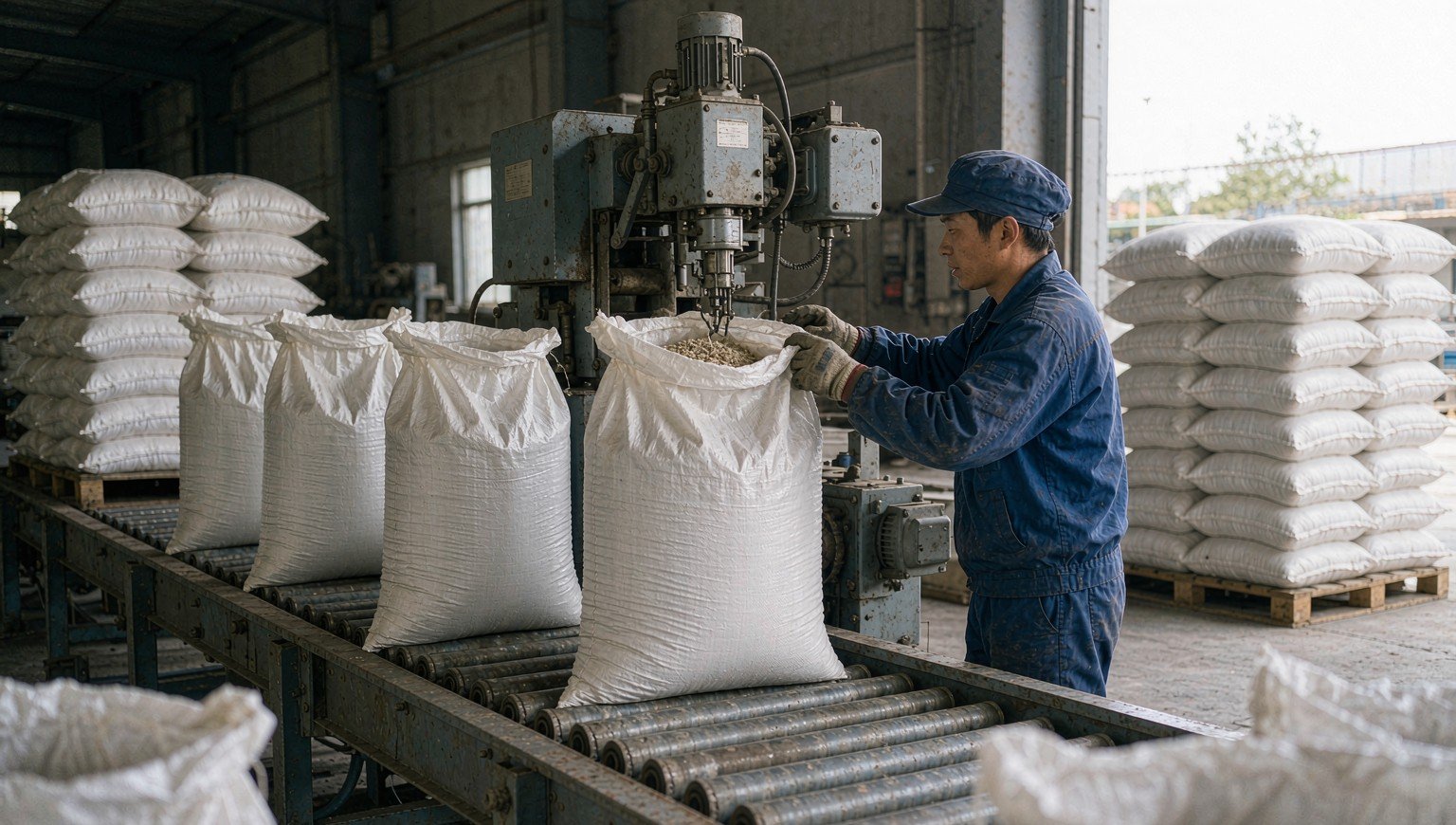
Every pellet and feed plant ends in the same place: product going into something. The choice between 25 or 50 kg sacks and 1,000 kg bulk bags is usually made late, by whoever is closest to the customer, then handed to the supplier as a fixed requirement. It deserves an earlier decision: it sets the labour count, the dust load, the loading bay layout and a share of the annual cost per tonne.
This comparison works through the six differences that change the numbers: throughput, weighing accuracy, labour, dust, packaging cost and layout. It closes with a decision framework for the four customer types we see most often in feed and biomass projects.
What Each System Actually Is
A sack line is a net-weigh scale that drops a pre-weighed batch into an open-mouth bag, then a closing device — sewing head or heat sealer — and a conveyor. The working range for the machines we build is 15 to 50 kg per bag, with a bag width of 450 to 750 mm, fed either manually or from a magazine. Throughput is set by the weighing cycle, not by the conveyor.
A bulk bag line is a filling frame with a suspended load cell system, a spout clamp and an inflatable neck seal, handling 1,000 to 5,000 kg. Our DCS1000 ton bag scale is quoted at 1,000 to 5,000 kg capacity, OIML R60 Class III or NTEP certified, with 0.1 kg resolution in the lower range and 0.2 kg above 2,000 kg. The bag is not moved by a person at any point; it is lifted by hoist or forklift, which changes the labour and safety case completely.
Both are scales. They differ in what happens to the bag afterwards, and that is where the cost sits. Our bagging machine range covers both forms because projects ask for both, and the specification conversation is different for each.
Throughput: The Number That Decides It
Run the arithmetic before comparing machine specifications, because it usually settles the argument. A 5 t/h line making 50 kg sacks needs 100 bags per hour, or 1.7 bags per minute. That is well inside the capability of a single semi-automatic weigher, and it means the bagging machine is not the constraint — the operator, the sewing head and the pallet stack are.
| Line output | 25 kg sacks | 50 kg sacks | 1,000 kg bulk bags |
|---|---|---|---|
| 5 t/h | 200 bags/h (3.3 per min) | 100 bags/h (1.7 per min) | 5 bags/h |
| 10 t/h | 400 bags/h (6.7 per min) | 200 bags/h (3.3 per min) | 10 bags/h |
| 20 t/h | 800 bags/h (13.3 per min) | 400 bags/h (6.7 per min) | 20 bags/h |
| Constraint at 5–10 t/h | Two operators, two sewing stations | One operator, one sewing head | Forklift cycle, not the scale |
Read the table in the other direction and the result is more useful. One 50 kg weigher at 6 to 8 bags per minute can serve a 15 t/h line, so the sack machine only becomes a bottleneck when the plant is large or the bag small. At 20 t/h in 25 kg sacks the line needs 13.3 bags per minute sustained, which is where automatic bag placers and palletisers stop being optional.
Bulk bags invert the constraint. Twenty bags an hour is nothing for a filling frame, but each bag has to be positioned by forklift, filled, sealed and removed, so the practical ceiling is the truck and forklift cycle. Plants that moved from sacks to bulk bags usually report the gain in labour, not in throughput.
Weighing Accuracy and Giveaway
Accuracy is quoted as a percentage of fill, which makes the two systems look closer than they are in cash. At ±0.5% on a 50 kg sack the tolerance is 250 g. On a 1,000 kg bulk bag at ±0.2% it is 2 kg.
Giveaway is the average overfill needed to keep every bag above the declared weight, and it is proportional to tonnage rather than to bag count. On 35,000 tonnes a year, a 0.5% average overfill gives away 175 tonnes; at $200 per tonne that is $35,000 of product leaving the gate unpaid, every year. At 0.2% the figure falls to 70 tonnes and $14,000. Neither number appears on a quotation, and neither is recoverable once the truck has left the yard.
The other half of accuracy is legal. Prepackaged goods sold by weight fall under national weights and measures rules, so a machine that weighs well but cannot be verified in the destination country becomes a commercial problem. Ask for the accuracy class and the certification route before the purchase order.
Labour, Manual Handling and Dust
A 50 kg sack is above the weight at which manual handling guidance starts to require assessment; the UK Health and Safety Executive’s guidance for manual handling sets 25 kg as the threshold at which a load becomes heavy for an average male worker, and 16 kg for an average female worker (HSE INDG143). In practice this means either two people on the bagging spout, a mechanical bag support, or both. The labour cost of a sack line is therefore not one operator per machine; it is one operator per machine plus the person who moves the pallets.
A bulk bag removes the manual lift entirely. The operator attaches the spout, the frame does the work, and the forklift takes the bag away.
Dust follows the same split. Filling an open-mouth sack pushes air through the fabric and around the spout, and that air carries fines, so a sack line needs extraction at the filling point. A bulk bag with an inflatable neck seal and a dust return sends the displaced air back into the product. In feed plants, accumulation is a housekeeping issue as much as a health one: OSHA’s grain handling standard 1910.272 is the reference most mills adopt regardless of jurisdiction.
Packaging Cost, Freight and the EU Rules
The sack is a consumable, the bulk bag is a reusable asset, and the comparison only works over the bag’s life. A 50 kg woven polypropylene sack is used once and cut open by the customer. A 1,000 kg FIBC is designed for a defined number of trips — often five or more in closed-loop industrial supply — and is then either reconditioned or disposed of as a single large item rather than 20 small ones.
Regulation has moved into this decision since August 2026. The EU Packaging and Packaging Waste Regulation, Regulation (EU) 2025/40, applies from 12 August 2026 and covers packaging placed on the EU market, including transport packaging and packaging around imported goods. Its heavy-metal limit — lead, cadmium, mercury and hexavalent chromium together no more than 100 mg/kg across all components, including inks and coatings — is already in force. Design-for-recycling requirements and recyclability grades apply from 2030, and grouped, transport and e-commerce packaging must keep empty space ratio at or below 50% from the same date.
Two consequences for a producer selling into Europe. Mono-material polypropylene sacks and FIBCs are simple to recycle, which is an advantage over laminated alternatives. And reuse ranks above single use, which favours the bulk bag where the customer returns it.
The Layout Question Nobody Asks
Sack lines are compact and vertical: a weigher over a spout needs 3 to 4 m of headroom, then a conveyor, a sewing head and a pallet area. They fit into an existing building, which is often the real reason a plant chooses sacks.
Bulk bag stations need 5 to 6 m of headroom for the frame and the suspended bag, a forklift aisle in front, and a floor designed for a 1.2 to 1.5 t point load on a small footprint. Retrofitting one into a building designed for sacks usually means cutting the roof. If bulk bags are even a possibility in year three, design the headroom now.
A Decision Framework
| Customer and channel | Best fit | Why | Watch out for |
|---|---|---|---|
| Farm supply dealers, retail agri | 25–50 kg sacks | Sold by the bag, handled by hand at the point of sale | Bag print, pallet pattern, giveaway |
| Industrial boiler and CHP fuel | 1,000 kg bulk bags | Customer has a hoist and a silo, not a labour force | Bag cleanliness, fines at the spout |
| Export in containers | 25 kg sacks or 1,000 kg bags, depending on the buyer | Loading weight per container, destination handling | Bag certification, ISPM 15 for pallets |
| Own feed mill, internal transfer | Bulk, or 1,000 kg for short moves | Bagging is a cost with no commercial benefit | Do not bag what a truck can carry loose |
A mixed plant is normal and does not need two lines. A weigher with a changeable spout can fill sacks and, with a frame attachment, 500 kg bags; what it cannot do is fill a 1,000 kg bag safely without the headroom and the hoist. Decide the largest bag you will ever sell, then design backwards.

Cost per Tonne of Bagging
Most of the difference is in the bag, not the machine. At 35,000 tonnes a year and a $200 per tonne product value, the arithmetic below uses bag prices and wages as local inputs. Conveyors, sewing, palletising and the rest of the end-of-line scope are priced in our feed mill investment breakdown.
| Cost line | 50 kg sacks (USD/t) | 1,000 kg bags (USD/t) | Basis |
|---|---|---|---|
| Bags | 9.00 | 2.00 | 20 sacks at $0.45; one bag at $10 over five trips |
| Bagging labour | 0.41 | 0.21 | Two operators against one on $600/month |
| Giveaway | 1.00 | 0.40 | 0.5% and 0.2% of $200/t |
| Visible total | 10.41 | 2.61 | Excludes capital and freight |
Against that, the bulk bag needs a hoist, a bigger footprint and a higher capital outlay, and its advantage collapses if the customer does not return the bag. The sack line wins where the product is sold by the bag to people who carry it.
FAQ
Can one machine fill both 50 kg sacks and bulk bags? Not well. The weighing range, the spout geometry, the bag support and the safety case are different. A 15–50 kg net-weigher with a bag clamp is a different machine from a suspended-load FIBC filler, and combining them produces a compromise that is slow at both.
How many operators does a 5 t/h sack line need? Two at the bagging station in most layouts: one on the spout and one on palletising, with the sewing head automatic. That is 100 bags an hour, which is a comfortable pace rather than a sprint. The equivalent bulk bag station needs one operator plus a forklift that is probably already in the plant.
Is a checkweigher worth it? Above roughly 10 t/h in sacks, yes — not to catch bad bags, which are rare, but to catch drift in the weigher before it becomes a week of giveaway. On a 35,000 t/y line, 0.3% of undetected drift is 105 tonnes.
What accuracy should I specify? For trade settlement, ±0.2% of fill is a realistic target for both systems, with ±0.5% acceptable for internal transfer. Specify the class, the verification route and the calibration interval in the purchase order, and require a test with your own product at the acceptance run rather than with sand.
Do bulk bags need a dust system? They need a dust return more than a collector: displaced air from a 1,000 kg fill carries fines that belong in the product, and a neck seal recovers them.
Which is cheaper per tonne? Almost always the system whose bag the customer returns. The table above prices the bag, the labour and the giveaway; add capital and freight from your own quotes before deciding.
One last check before ordering: bag quality. A sack that fails at the seam costs a customer, a cleanup and a claim, and the small bag packing scale is the cheapest part of the decision and the one that decides whether the bag arrives full.