
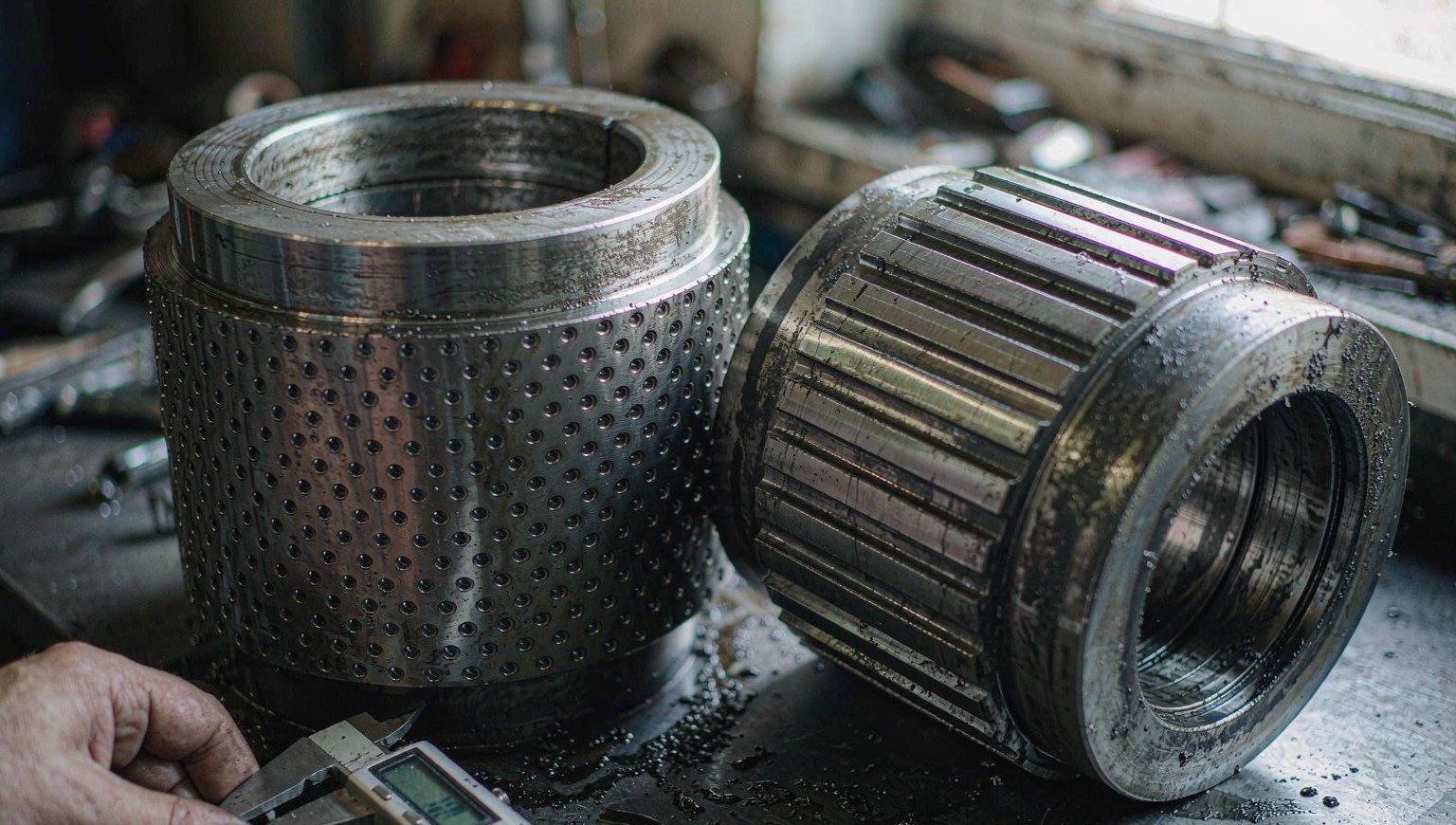
The spare parts list is normally the last page of a pellet line quotation, and the first thing that gets cut when the budget tightens. That is the wrong order. A pellet mill is a machine that consumes its own tooling: the die and the rollers are the tooling, they wear by design, and the plant’s output per hour falls as they do. Treating them as an afterthought converts a scheduled maintenance item into an unplanned stoppage.
This is a list of the seven items worth holding before the first tonne is produced, with the reasoning behind the quantity of each, the storage conditions that decide whether a spare survives two years in a warehouse, and the documents a buyer should insist on so the second order is not a guessing game.
Why Spares Are a Process Decision, Not a Purchasing One
Wear in a pellet mill does not announce itself. A die that has lost hole geometry raises specific energy first, then raises fines, then starts producing pellets that fail a durability test. By the time an operator notices, the mill has been running inefficiently for weeks and the plant has shipped product that a customer may reject.
The connection to product quality is measurable. ENplus certification, the scheme most European buyers reference, requires A1 pellets to stay below 10% moisture, below 0.7% ash, at or above 97.5% mechanical durability and no more than 1.0% fines at loading (ENplus). A worn die and a mismatched roller shell both attack the durability and fines figures directly, which means the wear part is not a maintenance item but a quality control variable.
The second reason is cascade. A roller bearing that fails at speed does not stop at the bearing: it takes the roller shaft, often the die, and occasionally the main shaft with it. The cost difference between changing a bearing on schedule and changing a shaft after a seizure is an order of magnitude, and the schedule is only possible if the bearing is on the shelf.
The Seven Parts That Actually Stop a Line
| Part | What it does | Early signal | If you do not hold one |
|---|---|---|---|
| 1. Ring die | Forms the pellet; sets density and output | Rising kWh/t, softer pellets, more fines | Mill stops until a die arrives and is bedded in |
| 2. Roller shells | Press material through the die holes | Uneven die wear, slipping, output drop | New die wears unevenly against old shells |
| 3. Roller and main bearings | Carry the pressing load | Grease discolouration, temperature rise, noise | Seizure damages shaft and die |
| 4. Hammer mill hammers | Reduce feedstock to die-ready particle size | Falling throughput, coarser grind, vibration | Grind quality drifts; the mill works harder |
| 5. Screens (hammer mill, cooler, screener) | Set particle size and remove fines | Torn mesh, sudden fines increase, oversize in product | Product out of specification until replaced |
| 6. Bucket elevator belt and buckets | Move material vertically between stages | Belt tracking, spillage at the boot, broken buckets | A single elevator stops the whole line |
| 7. Small parts kit | Shear pins, couplings, die clamps, seals, pulse valves, filter bags | Usually none; these fail without warning | Days of downtime for a part that costs tens of dollars |
The seventh row is the one buyers skip and operators curse. A shear pin costs almost nothing and is designed to fail; a pulse valve diaphragm costs less than a lunch and stops the dust collector; a coupling element fails quietly and takes a motor alignment with it. None of these belong on a critical spares list by value, and all of them belong there by consequence.
How Many Sets to Hold
Quantity follows from three facts: how many mills you have, how long a change takes, and how long delivery takes. The first is fixed, the second is a maintenance window, and the third is the only one that can be reduced by planning.
The rule we recommend is one die in service and one die ready per mill, one complete roller set per mill, and one set of hammers per hammer mill. That sounds generous until the alternative is costed: on the 5 t/h model in our payback analysis, EBITDA is about $56 per tonne, and the next section turns that into the cost of waiting.
| Item | Single mill, 2–3 t/h | Two mills, 5–6 t/h | Four mills, 10–12 t/h |
|---|---|---|---|
| Ring dies | 2 | 3 | 5 |
| Roller shell sets | 1 | 2 | 4 |
| Roller bearing sets | 2 | 4 | 8 |
| Hammer sets | 1 | 2 | 2 |
| Screens per size in use | 2 | 3 | 4 |
| Elevator belt (one length) | 1 | 1 | 1 |
| Filter bags (one set) | 1 | 1 | 1 |
Two multipliers sit on top of the table. If the site is more than a few weeks from the factory by sea, add one die. If the feedstock is abrasive — high ash, silica, or a high proportion of rice husk, straw or palm kernel shell — add one more die and one more roller set, because those materials consume tooling faster than clean softwood. The relationship between feedstock and die specification is covered in our note on die compression ratio, and it is worth reading before ordering the second die: a die ordered at the wrong L/D ratio wears out quickly and produces pellets that fail durability.
Budget sanity check: IRENA’s pellet plant case carries operation and maintenance at 2% of investment annually and “other costs” at a further 4% (IRENA solid biomass supply). On a $6.5 million line that is $130,000 a year, and the majority of it is wear parts and the labour to change them. A spares budget that is a rounding line in year one becomes the maintenance line in year three.
What Downtime Costs at Three Line Sizes
The same arithmetic scales with output. Using the $56 per tonne contribution from the payback model, and assuming the line is sold out — which is the case in which downtime hurts most.
| Line output | Contribution per hour | One day stopped | Four days stopped |
|---|---|---|---|
| 2 t/h | $112 | $2,700 | $10,800 |
| 5 t/h | $280 | $6,700 | $27,000 |
| 10 t/h | $560 | $13,400 | $54,000 |
Read the right-hand column against a spare die. At every line size in the table, the second die costs less than the stoppage it prevents — and that comparison ignores the customer relationship, which is the part that does not appear in any model.

Storage: Where Spares Actually Fail
A spare part that is stored badly is not a spare part. Three failure modes account for most of the losses.
Corrosion. A machined die bore and the polished working face of a roller shell are unprotected steel. In a humid climate — coastal Southeast Asia, West Africa, the Gulf — a die stored upright in an open warehouse will show surface rust within weeks, and rust in a die hole changes the friction that the compression ratio was designed around. Store dies and shells coated in a protective grease, wrapped, and off the floor.
Bearing grease migration and contamination. Bearings stored for two years in a hot warehouse can lose their initial grease charge or take in moisture. Keep them in their original sealed packaging, in a dry store, and rotate stock so the oldest set is used first. A bearing that has been on the shelf since commissioning and is fitted in year four is not a new bearing.
Elastomer and fabric ageing. Conveyor and elevator belts, filter bags, diaphragms and seals all have a shelf life. Heat, sunlight and ozone shorten it, and a belt that has been folded in the same position for three years will crack along the fold. Store belts on a pallet, not hanging; store bags in their carton, away from windows.
Two practical additions. Keep a torque and clearance sheet with the spares, not in the project folder — the person changing a die at 2 a.m. needs the roller gap figure on the wall. And record what was fitted and when: die serial number, hours run, tonnes produced, feedstock source. Without that record, the second die order is a guess, and the warranty conversation has no evidence.
Lead Time Is the Only Variable You Control
Everything in this article reduces to one comparison: the cost of holding a part against the cost of waiting for it. Holding costs are small — warehouse space, a little capital, some grease. Waiting costs are not, and they are asymmetric: a plant that waits for a die loses output, a customer and, if the delay is long enough, a contract.
Sea freight from China to most destination ports is measured in weeks, and a shipment is not complete until it clears customs. That is the reason the recommendation is to order critical spares with the line rather than after commissioning: the parts travel in the same container, clear on the same documents, and arrive before they are needed. Our spare parts range is quoted this way, with the ring die specification and the roller and roller shell dimensions confirmed against the mill model before the order is placed.
One safety point that is not optional. Die and roller changes happen inside a guarded machine with stored energy in the hydraulic system and gravity in the die. Lockout and tagout before any change, every time; OSHA’s 1910.147 standard is the reference framework even where it does not apply legally, and most serious suppliers issue a change procedure with the machine.
Documents to Ask For With the Parts
Four documents make the difference between a spare part and a correctly specified spare part.
Dimensional drawing with tolerances. Die outer diameter, working width, hole diameter, hole count and compression ratio. Without the drawing, a replacement die is ordered from a description.
Material and hardness certificate. Surface hardness and core toughness trade against each other; a die hardened only for wear resistance cracks under roller load. The certificate is how you know which compromise was made.
Matched roller and die record. Rollers and dies wear as a pair. Ordering a die without checking roller shell diameter leaves a mismatched pair that wears the new die unevenly from day one.
Change procedure and torque values. Die clamp torque, roller gap setting, bearing preload. These belong in the maintenance file, not in an email.
Key Takeaways
A pellet mill consumes tooling by design. The die and roller shells are not parts that fail; they are parts that wear, and the only decision is whether they are replaced on schedule or mid-shift.
Hold one die and one complete roller set per mill before commissioning, plus a small parts kit that costs almost nothing and stops the plant anyway. Add a die if the site is remote by sea or the feedstock is abrasive.
Store steel for the climate, not for the shelf: greased, wrapped, off the floor, rotated, with the oldest set used first. Bearings in sealed packaging, belts on pallets, bags away from sunlight.
Cost the wait, not the part. At 5 t/h and roughly $280 of contribution per hour, a four-day wait for a die costs more than the die, the freight and the warehouse space combined.
Order with the line. The parts that arrive in the same container as the machine are the ones that are there when the machine stops.