
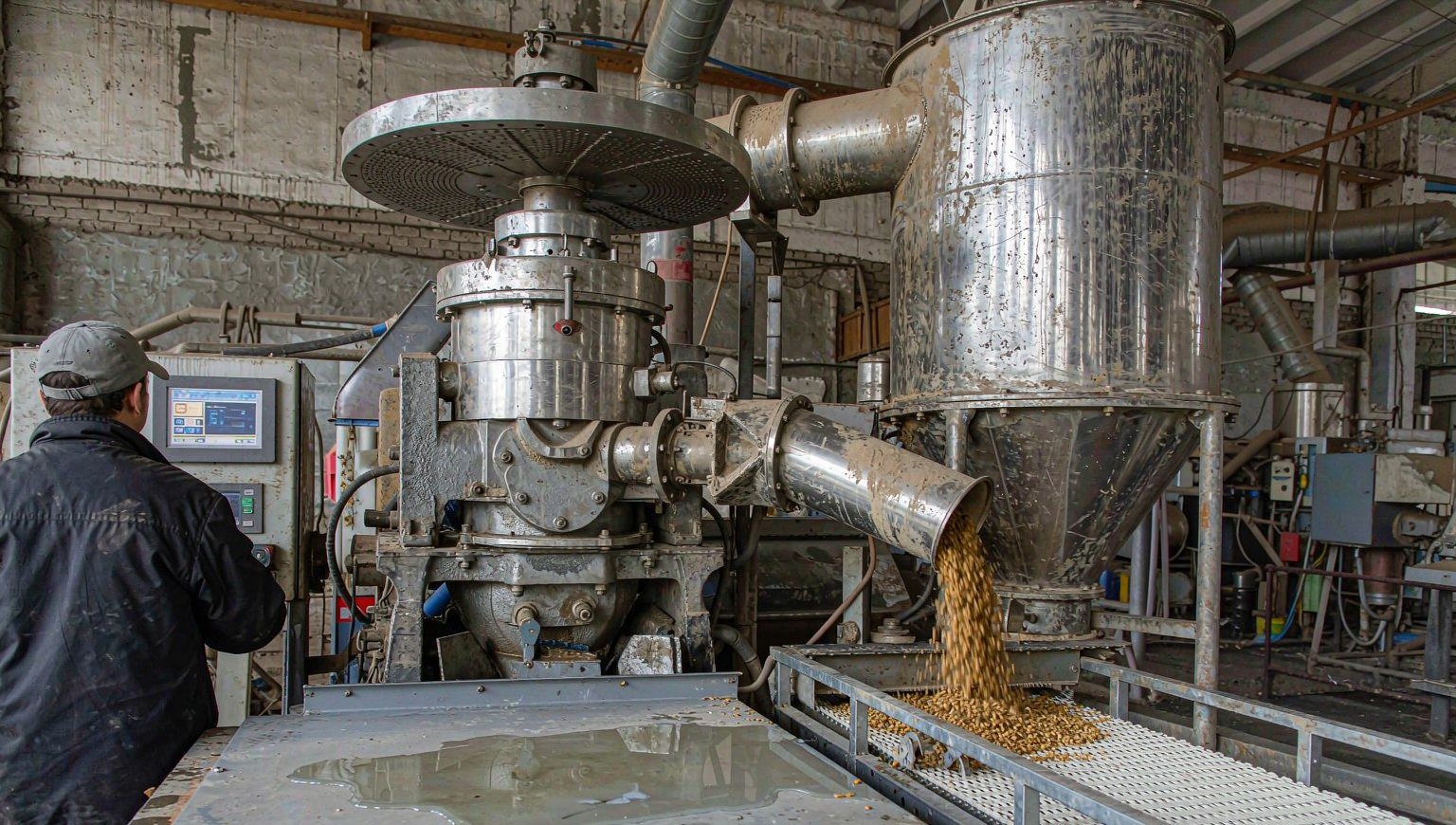
A pellet line that never reaches its nameplate rate has a way of turning a solid business plan into a running argument. The plant was bought on a tonnage figure; the bank was paid on that figure; and the machine runs at two-thirds of it. The instinct is to blame the mill. In our experience, the mill is usually the last place to look. Output shortfalls almost always come from conditions the mill was rated against — raw material, grind size, conditioning, die selection, wear state, feeding stability — or from a bottleneck sitting somewhere else in the line.
This article lists the seven causes we encounter most often, in the order they should be checked, with the data points that distinguish one from the next.
First, Be Clear What “Nameplate Capacity” Actually Promises
A rated tonnage is a statement about a specific material, moisture window and die specification — not a guarantee for whatever arrives on your floor. Our own biomass pellet mill range is a fair example: the line spans 1-15 t/h depending on material and die specification, and the reference figures for one mid-size model list agricultural straw at 14-18% incoming moisture producing 2-5 t/h at 35-50 kWh/t of press electricity. Change the raw material to hardwood sawdust or palm fiber, or let the moisture drift outside the window, and the honest expectation moves with it.
So step one is to restate the nameplate in its own terms: what material, what moisture, what die, what hour basis. Every shortfall diagnosis starts from that baseline, because “underperforming” can only be measured against a spec, not against a sticker.
Reason 1: The Grind Is Wrong — in Either Direction
Particle size sets both the energy cost and the ceiling on throughput before material ever reaches the press. The best-documented dataset comes from swine feed research at Kansas State University: Wondra and colleagues measured hammermill performance across four corn particle sizes, and the numbers show how steeply fine grinding taxes capacity.
| Corn particle size (µm) | Milling energy (kWh/t) | Milling production (t/h) |
|---|---|---|
| 1,000 | 2.42 | 3.0* |
| 800 | 2.78 | 3.0* |
| 600 | 3.46 | 2.85 |
| 400 | 7.35 | 1.43 |
Wondra et al. 1995, as summarized in the Iowa State University PorkGateway feed processing resource; *production was limited by the exit auger at the two coarsest settings, so the true mill ceiling is higher. The same resource notes modern grinding equipment adds roughly $0.05/ton of grinding cost for every 100 µm reduction between 800 and 400 µm.
Read from the pelletizer’s side, the table explains two opposite failure modes. Grind too coarse and large particles and long fibers jam the compression channel — the press spends its power on restructuring material instead of extruding it, and output sags. Grind much finer than the job needs and the grinding stage itself becomes the bottleneck: production falls and energy per ton climbs more than threefold between 1,000 and 400 µm in the dataset above. The full reference, including the trade-off discussion, is on the PorkGateway feed processing page. For biomass lines the same logic holds with different numbers; our article on making pellets from pine sawdust covers the grind targets on the wood side. If your measured deficit appears only at the hammer mill’s ammeter, check screen size selection before you touch anything downstream.
Reason 2: Conditioning Has Fallen Outside the Work Window
Steam conditioning is where capacity and quality trade against each other most visibly, and the operating window is narrower than most plants maintain. Kansas State University’s pelleting quality assurance guidance gives concrete targets for corn-soybean meal type feed: 17-18% total mash moisture and 180-200°F conditioning temperature at the die. The same document warns that total moisture above about 18% can plug the pellet mill outright, and that every 25°F of steam temperature rise adds roughly 1% moisture to the mash — which is why the same setpoints behave differently in winter and summer. With mash entering at 40°F on a winter morning, reaching a 190°F target adds about 6 points of moisture; from a 90°F summer mash, the same target adds about 4.
Both edges of the window cost tonnage. Too much moisture or condensate and the rolls slip on the die surface, the press plugs, and operators trade throughput for safety by starving the feeder. Too little conditioning and the material stays hard and abrasive: frictional heat rises, specific energy climbs, throughput drops and die wear accelerates. Retention time moves the same lever — the KSU guidance notes that longer conditioner retention improves pellet quality but decreases pellet mill throughput, while drier formulations may actually need longer retention to absorb the moisture they are given. The full conditioning chapter is worth reading in the K-State pelleting guidelines PDF, and our article on steam conditioning in feed pelleting covers the parameters in depth.
Diagnostic shortcut: if output drops seasonally, log the mash temperature entering the conditioner across the year. A mill set up correctly in a tropical climate will sit off-window in a continental winter without anyone changing a single setting.
Reason 3: The Die Compression Ratio Does Not Match the Material
Die effective length divided by hole diameter (L/D) decides how much compression work the material receives. Match it wrong in either direction and the nameplate is unreachable: an over-long ratio for an oily, easily bound material drives specific energy up and throughput down; a ratio too short for a hard, lignin-poor material cannot build enough friction to form dense pellets, so the line recycles fines instead of shipping them. The press ends up “running fine” at a fraction of its rate, and nobody re-examines the die because it looks new.
As a reference band, our biomass pellet mill specifications list die L/D ratios from 1:6 to 1:12 across biomass-optimized profiles, with the correct point inside that band set by the raw material. The selection logic — and the failure symptoms that point to a ratio mismatch — are laid out in our article on die compression ratio. If output improved or collapsed the day a new die went on, this is the first suspect, and it costs nothing to check because the answer is stamped on the die.
Reason 4: Die and Roller Wear Has Crossed the Useful Line
Wear removes capacity quietly. As die holes enlarge and inlet land areas erode, the friction pattern that grips and compresses the material degrades; worn roller shells stop biting feed and start sliding over it. The classic presentation is a mill that pulls current, produces weak pellets, and recirculates an ever-growing share of fines — the tonnage that leaves the building falls long before anything breaks. Equipment suppliers describe the same pattern: worn dies and rollers are among the first causes they list for output below rating. Conditioning interactively accelerates this: the KSU guidance quoted above notes that low-conditioning-temperature operation increases frictional heat and die wear, so a plant running cold all winter buys a shorter die life as well as a lower rate.
Track die condition by measuring output against hours on the current die set rather than against the machine’s age, and record hot-pellet temperature and main-drive amperage at the same time. A falling throughput trend on an aging die set, with stable material and settings, is a replacement signal — not a reason to re-tune the feeder.
Reason 5: Feeding Is Unstable
A pellet mill reaches its rate only with a consistent, thin bed of material under the rollers. Feed that surges and starves forces the press to cycle between overload protection and light load, and the average over any hour lands well below the steady-state rate the machine could hold. Common sources: a screw feeder controlled manually instead of by the press load signal, bridging in the feed bin above the conditioner (moist or fine material is the usual culprit), and conditioner paddles set or worn so that material channels rather than fills.
The check is simple and worth doing on any underperforming line: trend main-drive amperage over ten minutes. A trace that swings widely is a feeding problem even if the average looks acceptable — the mill is paying for every swing in lost rate and accelerated wear. Steam condensation interacts here too: the KSU document notes that excess condensation in the conditioner causes rolls to slip and the mill to plug, so a feeding diagnosis should rule out steam-side surges before blaming the feeder hardware.
Reason 6: A Bottleneck Somewhere Else in the Line
The pellet mill can only be fed as fast as the equipment in front of it allows. Dryer throughput that falls short on humid days, a hammer mill that was sized optimistically, a cooler whose airflow cannot absorb the hot pellet flow, a bucket elevator or conveyor running near its limit — any of these starves the press intermittently, and the mill’s hour-by-hour average lands below nameplate even though the press itself is healthy. This is why an honest capacity audit is a mass balance, not a machine inspection: clock the actual flow at each stage boundary for a full shift and find where the line loses headroom.
Moisture is the stage that most often hides a bottleneck. Water removal is thermally expensive — IRENA’s supply-chain analysis assigns roughly 171 kWh/t of electricity to its model pellet plant that dries fresh wood from 50% moisture, with thermal drying energy on top — so a dryer that under-dries both slows the line and inflates the energy per shipped ton. Our breakdown of wood pellet plant energy consumption shows the stage-by-stage budget shape to compare against. If the mill sits idle waiting for material, the nameplate argument is over; upgrade the bottleneck or reset the plant’s rated rate.
Reason 7: Measuring the Wrong Thing
Plants under-rate themselves and over-rate themselves through the same error: measuring at the wrong point or over the wrong window. Bag weight over five minutes includes startup surge and purge losses; cooler discharge over a full shift averages in every stop; nameplate comparisons that ignore material moisture are comparing different products. Establish one metered point — typically the finished, cooled product at load-out — and one averaging window, a full shift. Then compare shift-tonnage against the nameplate restated for the actual material (Reason 0). A surprising number of “underperforming” lines are within a few percent of their material-adjusted rate once measured properly; the real gap was in the expectation, not the equipment.
Symptom Table: From Observation to First Check
| Symptom | Likely cause | First check |
|---|---|---|
| Hammer mill amperage high, mill starved downstream | Grind too fine for the duty | Screen size vs. target particle size (Reason 1) |
| Slipping rolls, periodic plugging | Moisture above window / condensate | Mash moisture and steam quality (Reason 2) |
| High specific energy, hard material, low rate | Die L/D too long for material | Die stamp and material spec (Reason 3) |
| Weak pellets, rising fines, stable settings | Die/roller wear | Hours on die set, hole condition (Reason 4) |
| Wide amperage swings at the press | Feeding instability | Feeder control mode, bin bridging (Reason 5) |
| Press idle periods during shift | Upstream bottleneck | Stage-by-stage mass balance (Reason 6) |
| Gap exists only “on paper” | Measurement basis | Single metered point, full-shift average (Reason 7) |
Next Steps
Run the sequence in the order above — it moves from cheapest to check to most expensive to change. Restate the nameplate for your actual material, verify the grind, log conditioner temperature and mash moisture across a full week, read the die stamp, trend amperage, mass-balance the line, and only then fix the measurement basis. Most plants find their shortfall in the first four checks; if all four are clean, the answer is in the feeding system or the upstream mass balance, and the data trail will already be pointing at it.
If the audit lands on equipment — a die that no longer matches your raw material, a press that needs matched conditioning, or a line whose bottleneck needs re-rating — our engineers work from the same sequence. Send us your material spec, measured moisture and current tonnage, and we will help you separate a settings problem from a sizing problem. The pellet mill with integrated conditioner on our equipment list shows how we match press and conditioning hardware to the material rather than to a single nameplate number.