

Ask a die supplier for a quote and one of the first questions back will be: which compression ratio do you want? Many buyers answer with a guess, run the die for a few weeks, and then wonder why pellets are crumbling, the main motor is tripping on overload, or output sits 20% below the nameplate. The die is not a consumable you pick from a list. It is the pressure vessel that sets pellet density, durability, specific energy consumption and throughput at the same time, and the single number that describes it — the compression ratio, or L/D ratio — deserves more attention than it usually gets.
This guide walks through what the ratio physically does inside the die, what published research actually shows about its effect on quality and energy, how we choose a starting ratio for different biomass materials in our own die shop, and how to read mill symptoms that tell you the ratio is wrong. The aim is that you can sit down with a die drawing and argue about it with data instead of instinct.
What Compression Ratio Means Inside a Ring Die
Compression ratio is the ratio of the effective length of the die hole to its diameter:
Compression ratio = effective hole length ÷ hole diameter
A die with 60 mm of effective hole length and 6 mm holes has a ratio of 10:1. The word effective matters. Total die thickness is not the same thing, because most dies do not compress along their full depth. The inlet side usually has a tapered or countersunk section that funnels material in, and the outlet side may have a relief bore — a slightly enlarged exit that lets the finished pellet slide out with less friction. Only the straight, full-diameter section of the hole does the compressing. When you compare two dies, always compare effective lengths from the technical drawing, not headline thickness. Two 70 mm dies can behave completely differently if one has a 15 mm relief on the outlet.
Inside that effective length, three things happen at once. First, the material is compacted: the rollers force the mash or ground biomass into the hole, and backpressure builds as the plug of material resists sliding. Second, friction generates heat — the die wall temperature commonly reaches 90–120 °C in wood pelleting, which softens lignin and lets it flow between particles as a natural binder. Third, the pellet is extruded: once the plug moves, the ratio determines how long it stays under pressure before exiting. A higher ratio means more residence time under pressure, more friction, more heat, and a denser, more durable pellet — until the point where the motor cannot supply the power, or the heat scorching the pellet does more harm than the extra compression does good.
The pressure involved is not trivial. Die wall stresses in a working ring die are commonly quoted above 20,000 psi, which is why die steel, heat treatment and hole finish matter as much as geometry. You can read more about how we specify these parameters on our ring die engineering page.
Why the Same Ratio Behaves Differently in Two Mills
A common mistake is treating compression ratio as a property of the material alone. It is not. The same 8:1 die on two mills of the same nominal capacity can produce different pellet quality, because the ratio interacts with everything else in the compression zone:
- Die speed. Faster die rotation shortens the time material spends under each roller pass and changes the friction regime in the hole. In a reduced-fat DDGS trial published in the Journal of Animal Science, raising die speed from 166 to 254 rpm improved Holmen PDI from 94.46 to 95.89 at the same L/D ratio — speed and ratio are not independent.
- Hole count and open area. Throughput per hole drops as open area rises, which lowers the effective backpressure per hole. A die with more holes at the same ratio runs “easier” but may produce softer pellets.
- Roller pressure and roller condition. Worn roller shells slip against the die face, starve the holes, and let material dwell unevenly — symptoms that get misdiagnosed as a ratio problem.
- Feed layer thickness and steam conditioning. Conditioning temperature and moisture change the friction coefficient in the hole. Wetter, warmer material slides more easily, which effectively lowers the resistance of a given ratio.
This is why die suppliers ask for the mill model, material, moisture range and target spec before quoting a ratio. If your supplier does not ask, ask them why.

What the Evidence Says About Ratio, Durability and Energy
The literature on L/D effects is old but consistent in direction. The most-cited dataset comes from alfalfa pelleting: Hill and Pulkinen reported that durability of alfalfa pellets increased by roughly 30–35% when the L/D ratio moved into the 8–10 band. Tabil and Sokhansanj, working across conditioning temperature, die geometry and particle size, found durability improved with smaller die diameter and higher L/D. Both results are summarized in the Idaho National Laboratory’s technical review of biomass densification systems, which remains the best single reference on die geometry effects.
Kansas State University’s extension fact sheet on pellet quality reports the same pattern for feed: raising die L:D from 5.6 to 8 improved pellet quality, and a thicker die (32 mm versus 22 mm) extended retention time in the holes — at the cost of higher pellet mill energy consumption. In Fahrenholz’s multi-factor study, die L:D was one of the most influential factors on energy use, second only to conditioning temperature.
More recent work adds material-specific numbers. A 2017 Journal of Animal Science trial on reduced-fat DDGS measured Holmen PDI at 87.10 with an L/D 5.5 die and 93.27 with an L/D 10.0 die — a 6.2-point gain from ratio alone, with no formulation change. A 2024 study in Forests on Caragana korshinskii pellets found an optimum forming-die L/D of 5.3 (paired with 15.5% moisture), delivering 96.21% mechanical durability and 1.139 g/cm³ relaxation density at no more than 41.3 kWh per ton. And a 2025 pilot-scale study in Biomass & Bioenergy on Canadian softwood, hardwood and wheat straw found optimal flat-die L/D values of 2.58, 2.08 and 2.92 respectively, producing 97.7%, 96% and 97.5% durability — note those are flat-die values at a different scale and geometry, not directly transferable to an industrial ring die, but they confirm that the optimum ratio is material-specific.
| Study / source | Material | L/D tested or optimum | Reported result |
|---|---|---|---|
| Hill & Pulkinen (1988), via INL review | Alfalfa | 8–10 band | Durability up ~30–35% versus lower ratios |
| Tabil & Sokhansanj (1996), via INL review | Biomass (press trials) | Higher L/D, smaller die | Durability improved; interaction with >95 °C conditioning |
| K-State extension MF3228 / Fahrenholz (2012) | Feed (corn-SBM diets) | 5.6 → 8.0 | Quality up; pellet mill energy up; L:D second only to conditioning temp among seven factors |
| J. Animal Science (2017), DDGS trial | Reduced-fat DDGS | 5.5 vs 10.0 | Holmen PDI 87.10 → 93.27 |
| Forests (2024), Box-Behnken optimization | Caragana korshinskii | Optimum 5.3 | 96.21% durability, 1.139 g/cm³, ≤41.3 kWh/t |
| Biomass & Bioenergy (2025), pilot flat die | Softwood / hardwood / wheat straw | 2.58 / 2.08 / 2.92 | 97.7% / 96% / 97.5% durability; flat-die geometry, not ring-die transferable |
Two conclusions hold across all of it. Higher effective L/D raises durability and density, and raises specific energy consumption with it. The optimum is material- and mill-specific, which is why a ratio copied from a neighbor’s pine pellet plant may be exactly wrong for your rice husk line. For producers selling across borders, where a durability failure means a rejected shipment rather than a phone call, the trade studies collected by IEA Bioenergy Task 40 make the commercial stakes of pellet quality explicit.
A Four-Stage Method for Choosing the Ratio
Stage 1: Audit the material, not the brochure
Measure the three properties that drive backpressure: lignin or protein/starch binder content (proxy for natural binding ability), abrasiveness (silica, ash), and the moisture band your dryer actually delivers — not the one on the datasheet. Rice husk carries 15–20% silica in the husk and wears dies aggressively; resin-rich softwood partially lubricates its own compression zone. The same nominal “wood pellet” spec covers a wide field.
Stage 2: Fix the target specification first
Decide which standard the pellets must meet before choosing a die. If you sell into Europe under ENplus, A1 requires 98.0% mechanical durability and ≤10% moisture — the scheme’s requirements sit on top of ISO 17225-2, and you can read how the ENplus scheme defines its certification scope. A die chosen for a 96% durability target will not hold 98% on a bad raw material day. Set the bar, then choose the ratio with margin.
Stage 3: Pick a starting ratio from the die library
In our production range, biomass dies are built with effective L/D between roughly 6:1 and 12:1 and hole diameters from 6 to 12 mm; our feed and biomass ring die page lists the hole size ranges we keep in stock. The table below shows the starting bands we use when a customer sends us a new material. Treat them as starting points for a trial, not as guarantees — every one of them gets trimmed after the first test run.
| Material | Starting effective L/D | Typical hole Ø | What to watch |
|---|---|---|---|
| Softwood sawdust (pine, spruce, fir) | 6:1 – 8:1 | 6–8 mm | Resin lubricates; do not over-ratio or the mill overheats |
| Hardwood sawdust and chips (oak, beech) | 7:1 – 9:1 | 6–8 mm | Dense fiber raises friction; monitor motor load at full feed |
| Rice husk, palm kernel shell | 8:1 – 10:1 | 8–10 mm | High silica: expect faster hole wear and rising effective ratio over life |
| Wheat straw, corn stalk | 9:1 – 12:1 | 8–10 mm | Low lignin needs long pressure retention; watch scorching at outlet |
| Mixed/agricultural blends | 8:1 – 11:1 | 6–10 mm | Ratio follows the weakest-binding fraction, not the average |
Stage 4: Run a trimmed trial and record everything
Run the die at three feed rates, log main motor load, die temperature, steam or moisture addition, and pull samples every 30 minutes for PDI and fines. Then adjust once. If durability is 0.5–1 point under target, first try conditioning changes and roller pressure — a die swap is the last lever, not the first, because it costs a production stop.
Reading the Symptoms: Ratio Too High or Too Low
Mills tell you when the ratio is wrong, but the symptoms overlap with conditioning and roller problems. The table below separates the two failure directions and the checks that confirm each before you spend money on a new die.
| Symptom | Likely direction | Confirming check before ordering a new die |
|---|---|---|
| Fluffy, crumbly pellets, high fines at the cooler discharge | Ratio too low (or moisture too low) | Measure mash moisture and conditioning temp; raise steam first, re-test PDI |
| Main motor overload, frequent plug-ups, dark or scorched pellet surfaces | Ratio too high (or feed too dry) | Check dryer output moisture; try small water or oil addition; measure die temp |
| Output fine at start-up, falls off after 2–3 shifts | Hole wear closing effective ratio — or blocked inlets | Drill out plugged holes, measure hole wall with gauge; compare against new-die drawing |
| Durability drops gradually over weeks | Die wear (ratio drifting down as holes enlarge and polish) | Track PDI trend against tons through the die; log tons-per-die from day one |
| Output never reaches nameplate even with correct ratio | Open area, feeder rate or upstream supply constraint | Count holes against drawing; check feeder and conditioner throughput |
The gradual-wear case deserves emphasis: as holes wear and polish, the effective ratio drifts downward and durability follows. On abrasive materials this is the mechanism behind the “pelleter ran fine for a month, then quality collapsed” phone call. We covered the wear side in depth in our article on rice husk pelleting and ring die wear.
The Energy Bill Behind a Higher Ratio
Durability is not free. Every extra millimeter of effective hole length adds wall friction that the main motor pays for. The direction is well documented — KSU reports pellet mill energy consumption rising with die L:D, second only to conditioning temperature among the factors studied — but the size of the penalty is plant-specific, so it is worth doing the arithmetic for your own line before ordering a heavier die.
Take a 3 t/h biomass line running 6,000 hours a year (18,000 t/yr). Suppose a trial die raises specific energy from 32 to 38 kWh/t while lifting PDI from 96.5% to 98.2%. The extra 6 kWh/t costs 108,000 kWh per year; at an assumed $0.12/kWh that is about $13,000 annually. If the alternative was selling at a discount for quality complaints or failing an ENplus audit, the trade can be easy to justify. If the pellets were already comfortably above spec, it is not. The point of the calculation is to make the choice explicit instead of defaulting to “thicker is better.”
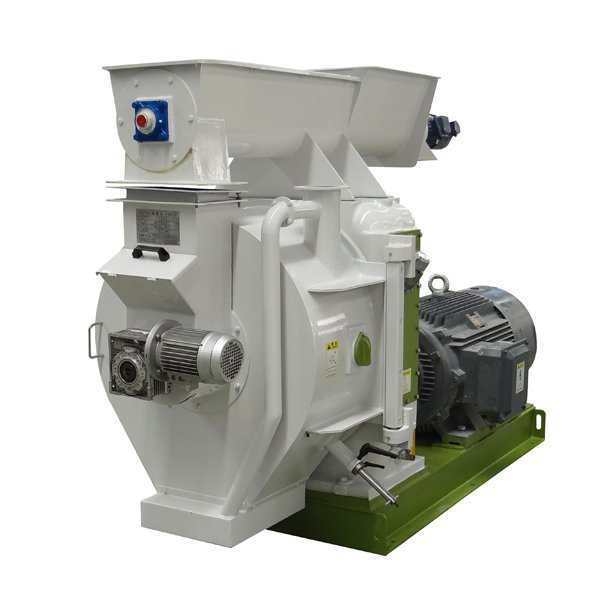
Our biomass pellet mill range is rated at 25–50 kWh/t for the complete system depending on material, with die diameters from 420 to 1,200 mm — wide enough that the mill and the die are selected together rather than a die being squeezed onto whatever mill is on the floor.
Die Metallurgy and Hole Finish: The Half of the Ratio Nobody Quotes
Two dies with identical geometry behave differently if the steel and the hole surface differ. Standard alloy steels such as 20MnCr5, carburized for a hard case, are the cost-effective choice for feed and moderate biomass duty; high-chromium stainless grades such as X46Cr13 hold a smoother hole wall and resist corrosion from acidic or resinous materials, which keeps friction — and therefore the effective ratio — stable over the die’s life. The inlet taper angle, the countersink geometry and the polish of the bore all shift where the material actually starts to compress. This is why we treat hole finish as a specification item, not a cosmetic one, and why our ring die category separates dies by material and hardness rather than by size alone.
For buyers comparing suppliers, the practical ask is simple: request the die drawing with effective length, taper and relief dimensions marked, plus steel grade and case hardness. If a quote gives you only “70 mm thick, 6 mm holes,” you are buying a number you cannot verify.
Managing a Die Library Instead of a Single Die
Plants that struggle with die decisions usually own one die. Plants that run well own several, and treat them as a small library: a high-ratio die for low-binding material or for contract periods demanding peak durability, a mid-ratio die for standard production, and a worn “run-out” die kept for low-spec or briquette-adjacent work. Log for each die the tons processed, hours run, and PDI at start, middle and end of life. After two or three die cycles you will have a material-specific map of how effective ratio changes with wear — data no supplier can give you, because it depends on your raw material and your operator habits.
Roller shells belong in the same log. Roller face wear changes the nip between roller and die, which changes how hard material is fed into the holes and how much backpressure actually develops. Replacing rollers and dies as matched sets, at least on abrasive materials, keeps the compression zone behaving the way the drawing says it should.
What to Send a Die Supplier So the Quote Is Right
A useful die enquiry fits in an email. Include: material and species (or feed formula), moisture band as actually produced, target standard and durability (for example ENplus A1 at 98.0%), mill model and main motor kW, current die drawing or the worn die’s hole measurements, throughput achieved with the current die, and the symptom that triggered the enquiry. Suppliers who receive this can usually name a ratio and steel grade on the first reply, and the trial that follows becomes a confirmation instead of an experiment.
Die Specification Checklist
Before you approve the next die purchase, run through this list:
- Effective hole length confirmed from the drawing, with taper and relief dimensions marked — not just total thickness.
- Compression ratio calculated and matched to the material’s starting band (Table 2), with the target standard named.
- Steel grade and case hardness specified (20MnCr5 carburized vs. X46Cr13 or equivalent for abrasive/corrosive duty).
- Hole diameter against your product spec: 6–8 mm for premium domestic/industrial wood pellets, 8–12 mm where the offtaker accepts larger diameter.
- Open area and hole count quoted, so predicted throughput is based on geometry, not optimism.
- Main motor load margin checked: the mill must carry the highest-ratio die in the library at full feed rate.
- Trial protocol agreed: three feed rates, PDI sampling every 30 minutes, moisture logged, one adjustment allowed before verdict.
- Tons-per-die and hours logged from the first shift, so wear-driven ratio drift is visible in the PDI trend.
- Roller shell condition inspected and replaced as a set with the die on abrasive materials.
- Second die (one ratio step down or up) ordered with the first, so a raw material change does not stop the plant.
Get the ratio right and the rest of the line behaves: the cooler sees stable pellets, the bagging scale sees fewer fines, and the customer sees durability that survives loading and transport. Get it wrong and no amount of downstream adjustment fixes it. When you are ready to match a die to a specific material, our engineering team can review your drawing, wear data and target spec before you commit — start from the ring die specification page or send the current die drawing with your mill details.