

Two buyers ask for a 10 t/h poultry feed mill. One quote comes back at a level the buyer expected; the other is 30 or 40 percent higher. Neither supplier is lying. The difference is almost always scope: what each quotation includes, what capacity actually means behind the number, and how much of the plant was quietly left out. This article dissects a 10 t/h feed mill investment line by line — the seven cost layers, where the equipment money concentrates, which scope items inflate the total after the fact, and how to normalize competing quotes so you compare plants instead of spreadsheets.
The market context explains why the question matters now. Global compound feed production reached an estimated 1.44 billion metric tons in 2025, up 2.9 percent, according to Alltech’s 2026 Agri-Food Outlook, based on data from 142 countries and 38,837 mills. Poultry remains the largest species segment, and most of that growth is happening exactly in the regions — Southeast Asia, Africa, the Middle East, Latin America — where investors are building 5 to 20 t/h mills for the first time. First-time buyers are the ones who pay the scope-discovery tax.
What “10 t/h” Means Before It Means Anything Financial
Every cost conversation downstream depends on how the capacity number is defined. A supplier quoting “10 t/h” may mean the pellet press alone at 90 percent availability on a corn-soy diet at 16 percent conditioning moisture. A buyer may mean 10 t/h of bagged finished feed leaving the warehouse across a shift that also includes changeovers, species switches and cleanup. Those are different plants.
Start with the arithmetic you should insist on in any quotation review:
Annual output = rated t/h × operating hours per day × operating days × utilization
Take a 10 t/h line running two 8-hour shifts, 300 days a year, at 80 percent utilization (changeovers, die changes, first-fill gaps, breakdowns):
10 × 16 × 300 × 0.8 = 38,400 t/year of finished feed.
Rated versus effective capacity is where the first disappointment lives. A press rated 10 t/h on broiler grower pellets will not hold that rate on a high-fiber dairy ration or a 2 mm pig starter. The die, the conditioner and the cooling capacity are all matched to one formulation band; if your product mix spans broiler, layer, pig and cattle feed, the effective rate across the mix is lower than the nameplate number, and the equipment sized for a single-recipe fantasy will disappoint across the real one.
| Variable | Unit / typical answer | What it changes |
|---|---|---|
| Point of measurement | Pellet press discharge vs finished-goods loadout | Cooler, screener, crumbler and packing capacity must match the higher number |
| Formulation band | Corn-soy broiler, high-fiber dairy, 2 mm pig starter | Die specification, conditioning, grinding fineness — and therefore motor sizes |
| Pelleted share | % of production pelleted vs mash | Mash-only lines skip press, cooler, crumbler — a large capital delta |
| Operating hours | 1 shift (8 h), 2 shifts (16 h), 24 h | Doubles annual output without new equipment — the cheapest capacity there is |
| Utilisation | 70–85% realistic for a multi-species mill | Receivables planning, silo sizing, working capital |
| Bagged vs bulk | % bagged at dispatch | Packing line speed, palletizing, warehouse floor area |
Two mills can both be labeled 10 t/h and differ by 50 percent in everything downstream of that label. When we price a project, the capacity definition is the first page of our proposal for a reason — every motor kW, every silo ton and every cooling-air m³/h traces back to it. The same logic applies to any supplier’s offer.
The Seven Layers of a Feed Mill Quote
A complete feed mill project splits into seven cost layers. The process equipment — the machines — is only the first. The other six are where “equipment-only” quotes hide their exclusions.

The shares below are indicative bands from our own 5–15 t/h project quotation files over the last two years. They are planning references, not a price list: your civil rates, your silo philosophy and your automation level will move them. But the structure of the split is remarkably stable, and it is the structure most “equipment-only” quotes silently assume you will pay for separately.
| Layer | What it covers | Typical share of project total | Commonly excluded from equipment quotes |
|---|---|---|---|
| 1. Process equipment | Intake cleaning, grinding, batching, mixing, conditioning and pelleting, cooling, screening, packing | 35–45% | Spare die and roller set, pre-cleaner for second intake, loadout |
| 2. Steel structure & platforms | Mill tower or mezzanines, platforms, ladders, guardrails, machine supports | 10–18% | Almost always excluded from machine-only offers |
| 3. Civil works & building | Foundations, pits, machine plinths, warehouse, offices, roads | 15–25% | Always local scope — highly site-dependent |
| 4. Electrical & automation | MCC panels, VFDs, cabling, batching controller, PLC/HMI, interlocks | 8–14% | Field cabling on site; remote support setup |
| 5. Utilities | Steam boiler and conditioning steam line, compressors, dust collection, water treatment | 5–10% | Boiler fuel storage; sometimes the entire boiler |
| 6. Silos, conveying & intake | Raw-material silos, buckets, conveyors, weighbridge, finished-goods handling | 10–18% | Frequently quoted separately by a different supplier |
| 7. Services | Installation, commissioning, training, spares package, freight, contingency | 8–15% | Installation crews, customs duties, site temporary works |
Add the layers and the pattern is clear: process equipment is under half of a complete project. A buyer who compares two equipment-only prices and books the cheaper one has compared roughly 40 percent of the real project. Everything else still has to be bought from somebody — the only question is whether it was designed by the same people who designed the machines.
Where the Equipment Money Concentrates
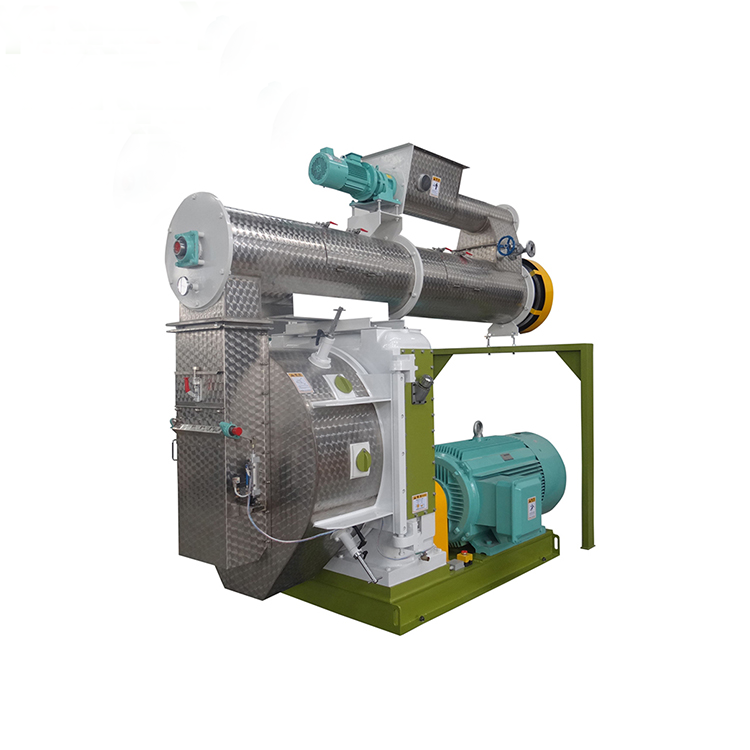
Inside layer 1, the pelleting section dominates. Industrial pellet press main motors run from roughly 90 to 400 kW, with die diameters from about 420 to 1,000 mm and L/D ratios between 1:6 and 1:12 on our own poultry and livestock feed pellet mill series; the conditioner alone adds 7.5 to 37 kW and a steam system sized for 3–8 percent steam addition at 2–6 bar. That section is mechanically simple compared to an extruder, but it concentrates the largest motors in the plant, the only pressure vessel upstream (the boiler), and the main consumable — die and roller shells.
Grinding is the second concentration. Our YHM68 series hammer mill covers 5–15 t/h at 9–14 kWh per ton depending on screen size and material. Since grinding and pelleting are the two biggest electrical consumers in any pelleting mill, the motor sizes you buy here also fix your transformer, your demand charges and your energy bill for the next fifteen years.
The energy frame is worth quantifying because it converts equipment choices into running money. Industry surveys put electrical consumption for a modern mash-and-pellet feed mill in the range of roughly 10 to 50 kWh per ton, with thermal energy for conditioning steam adding around 20 to 30 kWh per ton, and the pelleting line taking 60–70 percent of the electricity (Feed Planet Magazine, “Energy efficiency in the feed sector”). For a 38,400 t/year mill at a mid-range 30 kWh/t:
38,400 × 30 = 1,152,000 kWh/year of electricity — call it 1.15 GWh. At an assumed tariff of $0.10/kWh that is about $115,000 a year, every year, for as long as the plant runs. The tariff is your input, not ours; the kWh figure is what the equipment choice fixes. When a supplier quotes a press with a smaller main motor than its competitor, ask what specific energy (kWh/t) it achieves at your formulation — the answer can be worth more than the price difference.
Batching and mixing sit between them. A twin-shaft mixer gives short mix times and high uniformity at large batch sizes, which is why it appears in most 10 t/h layouts; our twin-shaft mixer page covers the configuration range. What inflates this section is usually not the mixer itself but everything attached to it: micro-dosing hoppers, premix addition, liquid dosing with metering accuracy, and the number of bins above it. Each added bin is steel, a feeder, a sensor and an extra control loop.
Six Scope Items That Quietly Add Cost After the Quote
These are the items most often discovered after contract signature, and each one is avoidable if you ask about it in writing before comparing prices.
1. The silo park. Equipment quotes cover the machines; they rarely cover storage. Silo volume is a risk decision: a mill next to reliable domestic grain supply can run on 7–15 days of cover; an import-dependent mill needs 30–60 days because vessel scheduling sets the exposure. At 10 t/h × 16 h × 300 days, monthly raw-material consumption is roughly 3,500–4,000 t — so the difference between 15 and 45 days of cover is thousands of tons of steel storage. Whatever your cover decision, get it into the same scope comparison as the machines.
2. Steam. Conditioning needs 3–8 percent dry saturated steam at 2–6 bar. A 10 t/h press at 5 percent steam addition needs roughly 500 kg of steam per hour continuously — a real boiler, fuel storage, water treatment and a condensate return, none of which are pellet mill accessories. If the boiler is missing from a quote, pelleting quality targets are missing from it too, because conditioning temperature is the strongest lever on pellet durability in most diets.
3. Automation level. Manual batching with operator-read scales, semi-automatic recipes, or a fully automatic micro-weighing system with PLC recipe management: the machines can be identical, but the price of the control layer varies enormously, and so does the labor cost of running the mill. Decide the automation level per function — batching, pelleting, loadout — rather than buying “automatic” as a single word.
4. Dust explosion and fire protection. Grain dust is combustible, and mills in North America are regulated accordingly: OSHA’s grain handling standard (29 CFR 1910.272) sets housekeeping, hot work and dust accumulation requirements that influence how the plant is built — bucket elevator construction and location, dust collector placement, explosion venting. A quote with no dust collection engineering, no venting philosophy and no housekeeping provisions is deferring a compliance cost, not avoiding one. We size and specify pulse jet dust collection as part of the plant design for exactly this reason.
5. Steel tower versus concrete. The mill tower itself can be welded steel (faster, container-shippable, priced by tonnage) or site-built concrete (local labor, slower, different risk profile). Steel tonnage is the single biggest swing item inside layer 2, and “structure excluded” is the most common reason two equipment quotes differ by a third.
6. Product flexibility. A crumbler, a post-pelleting liquid coater, a second packing line or a mash bypass conveyance — each adds flexibility that shows up in the first year of real orders, not in the capacity table. Buyers regret its absence more often than its cost.
How Site Conditions Move the Number
The same equipment list priced for two different sites is two different projects. The variables that consistently move the total:
- Power supply. A plant whose largest motor is 400 kW needs a transformer and switchgear sized for its starting strategy. Weak-grid sites push buyers toward VFDs or soft starters across more drives — layer 4 grows.
- Climate. Cooling capacity is matched to the hottest ambient you will run in. High-humidity coastal sites need more cooler air and more dryer margin on stored raw material; tropical sites stress the electrical room too.
- Seismic and wind loads. Tall steel structures and silos must be designed to local codes; a coastal cyclone zone changes the steel tonnage in layer 2.
- Distance from port. Container freight, inland haulage and the practicality of shipping max-dimension items (large dies, silo panels, long conveyors) all scale with distance and road quality.
- Labor. Installation needs local crews supervised by commissioning engineers. Where skilled riggers and welders are scarce, installation duration and supervision cost rise — layer 7 grows.
None of these are equipment problems; all of them are money. This is why serious suppliers ask for a site questionnaire before pricing, and why the absence of one is itself a signal about the quote you are reading.
Normalize Quotes Before You Compare Them
The tool that turns three incomparable offers into one decision is a scope normalization sheet. Put the same line items down the left side, force every supplier to answer in the same units, and mark anything unanswered as “excluded — buyer to provide” with your own local estimate beside it. Only then are the totals comparable.
| Line item | Ask for it in | The question that exposes scope gaps |
|---|---|---|
| Capacity | t/h at stated formulation, moisture and point of measurement | “10 t/h of what, measured where, on which recipe?” |
| Installed power | Total connected kW + largest motor kW | “What transformer size does the plant assume?” |
| Specific energy | kWh/t for grinding and pelleting separately | “What kWh/t did you guarantee on a similar diet?” |
| Structure | Steel tons and platform m², or “excluded” | “Who designs and supplies the tower?” |
| Storage | Silo tonnage and days of cover assumed | “How many days of raw material does this plant hold?” |
| Steam | Boiler capacity (kg/h at stated pressure), included or not | “Is conditioning steam inside this price?” |
| Installation & commissioning | Days on site, crew nationality, who does civils handover | “To what definition is the plant ‘accepted’?” |
| Consumables | Die + roller set price, expected tons per set | “What does a die change cost per ton of feed?” |
| Delivery basis | Incoterm 2020, container count, lead time | “What exactly crosses the ship’s rail?” |
The consumables line deserves emphasis. Die and roller shells are recurring costs for as long as the mill operates, and their price and service life are part of the equipment decision. A press whose dies cost less per ton but last fewer tons is a different machine from the one whose consumables page implies. Ask for die price and expected tons per set on your formulation, and treat the answer as a competitive criterion, not a footnote. Buyers who want a worked example of operating-cost modeling on the biomass side can look at our 5 t/h poultry feed mill setup walkthrough, which applies the same capacity-balance thinking at a smaller scale.
The Cost of Money: Payment Terms, Lead Time and Spares
The layer nobody prices explicitly is financing. A feed mill project is usually paid against milestones — a deposit with the order, progress payments against fabrication photos, a balance against bill of lading or installation completion. The payment schedule changes the real cost of the project even when the headline price does not move: a higher deposit on a longer fabrication cycle ties up more capital per month of lead time, and a buyer financing the project with a loan pays interest during construction on every milestone payment, not just on the final one.
Lead time deserves the same treatment. Fabrication plus shipping plus installation typically spans several months from order to first bag; every month of that period the buyer is paying civil crews, idle storage assets and interest without revenue. This is one more reason the seven layers should come from one supplier: when the tower, the machines and the electrical scope are engineered together, container planning, foundation drawings and installation sequencing fit, and the schedule shortens. Split-scope projects pay twice — once for the interface gaps themselves and once for the months they add.
Spares belong in the same financial frame. A first-year spares package (die, roller shells, screens, belts, bearings, contactors, heater elements) looks like an optional line until the first die change is due and sea freight from the factory is the only path to a replacement. Price it, size it against the consumables schedule, and store it — the cost is trivial next to one month of stoppage on a mill with 38,400 tons of committed feed contracts.
Where “Cheap” Costs More
Cutting capital in predictable places converts into operating losses with unremarkable reliability:
- Undersized drives. A press motor sized exactly to the nameplate capacity on one formulation has no margin for the harder ration you will run in year two. Specific energy rises as dies wear; a drive sized without that headroom throttles the whole plant.
- Thin casings and light rotors. Hammer mill casings and rotor shafts are cheap to lighten and expensive to fail. A cracked rotor weld is a stoppage measured in weeks of parts lead time, not hours.
- Skipped aspiration. A hammer mill without proper air assist loses screen-clearing capacity and runs hotter — the aspiration retrofit that “wasn’t in the budget” eventually gets bought anyway, at worse prices.
- One conditioner stage instead of two. Retention time is the cheap capital in pellet quality. A second conditioner costs a fraction of a press upgrade and buys the retention that high-fiber diets need; its absence shows up as PDI complaints instead.
Conditioning temperature and time are worth one more sentence, because they are the clearest case of quality bought with properly-scoped capital: extension work at Kansas State University documents that raising conditioning temperature from 74 to 85 °C improved pellet durability linearly in corn-soy diets without an energy penalty, and that die L/D shifts move Holmen PDI by several points (KSU, Evaluating Pellet Quality). A quotation that prices the steam system and conditioner correctly is quoting a different plant than one that does not — the difference hides until the first bagging line of fines.
Key Takeaways
- Define “10 t/h” in writing first: point of measurement, formulation, pelleted share, shifts and utilization. Every other number in the project is downstream of that definition.
- Process equipment is roughly 35–45% of a complete project. Compare seven layers, not one price: equipment, steel, civils, electrical, utilities, silos/intake, and services.
- The pelleting and grinding sections fix both your capital and your energy profile — 10–50 kWh/t electrical plus 20–30 kWh/t thermal is the planning frame; ask for kWh/t guarantees, not motor kW alone.
- Silo park, steam, automation level, dust explosion compliance, tower steel and product flexibility are the six scope items most often discovered after signature. Force them into the quote.
- Normalize offers on a worksheet: same capacity definition, same Incoterm, same consumables line, same acceptance definition. Then the cheaper quote wins for real reasons.
If you are budgeting a feed mill project now, send us your capacity definition and site basics — we will return a scoped quotation structured exactly along these seven layers, so what you compare is what you will build. Our feed pellet machine range and line engineering are the starting point.