
Belt conveyors and chain conveyors both promise the same thing: material moves from point A to point B at a fixed cost per ton. The two machines achieve it in completely different ways, and the differences matter most exactly where projects get into trouble — steep inclines, abrasive or hot material, dust containment, and the maintenance budget three years in. This comparison walks through the mechanics, the numbers, and the material properties that decide which machine fits your route, with a selection matrix for the materials feed and pellet plants actually handle.
Two Different Ways to Move Material
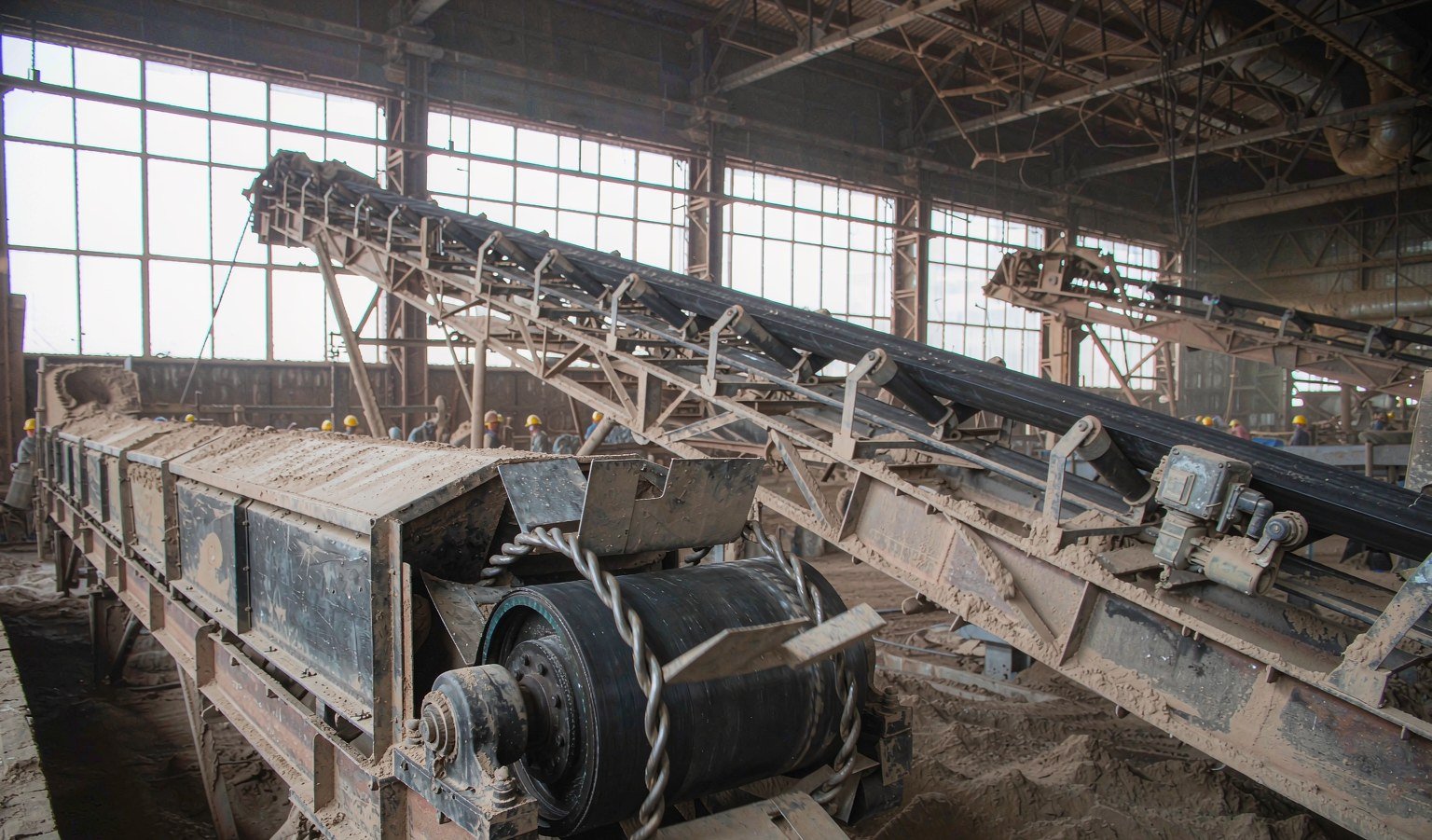
A belt conveyor carries material on its top surface. An electric drive pulley turns a continuous fabric or steel-cord belt, idlers support and trough it, and material rides along by friction. The belt does not push anything — it is a moving floor. Because the moving parts (idlers, pulleys) carry only the belt itself plus a rolling load, friction losses are low, which is why belts scale well: our own belt conveyor series covers 100 to 20,000 t/h at belt speeds of 1.0 to 5.0 m/s, with standard widths from 300 to 3,000 mm.
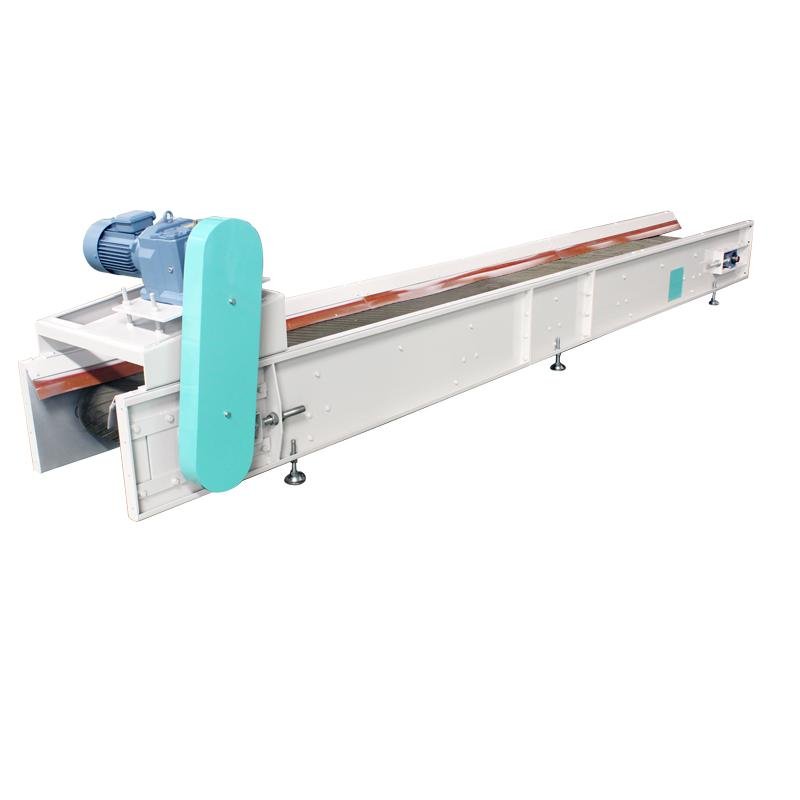
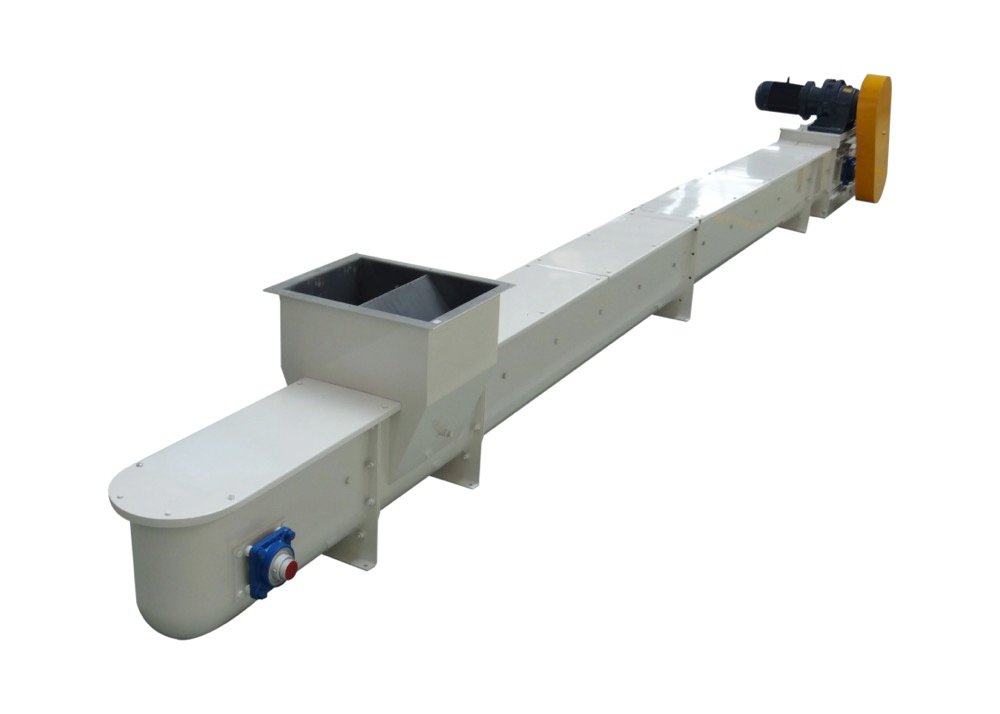
A chain conveyor moves material by dragging it. One or more endless chains with flights run through a steel trough; the flights push material along the trough floor. In the en-masse (drag) variant, the material fills the trough and the whole column moves slowly — the friction of the material against itself and the trough walls does the conveying. Chain speeds are much slower than belt speeds, typically 0.2 to 0.5 m/s, and the whole mechanism runs inside a sealed steel casing.
That structural difference drives nearly every practical distinction below: the belt is open and fast, the chain is enclosed and slow; the belt is gentle, the chain scrapes; the belt is cheap per meter, the chain is heavy per meter. Neither is “better” — each one wins a different set of routes.
Capacity, Speed and Power
Belt capacity follows the classic volumetric relationship:
Q (t/h) = 3,600 × A (m²) × v (m/s) × ρ (t/m³)
where A is the cross-section of the troughed load. Because a belt can run at 2–3 m/s over a troughed section 0.1–0.2 m² in area, a modest belt moves serious tonnage: a 1,000 mm belt at 2.0 m/s carrying grain at 0.75 t/m³ and a 0.1 m² effective section delivers around 540 t/h. Chain conveyors compensate for slow speed with a full trough: an en-masse unit can run from horizontal up to a 90° vertical leg in one machine at rates up to 1,000 t/h with a single chain, as documented for industrial en-masse drag conveyors (Powder & Bulk Solids).
Power is where the machines separate economically. A belt’s rolling idler friction is low, so its power per ton is the lowest of any mechanical conveyor — that is why long overland routes are always belts. An en-masse chain drags the entire material column along a trough, and the internal friction grows with every added meter and every degree of incline; field comparisons put chain power draw roughly 15–30% above an equivalent belt on the same duty (Manxing Group, chain vs belt selection guide). On a short transfer that difference is a rounding error. On a 100-meter route running 16 hours a day, it is a permanent line item on the power bill, which is why the length threshold is the first question to settle.
| Dimension | Troughed belt conveyor | Chain / en-masse conveyor |
|---|---|---|
| Typical capacity | 100–20,000 t/h (width + speed dependent) | 10–1,000 t/h (trough cross-section dependent) |
| Operating speed | 1.0–5.0 m/s | 0.2–0.5 m/s |
| Maximum incline (grain/pellets) | ~15–20° plain; higher with cleated belts | Horizontal to 90° vertical in one unit |
| Practical route length | 5 m to 15,000+ m | Best under ~80 m; long routes pay heavily in friction |
| Dust containment | Open; needs covers, skirting and transfer-point extraction | Enclosed steel casing by design |
| Material temperature | Rubber limits roughly 80 °C standard covers; hot covers cost extra | Steel trough and chain tolerate several hundred °C |
| Material handling | Gentle — best for fragile pellets and grain | Scraping action; some abrasion of friable material |
| Power per ton | Lowest of any mechanical conveyor | Roughly 15–30% higher on equivalent duty |
| Maintenance profile | Idlers and tracking; belt replacement every few years | Chain wear and stretch, flight and liner wear; predictable, gradual |
| Failure mode | Sudden (rip, mistracking spillage) | Gradual (wear), usually announces itself |
The Material Decides First
Route geometry comes second; material properties come first. The properties that flip the decision:
- Abrasive material (sand-carrying grain, mineral premix, chip-screen fines) chews through belts’ covers, idlers and skirting. An enclosed chain with abrasion-resistant trough liners isolates the wear into replaceable liners and chain — more predictable, less mess.
- Hot material — anything above roughly 80 °C — rules out standard rubber belts. Pellet-line material leaving a poorly cooled press, or biomass straight off a dryer upset, belongs on steel.
- Sticky or oily material (wet distillers grains, canola meal, damp sawdust) builds up on belt return idlers and scraper systems. Enclosed chain troughs with UHMW liners handle it better.
- Fragile material — finished feed pellets above all — is the belt’s domain. Pellets dropped and dragged through a chain trough pick up fines; since pellet fines are exactly what buyers penalize, post-cooler pellet transport should stay on belts where the route allows.
- Steep or vertical lifts with limited floor space: an en-masse conveyor climbs 90° in one machine; a belt needs a long inclined run or a separate bucket elevator.
| Route | Recommended | Why |
|---|---|---|
| Raw grain intake → silo (long, gentle, high tonnage) | Belt | Lowest power per ton; gentle on grain; long runs |
| Silo → grinding (horizontal, short) | Chain / en-masse | Enclosed, self-feeding, metered discharge into mill |
| Pellet press → cooler | Belt (warm, fragile) | Gentle handling minimizes fines before the cooler |
| Hot or damp biomass from dryer | Chain | Temperature tolerance and sealed handling of damp fines |
| Sawdust → boiler hopper (dusty indoor route) | Chain | Enclosed casing contains dust without extraction |
| Finished pellets → loadout (long horizontal) | Belt | Fragile product; low power; covered with dust extraction at transfers |
| Vertical lift, small footprint | Chain (or bucket elevator) | 90° capability in one machine; see our bucket elevator sizing guide for the vertical case |
Dust, Explosion Safety and Guarding
In a feed or pellet plant, conveyor choice is also a dust decision. Grain and feed dust are combustible, and facilities are expected to manage the hazard through a documented dust hazard analysis under NFPA 652 (NFPA 652). Enclosed chain conveyors contain dust at every meter by construction; belts contain it nowhere except where you add covers, skirting, seals and extraction — all of which cost money and need maintenance. This is one reason chain conveyors dominate short indoor routes where fines are airborne.
The trade is not free, though. An enclosed conveyor full of combustible dust needs its own attention: casing strength and venting philosophy on sections that could propagate an explosion, and housekeeping standards that assume dust stays inside the machine until it does not. On the mechanical-safety side, both machine types must be guarded to the applicable power-transmission requirements — OSHA’s 29 CFR 1910.219 is the reference most North American inspectors reach for — with guarded drive couplings, chains and sprockets, and lockable isolation on both belt and chain drives.
Failure Modes and What They Cost You
Belt conveyors fail suddenly. The classic sequence is mistracking → edge wear → splice failure or rip, and a torn belt on a main intake line stops the plant until a replacement is spliced or shipped. The preventive toolkit is mature and inexpensive: training idlers, alignment switches, belt condition checks at transfer points, and keeping one spare splice kit per belt type on the shelf.
Chain conveyors fail gradually. Chain stretch, flight wear and trough liner thinning progress over months and announce themselves through rising amps and slower throughput. That predictability is a genuine operational asset — a weekly tension check and a chain-length measurement against the wear limit turn failure into a planned maintenance window. The cost is continuous attention: lubrication, tensioning, and sprocket alignment discipline that a belt does not demand.
For either machine, the take-up system is where most neglect concentrates. Undersized or seized take-ups cause a large share of both mistracking and chain jump — sizing and access for the take-up is worth more engineering attention than it usually gets, whichever machine you buy.
A Short Decision Rule
When both machines can do the route, the tiebreakers in practice are: length over 80 m and fragile material → belt; dust containment, heat, abrasion, or a vertical leg → chain; everything else → whichever matches your maintenance culture. Buyers planning a full line can see how the machines sit together in context on our conveyor category, and we size mixed belt-chain-elevator routes as part of the plant design.
FAQ
Can a belt conveyor handle inclines at all?
Yes, within limits. Plain troughed belts handle roughly 15–20° with grain and pellets before rollback becomes the governing issue; cleated or high-friction belts push higher, at the cost of cleaning difficulty and product carry-back. Beyond about 30°, you are designing a different machine or switching technology.
Is the en-masse conveyor gentle enough for finished pellets?
It is used that way, but it is not the first choice. The scraping action generates some fines on friable products, and fines are the quality metric your customer sees. Our rule of thumb: keep finished pellets on belts wherever the layout permits, and reserve chain conveyors for raw material and dusty intermediates.
How much more power does a chain conveyor really use?
On the same duty, roughly 15–30% more, scaling with length and incline. On short indoor transfers the absolute difference is a few kilowatts; the number only becomes a decision factor on long horizontal runs.
Which one is cheaper to buy?
Per meter of route, the belt is usually cheaper for open runs; the chain conveyor’s casing costs more per meter but includes the containment that a belt must buy separately as covers, skirting and extraction. Compare installed and dust-managed costs, not conveyor costs alone.
Do enclosed conveyors increase explosion risk?
They concentrate dust, which is why venting philosophy, casing design and the NFPA 652 dust hazard analysis matter. Managed properly, an enclosed conveyor is part of the dust-control solution; ignored, any conveyor carrying combustible dust is part of the problem.