
Most feed mill projects treat feed safety the way they treat spare parts: as something to buy at the end, after the equipment is chosen. The result is a plant where the HACCP binder describes controls the hardware cannot actually deliver — a conditioner that cannot hold temperature through a cold start, a magnet installed where the flow splits three ways, a cooler that pulls dusty air across freshly pasteurized pellets, no place to flush a medicated batch.
This guide is written for the people who sign the purchase order rather than the ones who write the plan: investors building a mill for institutional, integrated or export customers, and engineers who have to hand over a plant that will pass a customer audit. It follows the same order an auditor does — regulation, prerequisites, hazard analysis, critical limits, then the steel — and it points out where a design decision at quotation stage is cheaper than a retrofit two years later.
The Regulatory Map You Are Actually Building Against
Four regimes cover most of the world’s compound feed trade, and they are more similar than the paperwork suggests. All of them want a hazard analysis, written controls, monitoring records, corrective actions, verification and a recall path. The differences are in who enforces them and how much documentation they expect.
In the United States, animal food falls under 21 CFR Part 507. Subpart B sets current good manufacturing practice: buildings and grounds, pest control, sanitary operations, water supply, equipment maintenance, and personnel training. Subpart C requires a written food safety plan built on a hazard analysis, with process controls, sanitation controls, supply-chain controls and a recall plan where the analysis shows they are needed. The regulation does not use the phrase HACCP for animal food, but the logic is the same one, and the FDA’s preventive-controls framework is explicit that controls may sit at critical control points or at steps that are not CCPs at all — see 21 CFR Part 507 Subpart C and the CGMP requirements in Subpart B.
In the European Union, Regulation (EC) No 183/2005 requires feed business operators to operate a HACCP-based system, and the Commission’s feed hygiene rules put the obligation on the operator rather than on a prescribed checklist. That matters for equipment specification: the operator has to be able to demonstrate control, which means instruments, records and physical access to clean.
Internationally, the Codex Alimentarius Code of Practice on Good Animal Feeding (CXC 54-2004) is the reference document most national standards are built from, and the FAO/WHO HACCP manual sets out the familiar seven principles and twelve implementation steps — the FAO manual is still the clearest short description of how a hazard analysis is supposed to be argued.
On top of the law sit the private schemes that buyers actually audit against: GMP+ Feed Safety Assurance for the feed chain, FAMI-QS for specialty feed ingredients, and the ISO 22000 family for mills that also supply food-adjacent customers. A mill built for export to the EU or for supply to an integrated poultry or shrimp producer will usually need one of these within two years of start-up.
| Regime | What it requires | What it forces on the equipment list |
|---|---|---|
| US 21 CFR 507 (CGMP + preventive controls) | Written food safety plan, hazard analysis, process/sanitation/supply-chain controls, monitoring records, recall plan | Calibrated temperature and weight instruments, reject or divert capability, cleanable surfaces, documented sanitation access |
| EU Regulation (EC) 183/2005 | HACCP-based system operated by the feed business, documented and verifiable | Traceable batch records, segregation of medicated and non-medicated production, pest-proof construction |
| Codex CXC 54-2004 | Good animal feeding practice from primary production to finished feed | Ingredient intake control, storage protection, contamination prevention along the flow |
| GMP+ FSA / FAMI-QS / ISO 22000 | Third-party audited scheme, usually with additional monitoring and supplier approval requirements | Sampling points, metal detection, documented cleaning validation, spare screens and magnets |
Start With Prerequisites, Because HACCP Cannot Fix a Dirty Building
Auditors spend most of a first visit on prerequisites, not on the plan’s CCP table. If the building lets water in, if the receiving pit shares air with the bagging line, if there is no place to wash a boot, no amount of critical-limit documentation will carry the audit.
The single most consequential prerequisite is hygiene zoning. Draw the plant as two territories: everything up to and including mixing is dirty, everything from the conditioner outlet to the finished bag is clean. Material goes one way. People, tools, pallets, forklifts and air should not go back. In practice this means separate entrances for intake and load-out, a changing or boot-wash point at the boundary, and a physical wall rather than a painted line on the floor. A 5 t/h poultry line in Southeast Asia that supplies an integrated farm will usually be asked to show this during the customer’s second-party audit, and retrofitting a wall into an existing tower is far more expensive than drawing it in the layout.
Dust is the second prerequisite, and it is usually underestimated because it looks like a housekeeping issue rather than a safety one. Dust from the receiving pit carries the same organisms as the incoming grain, and a dust layer on a warm surface is a growth site. Two design points follow. First, receiving and grinding get their own collection system, separate from the pelleting and bagging areas, so the air from the dirty end never returns to the clean end. Second, the cooler air intake has to be taken from a clean, filtered source — roof level with filtration, not from the pit area or from under the eaves where dust settles.
Steam quality belongs in the same list. Saturated, dry steam at the conditioner is a process control; wet steam is a moisture variable you cannot measure and a corrosion source inside the die chamber. Boiler treatment chemicals, carryover and condensate drainage are part of the feed safety file because they end up in the meal.
Then the unglamorous items: smooth, cleanable surfaces without ledges; no exposed timber; rodent-proof doors with kick plates; insect screens on openings; drains that slope away from production areas; lighting bright enough to see residue; and compressed air that is dry and oil-free if it touches product lines. None of these appear in a quotation unless somebody writes them in.
Hazard Analysis, Step by Step Through the Line
The method is the Codex one: draw the process flow, list the hazards at each step, decide which are reasonably likely to occur and would cause illness or injury if not controlled, then decide whether a control at that step is necessary. What follows is how that analysis usually lands in a compound feed mill — not as a template to copy, but as a map of where the real controls sit.
| Process step | Main hazards | Control type | Equipment that carries it |
|---|---|---|---|
| Ingredient receiving | Salmonella and mould in grain, mycotoxins, foreign matter, wrong load | Supply-chain control + sanitation | Intake pit design, pre-cleaner, sampling probe, truck log |
| Silo and ingredient storage | Condensation, hot spots, insects, rodent access | Sanitation / other control | Aeration, silo temperature monitoring, sealed discharge, pest proofing |
| Grinding | Metal, stones, screen failure, heat damage to nutrients | Process control (screen integrity) | Hammer mill with intact screen, magnet upstream, screen inspection log |
| Batching and micro-dosing | Wrong ingredient or weight, drug carryover, premix segregation | Process control | Calibrated scales, sequenced hoppers, dedicated micro-bin |
| Mixing | Incomplete dispersion, residue from previous batch | Process control + sanitation | Mixer with verified CV and clean-out access, flush procedure |
| Conditioning | Pathogen survival (Salmonella), under-processed meal | Process control — usually the primary CCP | Conditioner with retention and temperature probe, steam control valve, divert valve |
| Pelleting | Friction heat, die blockage, lubricant contamination | Process control (supporting) | Ring die press, food-grade lubricant, die inspection |
| Cooling | Recontamination from dusty air, condensation, mould at high moisture | Process control + sanitation | Counterflow cooler with filtered intake, temperature and moisture checks |
| Sieving and crumbling | Metal, oversize, cross-batch mixing | Process control | Screener with magnetic separator, dedicated crumbler rolls |
| Bagging and load-out | Metal, wrong weight, bag contamination, bulk truck residue | Process control + sanitation | Metal detector, checkweigher, enclosed load-out spout, truck cleaning record |
Where the Critical Limits Actually Sit
A first draft plan often carries nine or ten CCPs. A plan that survives a professional audit usually carries one to three, because most steps are better controlled by prerequisites than by a critical limit somebody has to monitor every hour. The difference matters commercially: every CCP you keep adds instrumentation, records and a deviation procedure.
Conditioning is the CCP that matters
Steam conditioning is the main biological kill step in a pelleted feed line. In our own conditioning work and in the retention data we specify with customers, the working window is 80–85 °C at the conditioner outlet with a retention time in the range of 30–90 seconds, depending on formula and on how much the customer’s validation supports. Below that window the reduction in vegetative pathogens is not defensible; far above it you start paying in lysine and vitamin loss, and in sticky meal that blinds the die.
The critical limit is not a number on a sheet, it is a loop: probe position, response time, steam valve authority, and what happens when the temperature falls. A conditioner whose temperature probe sits in a dead pocket, or whose divert valve is manual, cannot hold a critical limit through a cold start. Retrofitting a divert valve and an automatic reject to a running line means a shutdown, a controls change and a re-validation — worth specifying at the quotation stage.
Metal and foreign matter
Physical hazards are controlled by three things working in series: screens that stay intact, magnets that get cleaned on a schedule, and a metal detector at the last point before the bag. The detector is only a control if the reject is verified — the standard audit finding is a detector that alarms correctly but whose reject flap has been wired open since commissioning. Test pieces should be run at the stated frequency and the result recorded, including the confirmation that the rejected bag actually left the line.
Mycotoxins and the supply-chain control
Aflatoxin and other mycotoxins are rarely controlled at a single point in the mill; they are controlled by supplier approval, intake testing, segregation and, in some markets, by binding agents in the formula. That is a supply-chain control rather than a process control, and it belongs in the plan as one. The FAO manual on HACCP and mycotoxins is useful here because it walks through the decision of whether a step is a CCP or a control point that depends on prerequisite programs.
Moisture and water activity
Finished feed moisture is usually treated as a quality parameter, but it is also a safety one: pellets bagged warm and wet mold in storage, and mold is how mycotoxins get made after the mill has done everything else right. Cooler performance, steam quality and bagging temperature are therefore safety-relevant, not just commercial.
| Control | Typical critical limit | Monitoring | Deviation action |
|---|---|---|---|
| Conditioner outlet temperature | 80–85 °C, value fixed by validation | Pt100 in the meal stream, continuous trend, alarm | Divert to rework; re-pellet the affected batch; record and investigate |
| Conditioning retention time | 30–90 s, matched to temperature | Fill level / variable-speed drive setting; periodic verification by tracer | Adjust retention before restart; re-validate after any change |
| Metal detection at bagging | All test pieces rejected | Fe / non-Fe / stainless test pieces at stated frequency | Stop line, re-test, re-screen product since last good check |
| Magnet condition | Clean, undamaged, in place | Inspection and cleaning each shift, recorded | Replace element; inspect product since last check |
| Finished feed moisture | Set per formula and climate; consistent with stable storage | Cooler discharge sample, moisture meter, bagging temperature | Hold batch, re-test after cooling, downgrade if out of spec |
The Hardware That Carries the Plan
Reading a quotation against a food safety plan is a quick way to see whether the plant will pass an audit. Four areas decide most of it.
Magnetic separation. One magnet before the hammer mill protects the mill; it does nothing for the feed. Product protection needs magnets on the meal line after grinding, before the mixer and after the mixer, plus a final unit ahead of the bagging scale. Tubular and plate magnets in a drawer frame are the practical choice because they can be pulled and cleaned without opening the spouting. A tubular magnet bank installed in a vertical spout costs little at build stage and is awkward to add later.

Screen integrity. The hammer mill screen is a physical-hazard control as much as a particle-size control. Torn screens pass tramp metal and coarse material into the mixer. Inspection frequency should be written into the plan and the screen should be quick to change, which is a question about the mill’s door and screen frame, not about its motor.
Mixer residue and sequencing. Cross-contamination between medicated and non-medicated batches is the classic feed safety failure. The equipment answers are a mixer that empties cleanly, a defined flush material, a production sequence that runs medicated batches last, and — where the product mix demands it — a wet-cleanable design. A twin-shaft mixer with full-length discharge doors is easier to validate for residue than a ribbon unit with a small bottom outlet, and the difference shows up in the flush quantity you have to declare.
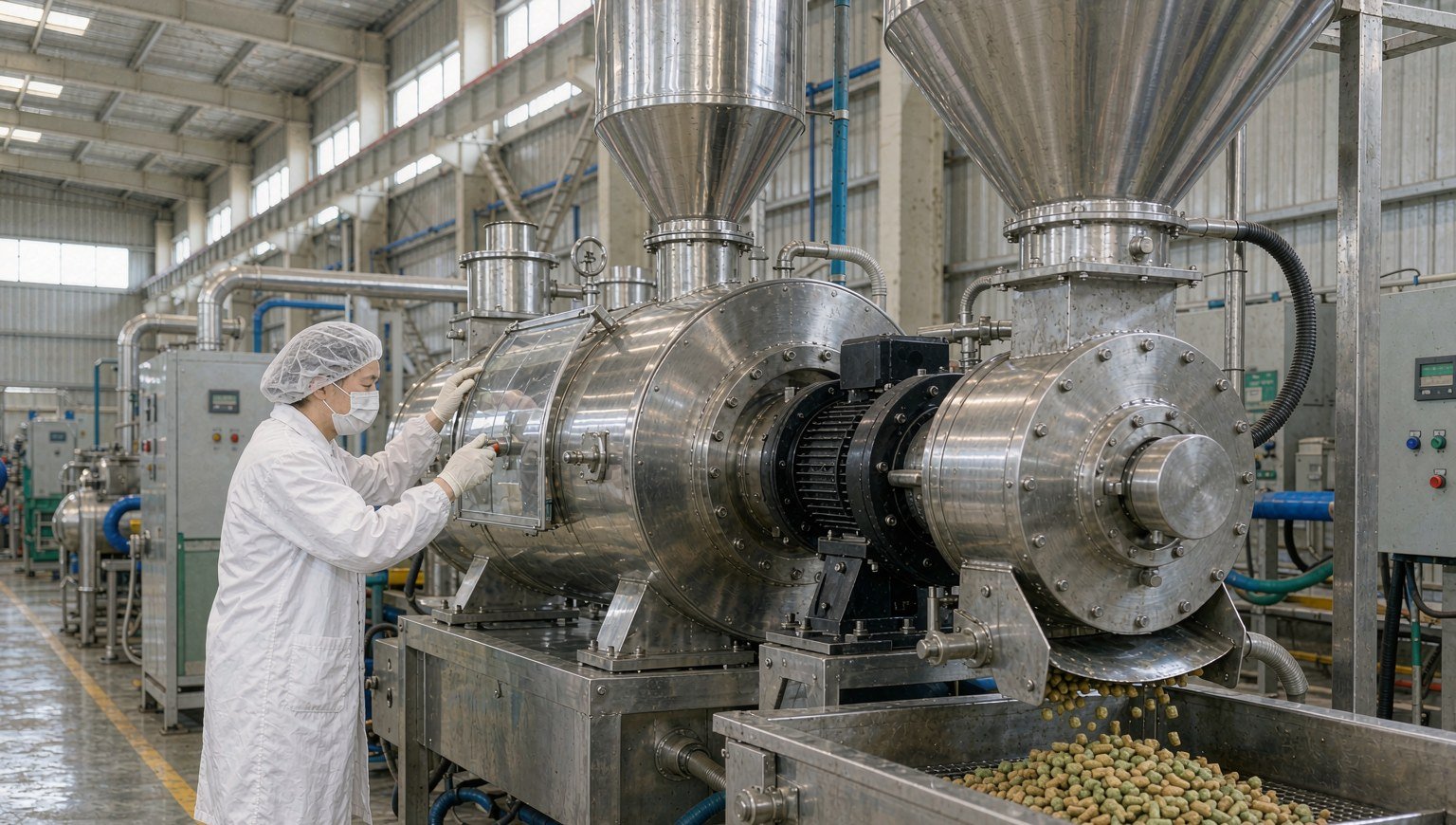
Conditioner and cooler. The conditioner needs retention, jacket or direct steam injection, and a temperature element in the moving meal. The cooler needs an air intake you can filter and a discharge temperature you can trend, because a cooler that pulls raw-area air across warm pellets is a recontamination device with a stainless cover. Our pellet mill with conditioner is specified with the retention and probe arrangement agreed at order stage for exactly this reason, and the counterflow cooler is normally ducted to a filtered roof intake rather than to the building’s general air.
Instrumentation and Records: the Part Buyers Under-Spec
Every control in the table above becomes a record, and records come from instruments. The instruments that decide whether the file is credible are unglamorous: a calibrated Pt100 with a known response time, a chart or PLC historian that cannot be edited by the shift, a reject confirmation sensor on the metal detector, calibrated weights on the batching scale, and a moisture meter that is checked against a reference method rather than against itself.
Two specification details are worth arguing about at order stage. First, alarm and trip logic: the conditioner should alarm on low temperature and, where the customer’s plan requires it, trip the pellet mill or open a divert path automatically, not rely on an operator noticing a screen. Second, data retention: the historian should keep the trend long enough to cover the plant’s record-retention period without manual export, because reconstructing a month of production from paper charts is the fastest way to fail a traceability exercise.
Records also need a home. A simple document structure — policy, prerequisites, hazard analysis, CCP monitoring, corrective actions, verification, supplier approval, training, recall — is enough. The audit failure is rarely a missing chapter; it is a chapter that describes a practice nobody follows, such as cleaning a magnet weekly when the plan says each shift.
Verification: How You Prove the Plan Is Working
Verification is where a plan earns its credibility, and it is usually under-budgeted. The activities that matter in a feed mill are:
- Instrument calibration against traceable references, on a schedule that covers temperature, weight and metal detection.
- Environmental and product sampling — swabs from cooler interiors, elevator boots, magnet housings and bagging spouts, plus finished-feed samples screened for indicator organisms and, where the customer requires it, Salmonella.
- Process validation records that show the chosen conditioning window actually achieves the target reduction, including the worst case: cold start, maximum throughput, wettest meal.
- Supplier approval and intake testing, especially for ingredients that carry mycotoxin risk.
- Internal audit and a mock recall that traces one batch from intake to customer in a defined time, with the paperwork to prove it.
- Durability and moisture testing of finished pellets, because a product that crumbles in the truck generates fines that behave like dust in the customer’s bins.
These link back to process quality. A mill that measures pellet durability index on every shift already has most of the sampling discipline a feed safety auditor asks for; the same samples can carry the microbiological program.
Design Choices at Purchase Time That Cost Little and Save a Lot Later
Some of the most expensive feed safety problems are cheap to prevent in the layout and expensive to fix in a running plant. The list is short and unromantic.
Put the wall in the drawing, with doors that close, so the clean end can be kept at slight positive pressure. Slope the floors to a drain outside the production rooms, not through them. Give every magnet and screen a service platform at working height, because a control you have to reach with a ladder gets skipped. Leave room to pull a die and a mixer rotor without dismantling spouting. Specify stainless for wet or corrosive contact surfaces and painted carbon steel only where it stays dry. Route cable trays so they do not create dust ledges over open product. Provide a dedicated flush bin and a written sequence for medicated batches. Keep a spare set of screens, a spare magnet element and a spare die on site, because a control that is out of spare parts becomes an exception.
The commercial argument is straightforward: adding a divert valve, a magnet bank, a filtered cooler intake and a service platform to a new 5–10 t/h line is a small percentage of the equipment value. Adding them to a commissioned plant means production downtime, controls rework and re-validation, and the downtime usually costs more than the parts.

Five Mistakes That Show Up in Almost Every First Audit
1. A plan written for a plant that does not exist. The document describes a separate dirty and clean zone; the building has one open hall. Auditors walk the line while reading, and the discrepancy is fatal to credibility.
2. Monitoring without authority. Operators record temperatures but have no instruction and no switch to act when the value is low. A record that shows an out-of-limit value with no corrective action is worse than no record.
3. Cleaning schedules that the equipment cannot support. If the cooler interior, the elevator boot or the mixer shaft cannot be reached in a normal shift, the schedule will be signed and not done.
4. Supplier approval as a filing exercise. Certificates on file, no intake testing, no performance review. The first mycotoxin incident exposes it.
5. Training recorded once. A single induction sheet for a workforce that has turned over twice. Training records should follow people, not the plant.
Commissioning Checklist: Ten Items to Sign Off Before the First Commercial Batch
Use this list at mechanical completion, before the plant runs product for sale. Each item should have a named owner and a recorded result.
- ☐ Hygiene zones drawn, walled and signed; personnel and vehicle routes agreed and walked.
- ☐ Receiving, grinding, pelleting and bagging dust systems balanced, with no cross-connection between dirty and clean air.
- ☐ Cooler intake ducted to a filtered clean source and verified by smoke or tracer test.
- ☐ All magnets installed, accessible, cleaned and logged; spare elements on site.
- ☐ Conditioner probe calibrated and positioned in the meal stream; response time measured.
- ☐ Low-temperature alarm and divert/trip logic tested at the worst case, including cold start.
- ☐ Metal detector tested with all three test pieces, reject confirmed, reject bin locked and logged.
- ☐ Batching and micro scales calibrated with traceable weights; dosing accuracy verified on the smallest inclusion.
- ☐ Mixer uniformity and residue checked; flush material and medicated sequence written.
- ☐ Records system live: batch traceability, CCP monitoring, corrective actions, and a mock recall completed before the first shipment.
A mill that can tick those ten items can write a plan that an auditor will accept, because the plan describes something real. The equipment choices behind them are ordinary — magnets, screens, a conditioner with retention, a cooler with clean air, instruments that record — but they have to be in the quotation, not in a retrofit budget.