
Raw material storage rarely gets the attention that the pellet mill gets, yet it is where a feed mill’s quality problems usually begin. Grain that sits in a warm silo for weeks develops temperature gradients, moisture migration, insects and hot spots — and by the time the miller sees the symptoms, the damage is already in the batch. Aeration is the cheapest tool that prevents this, and the interesting part is that it works by controlling temperature, not moisture.
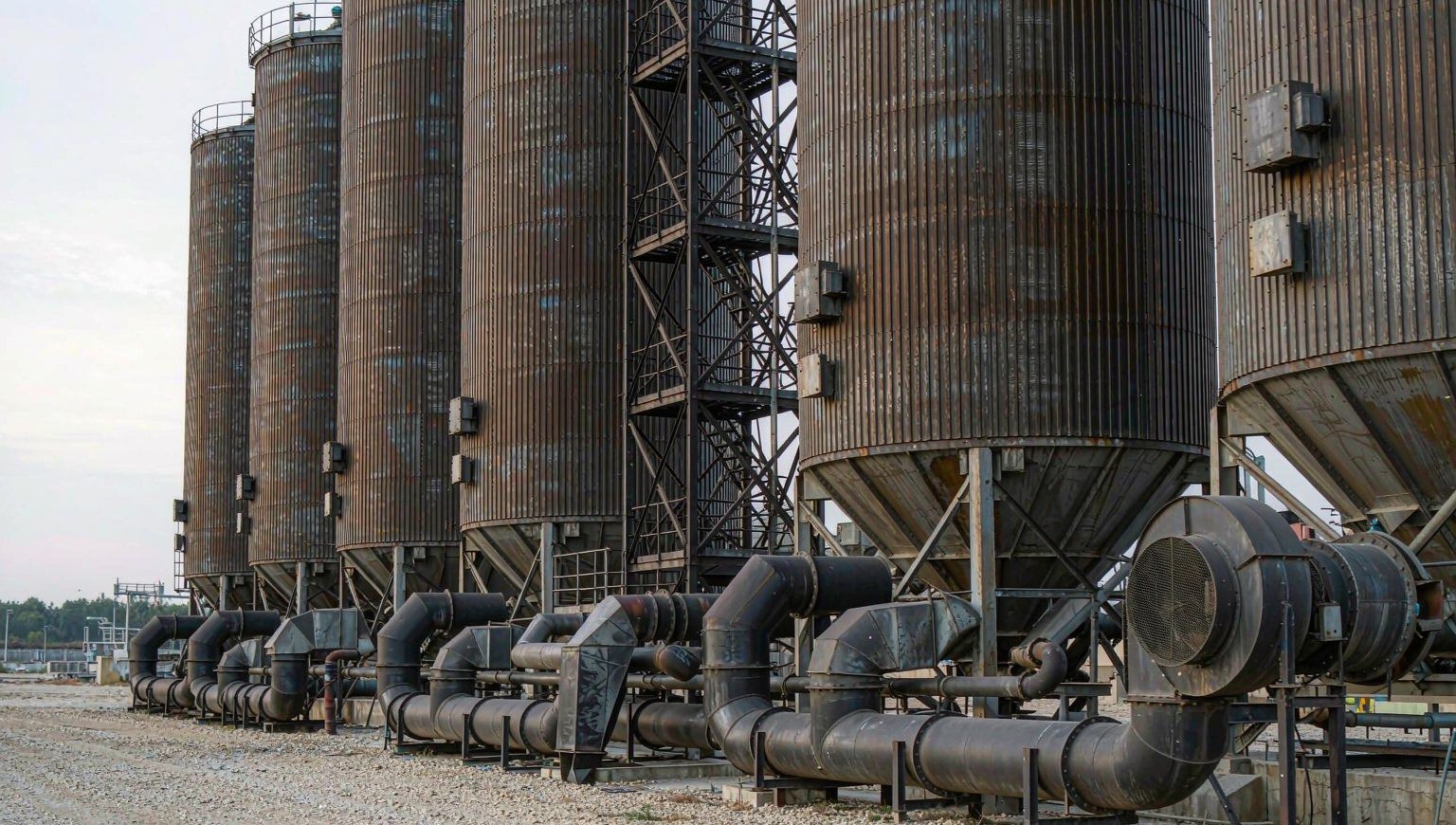
This article covers the basics a feed mill or pellet plant operator needs: what aeration actually does, how much air is enough, how long a cooling cycle takes, what targets to set, and the failure modes that show up when the fan philosophy is wrong.
Why Temperature, Not Moisture, Is the Control Variable
An aeration system moves small amounts of ambient air through stored grain, and the purpose is temperature management. The University of Nebraska’s guide to aeration of stored grain puts it plainly: aeration systems for dry grain are sized primarily to control temperature, and low airflow rates — typically between 1/10 and 1/5 cfm/bu — are adequate for this purpose. Those rates are far below what natural-air drying needs, which is why an aeration fan will not dry your grain no matter how long it runs.
Why does temperature matter so much? Because moisture moves toward cold spots. When one part of a silo is warmer than another — typically the center or the wall on a sunny side — water vapor migrates through the grain mass and condenses on the cooler surface. That damp patch is where mold starts and where insects concentrate. A uniform grain temperature removes the gradient, and with it the migration. Kansas State University’s wheat storage bulletin adds that a cooling front moves through grain about ten times faster than a drying front, so a short aeration cycle changes temperature while barely touching moisture — see the K-State bulletin on storing wheat (MF-855) for the underlying discussion.
The practical consequence is a different fan philosophy than most new operators expect. You do not run the fan continuously through humid weather; you run it when the outside air is cooler than the grain, long enough to push one complete cooling front through the bin, and then you stop and cover the fan. K-State suggests operating when outside air is within about 20°F of grain temperature and warns that the most common mistake is stopping halfway through a cycle — the interrupted front leaves a moist layer that molds and insects colonize faster than dry grain ever would.
How Much Air, and What Targets
Two numbers define most systems. The first is airflow: 1/10 cfm/bu is the classic cooling rate for dry grain in longer-term storage, with higher rates (1/4 to 1 cfm/bu) used when grain must be cooled quickly after harvest. The second is the target temperature: cool grain in steps of about 10–15°F as the season allows, and hold it near 40°F (about 4°C) through winter, per the same K-State bulletin. Cool grain slows insects, molds and respiration all at once — the Australian grains industry’s stored-grain research body makes the same point from a pest-control angle: sustained aeration cooling suppresses insect development without chemicals (see GRDC aeration cooling guidance).
| Parameter | Working value | Source / note |
|---|---|---|
| Airflow, long-term cooling | 0.1–0.2 cfm/bu | UNL NebGuide G84-692; 1 cfm/bu ≈ 48 m³/h per m³ grain (unit conversion) |
| Airflow, rapid cool-down after harvest | 0.25–1 cfm/bu | Higher rates cost fan power; power rises roughly with the square of airflow and grain depth |
| Aeration cycle duration at 0.1 cfm/bu | 5–7 days of intermittent running | K-State MF-855 |
| Cooling steps | 10–15°F per cycle | K-State MF-855 |
| Winter holding temperature | ≈ 40°F (4°C) | K-State MF-855; warm to 55–60°F before spring fumigation |
| Roof exhaust opening | 1 ft² per 1,000 cfm fan capacity | K-State MF-855 (ridge caps, vents and cracks all count) |
| Storage without aeration | ≤ 6 months, grain dried to 10–11% + turning every 3–6 months | K-State MF-855 |
How to read this table: the cfm/bu figures are airflow per bushel of stored grain volume (1 bu of maize ≈ 56 lb ≈ 25.4 kg). If you store in metric terms, multiply your silo volume in m³ by roughly 48 to convert 1 cfm/bu into m³/h of fan delivery, then size the fan from the manufacturer’s rating curve at your silo’s static pressure — not by motor horsepower.
Fan Hours, Controllers and Insect Pressure
Because a cycle is measured in days, manual fan management gets sloppy, and that is where automatic aeration controllers earn their keep. Kansas State’s Q&A on aeration controllers for pest control (MF-2090) describes the strategy: the controller starts the fan whenever outside air falls below a setpoint, logs fan hours, and the operator resets the setpoint lower each cycle. In the Kansas work, three cycles between July and November brought wheat to 50°F (10°C) or colder — cold enough to stall the stored-grain insects that otherwise reproduce fastest near 100°F grain temperatures. The same publication notes that a simple thermostat-based controller costs a fraction of a full weather-sensing unit and is sufficient for cooling applications.
Direction of airflow matters less than completeness. Pushing air up through the grain (pressure aeration) is the preferred arrangement in most extension guidance because the last zone to cool is the top surface — where you can check it with a thermometer — rather than hidden under the floor. Whatever the direction, the cycle is only complete when the front has passed the far surface, which a probe thermometer in the top 6–12 inches of grain confirms.
What Goes Wrong Without It
The failure chain in unaerated or badly managed grain is predictable, and each stage has a visible symptom an operator can act on:
| Symptom | Likely cause | Action |
|---|---|---|
| Condensation under the roof | Warm air rising against a cold roof; wetting front never completed | Aerate to complete the cooling cycle; check roof vent area |
| Crusted or moldy top surface | Moisture migration to a cold or damp zone; peaked, uneven grain | Level the surface, aerate, remove crust if formed |
| Musty smell, warm grain on probing | Hot spot developing from mold or insects | Aerate immediately to cool the spot; plan to move the grain |
| Insect activity in warm grain | Grain held above the ~50–60°F range where development continues | Step cooling via controller; fumigate only after warming per label |
| Clumping or bridging at discharge | Fines concentration and localized moisture from incomplete cycles | Core the bin (draw center grain first); review fines handling at intake |
None of these symptoms waits politely for business hours. The grain mass should be probed and inspected on a fixed schedule — the K-State bulletin’s summary is that even dry grain should be probed periodically and aerated when hot spots are detected — because a hot spot found by thermometer is a maintenance item, while one found by smell is a write-off.
Designing Aeration Into a Feed Mill or Pellet Plant
In a feed mill context, aeration belongs in two places. The first is the raw material silos, where grain may sit for weeks between harvest windows; the sizing logic above applies directly. The second, less obvious place is the finished-goods side: pellets leave the counterflow cooler and should enter bagging or storage at within a few degrees of ambient temperature. A pellet stack that goes into a warehouse warm will do exactly what grain does — develop temperature gradients, condensation and mold — so the cooler discharge check is aeration thinking applied downstream.
When you lay out the intake line, remember that aeration fans, bucket elevators and conveyors all draw power at the same time as the process line. Include them in the electrical load calculation, and give the fan circuit its own protection and hour meter so the controller data survives. The intake equipment family we build is listed on the feed machinery category page, and the silo and conveying interfaces are sized together with the fans rather than bolted on afterward.
Safety: The Part No Layout Drawing Shows
Stored grain is an entrapment hazard, and aeration does not change the rules about entering bins. OSHA’s grain handling facilities standard (29 CFR 1910.272) prohibits entry into bins where engulfment hazards exist unless specific procedures — isolation of equipment, personal fall-arrest systems, an observer — are in place, and requires warning signs and safe work practices around bin entry. Never enter a bin that is being loaded or unloaded, never walk on crusted grain, and lock out the aeration and unloading equipment before any bin entry. These rules apply to a 50-ton farm bin and a 5,000-ton terminal silo alike.
FAQ
Can aeration dry my grain?
No, not at cooling airflow rates. The 0.1–0.2 cfm/bu range used for temperature control is roughly an order of magnitude below what natural-air drying requires. Grain should enter storage at its safe storage moisture; aeration then keeps it uniform and cool. If you need to remove points of moisture in the field, that is a drying system, not an aeration retrofit.
How long does one aeration cycle take?
At 0.1 cfm/bu, K-State’s guidance is five to seven days of intermittent operation for a complete cycle, run when outside air is cooler than the grain and within roughly 20°F of it. Higher airflow rates shorten the cycle roughly in proportion, at the cost of fan power.
What temperature should I cool grain to?
Step down in 10–15°F increments and hold near 40°F (4°C) through winter in temperate climates. In hot climates the practical target is the coolest achievable grain temperature with stable conditions — the point is to remove gradients and slow insects, and sustained cooling near 50°F (10°C) or below stalls most stored-grain pests.
Do I need a full-perforated floor for aeration?
A perforated floor gives the most uniform airflow, but well-designed duct systems under grain also work and are cheaper to install in existing bins. What matters more is total roof exhaust opening — about 1 ft² per 1,000 cfm — and a fan selected from its rating curve at your silo’s static pressure.