
A pellet line does not ship as a line. It ships as forty or more crates, bundles and loose steel items loaded into shipping containers, and the difference between a smooth start-up and a stalled project is usually decided twice: once at the loading yard before the vessel sails, and once on your site before the crates arrive. This article lists the eight checks we make before any biomass pellet or feed line leaves the factory, with the container data and the installation sequence that turns a mountain of crates into a running plant.
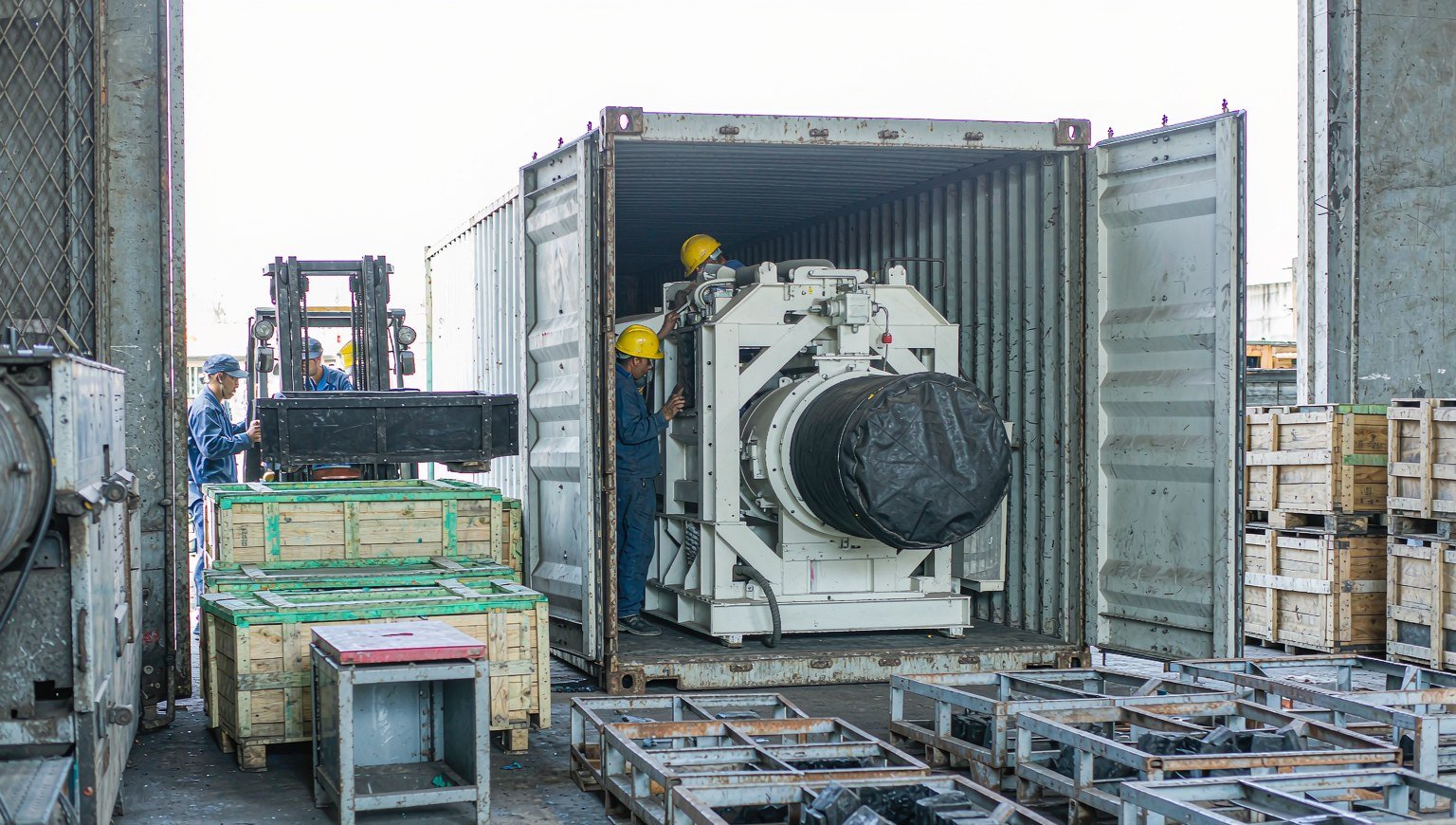
Check 1: Match the Container Type to the Cargo, Not to the Freight Quote
Machinery cargo is dense. That means the container usually runs out of payload before it runs out of volume, and the container that looks cheapest per cubic meter can be the wrong one. The physical envelope is fixed by ISO 668, while internal dimensions and payload vary slightly by carrier and build year. Maersk’s published equipment specification — the dry container specification sheet — is a workable planning baseline:
| Specification | 20′ standard | 40′ standard | 40′ high cube |
|---|---|---|---|
| Internal length | 5,896 mm | 12,032 mm | 12,032 mm |
| Internal width | 2,350 mm | 2,350 mm | 2,350 mm |
| Internal height | 2,393 mm | 2,393 mm | 2,697 mm |
| Door opening (w × h) | 2,340 × 2,274 mm | 2,340 × 2,274 mm | 2,340 × 2,577 mm |
| Internal volume | 33 m³ | 67 m³ | 76 m³ |
| Maximum payload | 28,200 kg | 28,800 kg | 28,620 kg |
| Maximum gross weight | 30,480 kg | 32,500 kg | 32,500 kg |
Values from Maersk’s published dry equipment specifications; external dimensions and maximum gross weight come from ISO 668:2020. Confirm the figures with the carrier actually booked, since tare and payload vary by build year.
Two practical consequences follow. A pellet mill with its die housing, a drum dryer section or a steel structure bundle can eat the payload limit of a 20′ unit with only half the volume used, so heavy machines go in their own container with the empty space filled by light items — screens, dust filter bags, handrails. And the door opening, not the internal box, is what rejects cargo: a crate 2,300 mm wide slides in, but one with fork slots protruding past 2,340 mm at the door does not, however much room the container has. Plan crate sizes around the door, then around the floor.
Check 2: Agree a Packing Plan, Not Just a Packing List
A packing list says what is shipped. A packing plan says where each item sits, which crate carries which machine’s parts, and in what order the site will want them. The difference costs nothing at the factory and saves days of crane time at destination, because unloading and installation follow a sequence, and crates should leave the container in the reverse of that sequence.
The plan we use assigns every crate a number that appears on four documents: the crate itself (stencil paint, not a paper label), the packing list, the layout drawing, and the installation schedule. Light, rust-prone items — electrical cabinets, controls, motors that cannot get wet — travel in sealed, desiccant-protected crates loaded last. Loose steel items such as silo panels and conveyor sections are bundled and strapped, not loose. As a rule of thumb from freight practice, plan for roughly 85–90% usable volume against the nominal container capacity once crates, bracing and handling clearances are counted — a benchmark discussed in container loading guides — and remember that machinery cargo almost always hits the weight limit first.
Check 3: Verify Lifting Points and Lashing Before the Doors Close
Most transport damage to pellet machinery happens on the ground at both ends, not at sea. Each heavy crate needs real lifting points — forklift slots sized for the site’s actual forklift, or certified lifting lugs for a crane — stamped or drawn on the crate, not guessed by the unloading crew. Machines shipped on their base frames should have the frame bolted down with the shipping bolts the manual lists, and any rotating parts (rotor of a hammer mill, dryer drum ride rings) blocked against movement.
Inside the container, lashing is what keeps two tons of steel from becoming a pendulum. Heavy crates sit on the floor against the front wall, wedged and nailed, with the weight distributed so the container floor’s line load is respected; lighter crates stack above, never below. Airbags or timber bracing fill the last meter of free space so nothing can shift when the container is opened months later. If the supplier’s loading crew photographs the lashing of every container before the doors close, both sides have the record — and both sides care, because a lashing failure is an insurance dispute neither party wins quickly.
Check 4: Confirm Wood Packaging Compliance (ISPM 15)
Every crate, pallet, dunnage timber and airbag spacer made of wood must meet ISPM 15, the international standard for wood packaging material in trade. The official ISPM 15 publication of the IPPC requires wood packaging to be debarked and treated (heat treatment or methyl bromide) by a certified provider and stamped with the recognizable IPPC mark. Non-compliant wood packaging is one of the few faults that can stop an entire shipment at the border — the container gets quarantined, re-exported or destroyed at the importer’s cost — so the stamp check belongs on the loading yard checklist, crate by crate, before the doors close, not at customs.
Check 5: Ship the Documentation Set the Site Will Need
The crates are half the shipment; the documents are the other half. A pellet line’s installation team needs, on paper and in duplicate: the numbered packing list, container-by-container; the foundation drawing with anchor bolt positions and loads; the general arrangement drawing of the line; wiring diagrams and the electrical load list; the commissioning manual with torque values and lubrication schedule; and the spare parts list cross-referenced to crate numbers. Our procurement checklist article on importing pellet machinery from China covers the commercial documents — contract, invoice, bill of lading — in depth; the point here is different: the technical documents should travel in two places, one set in a document tube inside container 1 and one digital set emailed ahead, because containers get inspected and opened out of order.
Check 6: Prepare the Site While the Vessel Is Sailing
The four to six weeks of ocean transit are a gift: they are exactly long enough to get a site ready, and too short if you start after arrival. Site readiness is the difference between an installation crew that starts bolting machines on day one and one that waits for a transformer.
| Site item | Ready means | Common delay if missed |
|---|---|---|
| Foundations | Poured to the supplier’s drawing, anchor bolts set and surveyed, cure time completed | Crew remobilized weeks later; anchor bolt rework |
| Power supply | Transformer and distribution panel energized, capacity matches the load list | Single-machine tests impossible; commissioning stalls |
| Steam system | Boiler installed, licensed, water treated, line to the conditioner piped | Pellet quality trials delayed; boiler permits are slow |
| Unloading access | Crane or forklift with capacity for the heaviest crate booked for arrival week | Containers sit at demurrage; crates opened with inadequate equipment |
| Storage and staging | Dry, covered, fenced area for crates; numbering visible | Lost small parts; rust on machined surfaces |
| Crew and consumables | Local welders, riggers, grouting and shimming material on site | Alignment jobs wait on a welder who is three towns away |
Also check import compliance before the vessel berths: machinery destined for the EU or other regulated markets must meet the applicable machinery safety directives, which our article on CE marking checks for pellet machinery lists in buyer-checkable form. Customs cleared with a technical file on hand moves faster than customs cleared on hope.
Check 7: Install in the Sequence the Building Dictates
Installation is a spatial puzzle. Tall, early dependencies go in first because the crane cannot reach them once other steel occupies the bay. The sequence below reflects how a pellet line actually goes together; your layout will vary, but the logic — from the sky down, from the power in — does not.
| Phase | Scope | Depends on |
|---|---|---|
| 1. Survey and setting out | Confirm anchor bolt positions against the GA drawing; datum line for the whole line | Cured foundations |
| 2. Tall equipment and structure | Bucket elevators, silo sections, dust filter body, pellet mill upper works | Crane access, empty bay |
| 3. Main process machines | Hammer mill, mixer, pellet mill base, cooler, screener, bagging line | Phase 1–2, grouting and shimming |
| 4. Conveying and ducting | Conveyors, airlock, ducting between machines, dust network branches | Machine positions final |
| 5. Electrical and controls | Cable trays, motors, panel wiring, interlocks | Mechanical installation complete |
| 6. Single-machine tests | No-load runs, rotation checks, safety device tests, machine by machine | Power energized |
| 7. Load trials and ramp-up | Material runs, capacity verification, operator training, quality checks | Raw material on site, steam available |
Phases 6 and 7 are where supplier support pays for itself, and they are also where spare parts planning shows its value: the start-up spares package — dies, rollers, screens, belts, seals — should arrive with the line, which our pellet mill spare parts stock list breaks down item by item. A cracked die in week two without a spare on site erases a month of good commissioning work.
Check 8: Book Commissioning and Training Before the Crates Land
The last check is calendar work. Commissioning engineers, local riggers and crane time all need booking weeks ahead, and the loading yard documents — crate numbers, packing plan, the site readiness table above — are exactly what a commissioning engineer asks for on the first phone call. Agree the acceptance criteria in advance: rated capacity at the contracted formula, pellet quality figures, and a training program for the client’s operators, with the criteria written into the contract rather than negotiated on site. If your supplier and your site team work from the same crate numbers and the same sequence, the line that left the factory in a hundred crates becomes a running plant in a matter of weeks.
Key Takeaways
- Machinery cargo is weight-limited before it is volume-limited: plan container type around the 28,200–28,800 kg payload band and the door opening, not the nominal 33–76 m³.
- A numbered packing plan beats a packing list: every crate numbered on the crate, the list, the drawing and the schedule, loaded in reverse installation order.
- Verify lifting points, lashing and ISPM 15 stamps crate by crate before the doors close — a wood packaging fault can quarantine the whole shipment.
- Use the sailing weeks for site readiness: foundations cured, power energized, boiler licensed, unloading equipment booked for arrival week.
- Install from the sky down and the power in: tall equipment and structure first, ducting after machines, single-machine tests before load trials.
- Ship the start-up spares with the line and book commissioning and training before arrival; acceptance criteria belong in the contract, not on site.