
Ask five suppliers whether a vertical or a horizontal ring die pellet mill is better and you will get five confident answers that contradict each other. The reason is that “vertical” and “horizontal” describe shaft orientation, and shaft orientation is a packaging decision that changes the die area you can fit, the way material reaches the die, and how much labour a die change costs. Those three things decide output per hour. The orientation itself does not.

This comparison is written from the machine side: what the two arrangements can physically do, where each one loses money, and which feedstock and capacity ranges make the choice obvious. It also untangles a terminology problem that has caused real specification mistakes, because three different machines are sold under two words.
The Naming Problem That Costs Buyers Money
In a vertical-shaft ring die mill, the die face lies horizontal and the main shaft is vertical. Rollers mounted on that shaft travel around the die face, and material falls into the chamber by gravity. Pellets are pushed outward through the die and drop away underneath. In a horizontal-shaft ring die mill, the die stands upright like a wheel, the shaft is horizontal, the die rotates and the rollers are held stationary inside it; material arrives from the side through a screw feeder.
A flat die press is also sold as a “vertical pellet mill” because its die plate is horizontal with rollers running on top of it — a different machine with different pressure geometry and a much smaller working area. Buyers who put a “vertical pellet mill” quotation next to a “horizontal ring die” quotation are sometimes comparing a farm machine with an industrial press, which is why the two capacity numbers look impossible to reconcile.
Before comparing anything, confirm the die type: ring or flat, and the die diameter in millimetres. Those two facts, plus motor kW, predict more about real output than the orientation label. Our own ring die versus flat die comparison covers the pressure geometry of the flat die case; this article stays with ring dies. Be equally careful with third-party tables — seller-published comparisons frequently mix the three machine types in one column, which is one reason identical nominal capacities appear at wildly different prices.
Die Area per Ton: the Number Behind the Claims
Output from a ring die press is roughly the product of working die area, die surface speed and the pressure the rollers apply, adjusted for how well material is distributed across the die face. Working area is the circumference multiplied by the effective die width, so a small increase in diameter buys a lot of area: at equal width, a 600 mm die has 2.25 times the face area of a 400 mm die. That relationship explains most of the market. Vertical-shaft machines are built around dies of roughly 300 to 800 mm because a larger horizontal die face becomes difficult to support and to feed evenly from above. Horizontal machines commonly run 420 to 1,350 mm dies because the upright die sits on a heavy main shaft and gearbox at one end. The published ranges from our own programme show the envelope clearly.
| Parameter | Vertical-shaft ring die | Horizontal-shaft ring die |
|---|---|---|
| Die diameter range | 300–800 mm | 420–1,350 mm |
| Main motor | 22–160 kW | 90–630 kW |
| Press rolls | 2–3, on a vertical shaft | 2–3, held inside a rotating die |
| Die speed | Low, large-diameter face | 120–300 rpm, material dependent |
| Rated output | 0.5–5 t/h | 1–15 t/h (biomass build) |
| Specific energy | 30–55 kWh/t, application dependent | 25–50 kWh/t, die and material dependent |
| Floor area per t/h | 40–60% smaller than an equivalent horizontal unit | Baseline; needs side access for die handling |
| Noise at the machine | 78–85 dB typical | Higher, gearbox and die drive dominate |
Read the table as an envelope, not a ranking. A 160 kW vertical machine at 5 t/h and a 630 kW horizontal press at 15 t/h are not competitors; each exists for a different job. The comparison that matters is always at equal output, equal feedstock and equal die specification.
Die Speed, Roller Coverage and Fines
Die surface speed is where the two designs diverge in behaviour rather than in size. Linear speed at the die face is proportional to diameter times rpm, so a large die reaches the same surface speed at lower rpm. Slower rotation means longer residence of material under each roller pass, which generally produces a denser pellet and fewer fines — provided the material is distributed evenly and the rollers are not slipping.
Roller coverage is the other half. Two rollers cover less of the die face per revolution than three, and the uncovered arc is where material can slip rather than be pressed. A three-roller arrangement at the same diameter raises the number of compression events and usually reduces slip, at the cost of tighter clearance setting: roller-to-die clearance has to be uniform and small, and a three-roller head is less forgiving of a warped die or a worn main bearing.
Fines are the practical symptom of getting this wrong, and not only a quality problem: they are recirculated material that passes through the die twice and consumes energy without producing saleable tonnage. If a vertical machine is producing 8–10% fines while a comparable press produces 4%, the difference is usually distribution and die speed, not the orientation. Since durability testing at the die stage is what finally decides acceptance, it is worth running a trial die in both configurations where the plant can, and judging against the durability targets published by bodies such as the Wood Pellet Association of Canada rather than against supplier brochures.
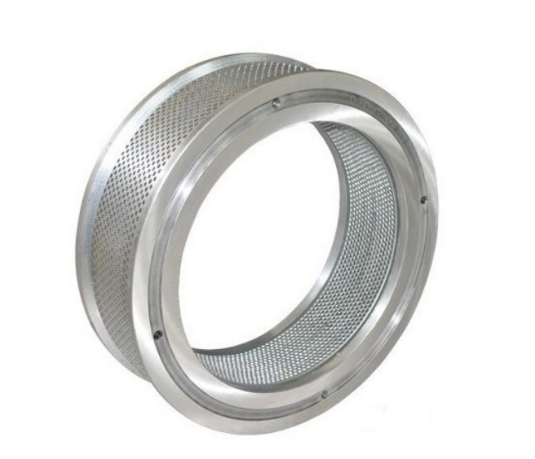
Die Change and Maintenance Access: the Hidden Labor Line
A ring die is a wear part. At 1,500 to 3,000 hours on biomass, a plant running 6,000 hours a year changes dies two to four times, and on abrasive feedstock more often. Die change time is therefore a production number, not a maintenance detail.
On a horizontal machine the die is heavy, sits inside a housing, and comes out from the side, usually with a hoist and often after removing the cutter, the door and sometimes the feeder. One to three hours is typical depending on size and layout. On a vertical machine the die lifts off the vertical shaft from above, which is faster and needs no side clearance — but it does require headroom and a lifting point directly over the machine.
Two design details change the arithmetic more than orientation does. A double-layer die allows the worn layer to be turned or replaced without scrapping the whole ring, and a die handling trolley with a properly placed monorail removes most of the difference between the two layouts. If a supplier quotes a 30-minute die change on a 700 mm die without showing the handling equipment, ask how.
Footprint, Height and Structure
Vertical machines win on floor area because the machine grows upward. Our published figure for the vertical range is 40–60% less floor area than an equivalent horizontal unit, which matters in an existing building where the bay is fixed and a new foundation is not an option. The cost moves to height: a taller building, a lifting beam above the machine, and a feed arrangement that can drop material into the top of the chamber. Horizontal machines need side access for die changes and a longer line, which is not a constraint in a greenfield tower but decides the project in a rented shed with a 7 m eaves.
| Feedstock / duty | Vertical-shaft fit | Horizontal-shaft fit |
|---|---|---|
| Clean softwood sawdust, single source, 8–12 t/h | Below its economic size | Best fit: large die, high tonnage, steady feed |
| Mixed hardwood, shavings, offcuts at 1–4 t/h | Good fit: gravity feed tolerates variable bulk density | Workable with forced feeding and die protection |
| Rice husk, palm kernel shell, straw | Good fit at small scale; die wear is the limit | Good fit at high tonnage with correct L/D and abrasion-resistant die |
| Compound animal feed, 5–20 t/h | Pilot and specialty lines only | Standard choice; conditioning and die area are well understood |
| Aqua feed with 1.5–3 mm pellets | Not typical | Standard, with high L/D and fine-hole die |
| Frequent formula changes, small batches | Better: fast die change, low residual material | Slower changeover, more purge material |
Energy per Ton Is Not a Design Constant
Both designs are sold with specific-energy claims, and most of them are not comparable. Specific energy at the press depends on feedstock, moisture, die compression ratio, hole diameter, die condition and throughput as a fraction of rated capacity. A vertical machine running at 60% of rated output will always look worse per ton than the same machine at 95%, because idling and slip losses are spread over fewer tons.
The honest comparison uses energy per ton at the same die specification and the same percentage of rated capacity, measured over a full shift with the same feedstock. If a supplier cannot provide a test report at those conditions, treat the number as marketing. Published trade comparisons, even thoughtful ones from engineers at other vertical mill builders, still quote energy per ton without stating the operating point, so ask for the test report behind any claim. Market-side pellet specifications from bodies such as the Pellet Fuels Institute and the trade analysis published through IEA Bioenergy Task 40 are useful for setting what the pellet has to achieve; they do not tell you which press will achieve it more cheaply in your building.
When Neither Design Is Right
Three cases deserve a warning rather than a recommendation. A buyer who needs 8 t/h from a single press but has a low building may do better with two smaller machines, which also gives redundancy. A buyer whose feedstock changes every month is constrained by die specification, and the machine that accepts a wider range of compression ratios without cracking wins over the one with the best peak output. And a buyer planning to run abrasive material on a low-cost die will find that die cost per ton dominates the business case: a machine with cheap, locally available dies matters more than a few percent of energy.
The vertical pellet mill in our range covers 0.5–5 t/h with 300–800 mm dies and is normally specified where floor area is tight, batches change, or the feedstock is mixed and light. The horizontal biomass pellet mill covers 1–15 t/h with 420–1,200 mm dies and is the default above roughly 6 t/h on a single feedstock. Die specification is a separate decision and is covered in our guide to die compression ratio.
Comparison Recap
| Decision point | Choose vertical-shaft if… | Choose horizontal-shaft if… |
|---|---|---|
| Output | 0.5–5 t/h on one press | Above 5–6 t/h per press, up to 15 t/h |
| Building | Small floor area, adequate height and a lifting point | Long bay, crane access, side clearance for die handling |
| Feedstock | Mixed, light, variable bulk density | Consistent, high-volume, single source |
| Product changes | Frequent small batches and formula changes | Long runs of one specification |
| Maintenance model | In-house crew, top-access die change, double-layer dies | Planned downtime with a hoist and a die trolley |
| Energy claim | Verify at 90%+ of rated output, same die | Verify at 90%+ of rated output, same die |
The useful way to end the argument is to specify the job rather than the orientation: tons per hour, feedstock and bulk density, die diameter and compression ratio, available floor area and height, die handling equipment, and the percentage of rated capacity you expect to run at. Once those are on the table, the orientation usually chooses itself — and if two quotes still differ by a factor of two in capacity, the difference is in die area and motor kW.