
Shrimp feed sits at the extreme end of pelleting: the smallest die holes in the industry, the highest compression ratios, a product that has to hold together in pond water for hours, and a customer — the shrimp — that will not eat a pellet that has already fallen apart. Each specification on the quotation maps to a physical limit somewhere in the line, and misreading one of them is how a mill ends up with a machine that runs well on poultry feed and badly on everything else.
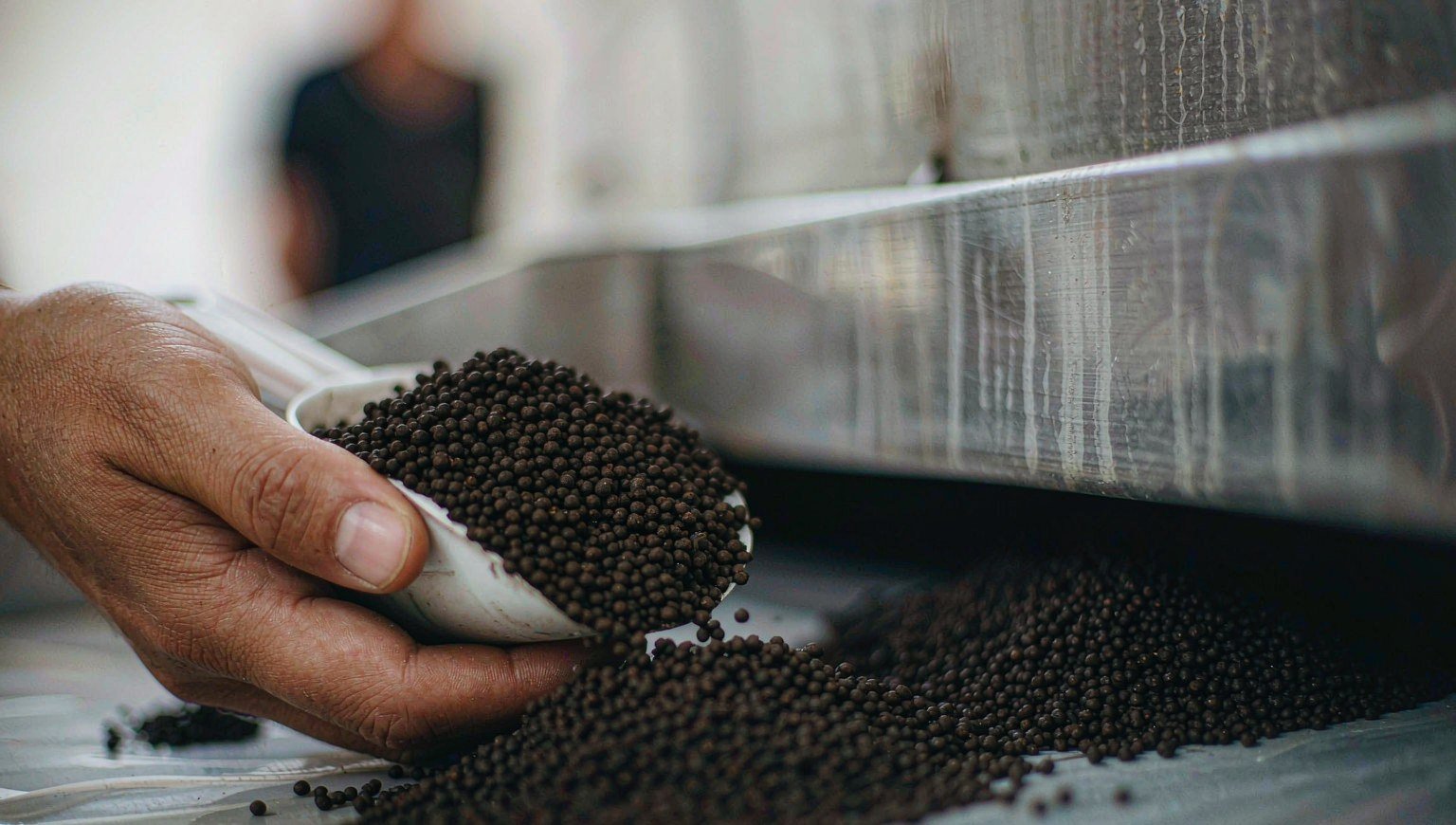
This article walks through the specification sheet item by item — die hole, L/D ratio, water stability, durability, grind fineness, conditioning — and connects each number to the equipment decision behind it. It is written for feed producers adding a shrimp or aqua line to an existing mill, and for investors comparing quotations that look similar until you read the die column.
Why Shrimp Feed Is Its Own Specification Problem
Aquaculture has grown into the fastest-moving segment of the feed industry, and the technical demands grew with it — see the FAO’s aquaculture programme for the scale of the sector, and the World Aquaculture Society for the research community behind feed and pond management practice. Shrimp are bottom feeders with tiny mouthparts and a slow feeding rhythm: the pellet has to sink, keep its shape while the shrimp graze on it, and shed as little powder as possible, because fines dissolve into the water column and degrade it faster than they feed anything.
That combination — small, dense, water-stable, low-fines — is the opposite of what a standard livestock feed line is optimized for. Livestock pellets are judged mainly on durability and starch conversion; shrimp feed adds a second, harder test that happens after the bag is opened. It is also the segment where buyers audit their feed suppliers hardest: certification schemes such as the Best Aquaculture Practices feed standard put the mill’s process controls under third-party inspection. Our shrimp feed pellet mill specification reflects all of it: die holes from 1.0 to 2.5 mm, an L/D range of 10:1 to 16:1, a double-shaft conditioner with 90–180 seconds of retention, and a density target of 450–550 g/L so the pellet sinks reliably.
The Numbers That Define the Product
The table below collects the specification values that decide whether a shrimp feed line works, with the reason each one exists. Ranges are those used in our own shrimp feed specification; individual projects land inside them depending on species and formula.
| Specification | Typical range | Why it matters |
|---|---|---|
| Die hole diameter | 1.0–2.5 mm | Sets pellet size to the shrimp’s mouthparts; smallest common holes in feed pelleting |
| Die L/D ratio | 10:1 to 16:1 | Compression length builds pellet density and water stability; too high risks die blockage |
| Preconditioning retention | 90–180 s | Time for steam and moisture to gelatinize starch, the main binder in a sinking pellet |
| Preconditioning moisture | 26–32% | Gelatinization needs water; the extra moisture must be removed again in drying |
| Starch gelatinization | 85–92% | The binding mechanism that keeps the pellet intact in water |
| Pellet density | 450–550 g/L | Sinking behaviour; lower density floats or drifts and is wasted |
| Water stability | 3–6 h without disintegration | The product-defining test for shrimp feed |
| Pellet durability (PDI) | Above 95% | Survival through cooling, handling and transport without generating fines |
| Pellet length | 1.5–3.0 mm, cutter controlled | Short pellets pass through small mouths; length uniformity affects intake uniformity |
Two of these deserve a closer look because they drive the equipment list more than the rest.
Grind Fineness Comes Before the Die
A 1.5 mm die cannot produce a stable pellet from a 2 mm particle. For shrimp feed, the mash is normally ground fine enough that the particles are small relative to the die hole — in practice this means grinding to well under 0.5 mm, with many producers targeting a large fraction below 0.3 mm for starter feeds. Coarse particles act as failure points: the pellet cracks around them in water, and the crack is where disintegration starts.
Fine grinding has costs that show up immediately. Specific energy at the hammer mill rises steeply as target particle size falls, screen wear accelerates, and the ground mash becomes dusty and prone to bridging in hoppers. This is why aqua feed lines use purpose-built fine-grinding equipment rather than a standard livestock mill pushed to its limit — our guide to hammer mill screen selection covers the screen-to-particle-size relationship. The specification to agree with your supplier is not “fine grinding” but a particle-size target with a measurement method, because two labs measuring the same mash can report different numbers.
Conditioning and Gelatinization Do the Binding
In a sinking shrimp pellet, the binder is gelatinized starch, not friction heat. Raw starch granules are inert; when starch is heated with enough water, the granules swell and burst, and the released amylose and amylopectin form the gel that glues the pellet together as it dries. That transformation needs moisture, temperature and time together — which is why the conditioner specification matters as much as the die.
A single-shaft conditioner passing meal in 15–20 seconds cannot deliver 85–92% gelatinization on a shrimp formula, no matter how much steam is injected. The double-shaft paddle design with 90–180 seconds of retention exists to buy that time; where a formula still falls short, producers add a pre-gelatinization step upstream — an expander or a dedicated cooking stage — and the aqua feed extruder is the usual answer when the line must also produce floating feeds. Our article on the aqua feed extrusion process covers that route; the point here is that a ring die shrimp feed line lives or dies on conditioner retention.

Steam quality is part of the same specification. Wet steam adds water unevenly and produces patches of over-wet meal that blind fine die holes, so a shrimp line needs dry saturated steam, good line drainage, and a boiler sized for the peak steam demand of the conditioner rather than the average.
Die Selection: Small Holes, High L/D and the Cost of Both
Dies for shrimp feed concentrate three difficulties: very small holes, a long compression path, and abrasive formulation components such as fishmeal and mineral premix. Small holes reduce open area per unit of die face, which caps throughput at a given die speed; high L/D raises the pressure needed to push meal through, which raises motor load and die temperature. This is the trade-off triangle that a shrimp feed die sits inside — one of the three always gives. Compression-ratio guidance published by die makers, including independent mills such as one die-selection guide we find consistent with our own die data, converges on the same conclusion: match the die to the formula, not to the machine.
| Product | Pellet size | Water stability target | Line notes |
|---|---|---|---|
| Whiteleg shrimp, grow-out | 1.2–2.0 mm | Above 4 h | High-protein formula; the main volume product |
| Black tiger shrimp | 1.5–2.5 mm | Above 5 h | Larger holes ease throughput; stability target is stricter |
| Freshwater prawn | 2.0–2.5 mm | Above 3 h | Tolerates more vegetable protein |
| Broodstock and hatchery | 1.8–2.2 mm | Above 6 h | Small volumes, strictest stability, often crumbled from a larger pellet |
Die life is the operating cost that surprises first-time shrimp producers. A fine-hole die on an abrasive formula wears faster than the same die on poultry feed, and hole enlargement shows up as falling water stability before it shows up as falling capacity. Budgeting for more frequent die replacement, and insisting on dies from a supplier with consistent hole boring, is part of the cost per ton.
Cooling, Sieving and Fines: the Quiet Quality Killers
A shrimp pellet leaves the die soft and wet. Drying and cooling have to bring it back to a storage-safe moisture without cracking the pellet, and fine pellets are more fragile than 6 mm livestock pellets because the same cooling airflow acts on a much smaller thermal mass. Overcooling with hot, dry air cracks the surface; undercooling bags moisture into the sack and molds it in the warehouse.
After cooling, the product is sieved, and the sieve is where the fines specification is actually met. Shrimp feed is usually double-screened: fines removed before bagging, and often a second check after the bagging transfer. Fines above a few percent fail the product at the farm even when every laboratory number is in range, because the fines dissolve into the water column instead of feeding anything, the shrimp pond clouds, and the farmer blames the bag.

What a 3–6 t/h Shrimp Line Looks Like
For a producer planning a dedicated shrimp line in the range our customers most often ask about, the equipment list below is the shape of the answer. It follows the layout of a purpose-built aqua feed pellet mill line, with gentle transfer points and screening sized for fine pellets rather than the free-fall-heavy livestock layout. Capacities are indicative and depend on formula and die selection.
| Stage | Equipment | Design note |
|---|---|---|
| Intake and dosing | Pre-cleaner, bins, weighing | Fishmeal and premix need accurate micro-dosing; hygiene zoning from day one |
| Grinding | Fine-grinding hammer mill | Particle size target agreed with a measurement method; screen stock for fine work |
| Mixing | Twin-shaft mixer | Uniformity on a fine, high-protein mash; short batch cycle to feed the mill |
| Conditioning | Double-shaft conditioner, 90–180 s | Retention is the binding step; dry saturated steam and correct boiler sizing |
| Pelleting | Shrimp feed pellet mill, 1.0–2.5 mm dies | L/D 10:1–16:1; die stock for each product size; watch die temperature |
| Drying and cooling | Dryer plus counterflow cooler | Gentle airflow for fine pellets; storage-safe moisture without surface cracking |
| Finishing | Screener, crumbler for starter sizes | Fines removed before bagging; crumble control for post-larvae feeds |
| Bagging | Small-bag line | Enclosed transfer, low free-fall, metal check at the bag |
Five Specifications Buyers Misread
1. Capacity at a 1.5 mm die is not the nameplate capacity. Rated output is always quoted at a workable die. Fine shrimp dies cut throughput substantially; a mill sized on a 3 mm broiler die will disappoint on shrimp formulas.
2. Water stability cannot be tested by soaking a handful in a bucket. The test needs a defined method — water temperature, exchange rate, sample size — or the number cannot be compared between batches or suppliers.
3. Gelatinization is measured on the product, not on the steam valve. Steam pressure and conditioner temperature are inputs; the number that matters is measured starch gelatinization on the finished pellet.
4. Fines are created after the die. Most fines in a bagged shrimp feed come from cooling air, transfer drops and bagging, not from the pellet mill. A supplier who only talks about the press is describing half the line.
5. Die life is a cost-per-ton line item. Abrasive fine-hole dies wear visibly; the plant that budgets die replacement per ton keeps quality stable, and the one that runs dies to failure ships product that fails at the pond.
Next Steps
If a shrimp line is on your project list, the specification conversation is the place to start — before prices, because the price follows the die and the conditioner. Bring four numbers to the discussion: your target products and pellet sizes, the water stability your customers demand and how they test it, the annual tonnage split between those products, and the feedstock list with the fishmeal and starch sources you can actually buy. With those, a supplier can put a real die schedule, a retention specification and a fines target on the quotation instead of a nameplate capacity.
Then ask for a trial: run your formula on the proposed die, measure gelatinization, water stability and fines with the same methods your customers will use, and only then compare machines. Shrimp feed rewards the mills that treat the specification sheet as an engineering document — and the equipment list that follows from it is not exotic, just precise.