
Aquaculture has quietly become the larger half of the world’s fish supply. FAO’s State of World Fisheries and Aquaculture 2024 reports that farming produced 94.4 million tonnes of aquatic animals in 2022, surpassing capture fisheries for the first time, and that global per-capita consumption of aquatic animal foods reached 20.7 kg in 2022. Feed is the biggest cost line behind that growth: Alltech’s 2024 Agri-Food Outlook put global aquafeed production at roughly 52 million tonnes in 2023. Almost every kilogram of that compound feed for tilapia, catfish, seabass, trout and shrimp passes through an extruder barrel, not a conventional pellet mill.
If you are planning a fish feed plant, the extrusion stage decides three things no other machine can give you: whether the pellet floats or sinks, how long it holds together in water, and how much fat the finished product can carry. This article walks through the full aqua feed extrusion process as it runs in a commercial plant, explains the physics behind floating and sinking products, and lists the parameter ranges and quality targets we use when building lines.

Density Is the Whole Game
A poultry pellet only has to survive handling. A fish pellet has to survive water. The single physical property that separates product categories is bulk density: floating feed sits below roughly 480 g/L, sinking feed sits above it, with slow-sinking products engineered into the 450–550 g/L band. These boundary values were first compiled by Rokey and Huber (1994) and have been reproduced in feed manufacturing references ever since, so they are worth treating as the working definition when you write a purchase specification.
FAO’s feed milling processes chapter describes expanded extruded fish feed as commonly landing between 0.25 and 0.3 g/cc (250–300 g/L) for floating products used in pond culture, low enough for the farmer to watch feeding activity and ration the fish by sight. That visual feedback is one of the main commercial reasons top-feeding species such as tilapia and catfish are fed floating pellets at all: uneaten feed is visible, so overfeeding and water quality problems are easier to catch early.
The extruder is the only continuous machine that can deliberately push product density across that boundary. A ring die pellet mill compresses mash into a dense pellet; it cannot inflate one. That is why every serious aquafeed plant is built around extrusion cooking, whatever else it buys.
From Recipe to Pellet: The Extrusion Line Step by Step
Grinding: finer than any other feed
Aquatic animals have short digestive tracts, and small pellets have thin walls, so the grind for aquafeed is the finest in the feed industry. FAO’s aquaculture feed manufacturing guidance sets the baseline: ingredients for premixes and starter feeds should be ground to pass a 0.25 mm sieve, and grower or broodstock pellets to pass a 0.35 mm sieve. To put that in perspective, a typical livestock feed mill works to particle sizes several times coarser.
| Stage | Target | Why it matters | Source |
|---|---|---|---|
| Premixes & starter feed grinding | pass 0.25 mm sieve | Digestibility; micro-pellet integrity at 0.5–1.5 mm | FAO aquaculture feed guidance |
| Grower / broodstock feed grinding | pass 0.35 mm sieve | Surface area for cooking; smooth pellet skin | FAO aquaculture feed guidance |
| Lifeline equipment | Tear-circle / superfine mill, 0.5–1.0 mm screen class | Grinding energy is a real cost; oversize causes raw cores | Plant practice |
Reaching those particle sizes at commercial tonnage calls for a dedicated superfine mill; that is the machine we standardise on for fish feed lines above one tonne per hour, and it is where grinding energy in a fish plant is spent (grinding to aquafeed fineness takes several times the specific energy of a livestock grind — plan the electrical connection accordingly).
Dosing, mixing and metal removal
Downstream of grinding, the recipe is batch-weighed and mixed. Nothing exotic here by livestock-mill standards, but two details matter more for extrusion. First, magnet and sieve protection ahead of the extruder: a stray bolt or stone in a ring die press makes noise, while in an extruder it scars screws and bushes that cost far more than the part. Second, mixing uniformity has to hold with fishmeal-rich, sticky formulations that behave differently from dry corn-soya mash.
Preconditioning
FAO’s aquaculture feed manufacturing guidance describes extrusion conditioning as bringing the feed mash to 20–30% moisture at 65–95 °C with steam before the material enters the pressurised barrel. Preconditioning does part of the cooking outside the barrel, which cuts screw wear and stabilises throughput. For fish feed, a double-conditioner or differential-diameter-conditioner layout is common because retention time, not barrel shear alone, is what gelatinises the starch fraction evenly.
Cooking in the barrel
Inside the barrel the mash cooks at roughly 130–180 °C for 10–60 seconds, with the exact temperature and dwell time set by ingredient particle size, formulation and the product property you want (FAO, aquaculture feed manufacturing guidance). The barrel is not just a heater: mechanical shear from the screw does a large share of the work, which is why the same recipe run on different screw configurations can produce visibly different pellets.
Die and knife
The cooked dough is forced through a die plate and cut by rotating knives. Die diameter for aquafeed runs from under 1 mm for larval feeds up to 8–10 mm for large pellets. Die design — open area, land length, whether the die is vented — is the main lever for controlling density, which is the next two sections’ subject.
Drying and cooling
A word on capacity balance before we go further: the extruder is rarely the bottleneck people assume. In most fish feed plants we audit, the dryer is what caps real throughput, because extruded pellets carry a lot of water into the oven and drying time is not negotiable. When you compare quotations, check the dryer bed area and evaporation duty behind every extruder capacity claim, not just the barrel size — two suppliers quoting the same extruder tonnage can be delivering very different plants.
Extruded pellets leave the die wet, typically far above storage-safe moisture, and pass through an oven or multi-pass dryer. FAO’s process description for expanded fish feed cites oven drying at around 120 °C down to storage-safe moisture, followed by a conventional pellet cooler; cooling normally starts once internal moisture is below about 13%. In practice we combine a dryer with a counterflow cooler and screener, and we covered the cooler side of that chain in detail in our article on the counterflow cooler working principle.
Post-drying liquid application
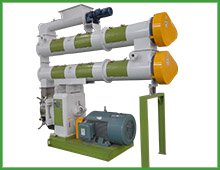
Extrusion heat destroys part of any heat-labile vitamin premix and limits how much oil can be mixed into the dough, so modern aquafeed plants spray oil and heat-sensitive additives onto the dried pellets instead. FAO recommends post-extrusion spraying for heat-sensitive additives rather than over-fortifying the dry recipe. Dedicated equipment for this — vacuum coaters or atmospheric spray lines — belongs on every fish feed flowsheet; see our oil addition system for how we implement it.
How Floating Feed Gets Its Structure
Floating pellets are foam, in engineering terms. The mechanism is straightforward once you see it as a pressure vessel event. The cooked mash enters the die under pressure; water in the mash is superheated relative to atmospheric boiling point. When the extrudate exits the die plate, pressure drops to atmospheric almost instantly, the superheated water flashes into steam, and thousands of tiny bubbles expand the pellet before it cools and sets. FAO likens the result to a puffed-rice texture.
Three process requirements follow from that mechanism, and all three trace back to FAO’s process description for expanded fish feed:
- Enough gelatinised starch to trap the bubbles. Raw starch is a requirement of a good floating pellet; roughly 90% of it gelatinises during the 30–60 seconds the feed spends in the barrel. Cereal grains expand to very low density, while low-starch protein concentrates barely expand at all — which is why a high-protein, low-starch recipe cannot be pushed to float without reformulation.
- Sufficient die pressure and product temperature. Classic reference values for floating extrusion put die pressure around 34–37 atmospheres with a product temperature of 125–138 °C and mash moisture of 25–27% at the die (Rokey & Huber, 1994). Drop the pressure or temperature and the bubbles stay small, and the pellet sinks.
- Post-die drying to set the foam. FAO’s numbers put expanded floating feed at 320–400 g/L straight after the die, with moisture falling 3–4 percentage points at the moment of expansion. Further drying to below about 10–12% moisture improves floatation further; wet foam collapses.
The floating behaviour is measurable and reproducible, not luck. A response-surface study on single-screw extrusion of fish feed published through Wiley and indexed in FAO AGRIS found that 120 °C barrel temperature, a 2 mm die and 100 seconds of steam preconditioning (400 kPa) produced pellets with 100% floatability, a durability index of 99%, an expansion ratio of 2.64 and bulk density of 479 g/L — right at the float/sink boundary, with water stability of 87%. Those numbers are a useful sanity check when a supplier quotes “excellent float rate” without qualification.
Making Sinking Feed Without Losing Water Stability
Sinking and slow-sinking products invert the objective: you want cooking and binding without expansion. Shrimp feed is the demanding case. Shrimp are bottom feeders with slow feeding behaviour, so the pellet must sink promptly and hold its shape in water for hours; a floating fraction in a shrimp pond is money floating away and ammonia waiting to happen.
Suppression of expansion is done on three fronts:
- Formulation. Sinking aquafeed runs far less starch (around 10%) and moderate fat (up to about 12%), leaving less bubble-forming material in the dough (Rokey & Huber, 1994 reference values).
- Conditioner strategy. For sinking product, the conditioner is fed mostly water with little or no steam, then additional water is injected into the barrel so the extrudate leaves at 28–30% moisture — wetter, cooler dough expands less.
- Die hardware. Vented dies (or second-stage/expansion-reducing dies on dry extruders) relieve pressure partway, cutting temperature, moisture and expansion before the final shaping die. Reference die pressures for sinking product run lower, about 26–30 atmospheres.
Post-die handling differs too. Sinking feed is dried only to 10–12% moisture; over-drying lowers pellet density enough that nominally sinking feed starts to float, a defect worth writing into your QC plan. Slow-sinking products for species like seabream sit between the extremes and are tuned by die temperature and moisture at the middle settings of both ranges.
For dedicated shrimp lines we build around purpose-designed equipment; our shrimp feed pellet mill page covers the pelleting route for farms that do not need extruded product, and the extruder category lists the extrusion route.

What Steam and Water Do Differently in an Aqua Line
Visitors coming from livestock feed plants usually notice one thing first: an aqua line drinks. Steam and water addition in fish feed extrusion runs well above what a poultry line uses, because the product needs to be plasticised, not just conditioned. The steam system therefore deserves sizing attention equal to the extruder itself — a boiler that is undersized shows up immediately as inconsistent pellet density, because the barrel then compensates with mechanical shear, which varies with screw wear and is much harder to hold steady.
The practical consequences for your plant design are worth listing. Steam consumption drives your boiler fuel choice: where biomass waste is available, a boiler fired on that waste often pays for itself quickly, while plants without residue supply should price diesel or gas boilers into the investment before signing. Condensate handling, water treatment and the hygiene of the conditioner all belong in the layout from day one, because retrofitting them into a running plant is disruptive. And since conditioner moisture sets density, we put steam and water meters on the line so operators can log and reproduce the recipe that produced an accepted batch — a small instrument budget that prevents the most common escalation, which is disputing whether the machine or the operator changed.
Reference Parameter Ranges by Product Type
The table below collects the ranges discussed above into one place. Treat them as engineering reference points, not guarantees: every recipe shifts them, and the right way to use the table is to know which knob moves which number.
| Parameter | Floating | Slow-sinking | Sinking | Source |
|---|---|---|---|---|
| Conditioner outlet temperature | 65–95 °C (steam-led) | 65–95 °C (steam-led) | water-led, low steam | FAO (conditioning range) |
| Moisture entering barrel | 20–30% | 20–30% | 20–24% mash, water to 28–30% in barrel | FAO; Rokey & Huber (1994) |
| Cooking temperature in barrel | 130–180 °C, 10–60 s | 130–180 °C, 10–60 s | lower end of range | FAO |
| Die pressure | 34–37 atm | between ranges | 26–30 atm | Rokey & Huber (1994) |
| Product temperature at die | 125–138 °C | ~120 °C | ~120 °C | Rokey & Huber (1994) |
| Bulk density after expansion | 320–400 g/L (FAO: down to 250–300 g/L in pond practice) | 450–550 g/L | 450–550 g/L | FAO; Rokey & Huber (1994) |
| Starch in formula | high (≥20% is a common working minimum) | medium | ~10% | FAO; Rokey & Huber (1994) |
| Final moisture after drying | below ~10–12% (drier = better float) | 10–12% | 10–12% (over-drying causes floating) | FAO; Rokey & Huber (1994) |
Single Screw or Twin Screw?
Both machine types cook identically; the difference is control. A single-screw extruder is simpler, cheaper to buy and to maintain, and is the standard choice for floating feed for tilapia, catfish and carp at moderate fat levels. A twin-screw machine handles difficult doughs better because the interleaved screws convey positively and self-wipe: high-fat formulations, very high fresh-meat or wet-mash inclusion, sub-1.5 mm product and frequent recipe changeovers are the cases where twin-screw machines earn their premium.
A practical selection rule we use with clients: if your product plan stays within conventional floating and slow-sinking feeds with moderate oil targets, a well-configured single-screw wet-extrusion line is the economic choice. If you are targeting premium marine fish or shrimp diets with high fat inclusion and fine diameters, specify a twin screw. Our aqua feed extruder page sets out both configurations and the capacity ranges we build them in.
Quality Targets to Put in Your Purchase Specification
Buyers who specify numbers get machines built to reach numbers. The measurable core of an aquafeed specification is short, and every line in it can be tested with modest lab equipment.
| Quality indicator | Typical target | Notes / reference point |
|---|---|---|
| Floatability (floating feed) | ≥90–100% after 10 min | Study cited above reached 100% at 479 g/L bulk density |
| Pellet durability index | ≥97–99% (extruded) | Same study measured 99% PDI at optimum settings |
| Water stability (shrimp feed) | shape retention over hours of immersion | Define test duration and method in the contract; species-dependent |
| Bulk density | per product class (see parameter table) | ~480 g/L is the float/sink working boundary |
| Final moisture | ~10–12% | Below 13% before cooling per FAO process description |
| Fines after screening | specify a maximum % by weight | Fines return to the mixer; excess signals die or knife issues |
One honest caveat belongs here: published trials show extrusion can partially destroy heat-labile nutrients, and FAO’s processing chapter notes that high-temperature processing reduces the availability of some amino acids. This is exactly why post-extrusion spraying exists, and why a supplier who only quotes barrel temperatures but not their coating system is not giving you the full picture.
Five Failure Modes We See Most Often
- Raw cores. Undercooked centres caused by coarse grinding, short preconditioning or excessive throughput. Symptoms are white middles and cloudy water. Fix the grind, raise conditioner moisture, cut feed rate.
- Float rate below spec. Usually insufficient gelatinisation: low starch in formula, or barrel temperature/dwell below what the recipe needs. Occasionally it is over-drying in reverse — wet foam has collapsed.
- Sinking feed that floats. Over-drying past ~12% moisture, or expansion not fully suppressed (vented die plugged, water injection drifted).
- Die blockage and pressure swings. Contamination (metal, stones), or feed rate out of step with screw speed. Magnets and a stable feeder recipe solve most of it.
- Excess fines. Knife gap wrong for the die, die land worn, or brittle over-dried product handled roughly in conveying. Each has a distinct signature on the screener.
None of these are exotic; all of them are commissioning-level issues if your supplier sends engineers who have run fish feed before. That is a selection criterion in itself — ask which aquafeed lines the team has actually commissioned.
Questions Buyers Ask Before Committing to an Extrusion Line
Is a conventional pellet mill ever the right choice for fish feed?
For some carp and tilapia pond operations, hard pellets made on a feed pellet mill are accepted, and FAO’s own pond trials found no growth difference between hard-pelleted and extruded formula feed for catfish under natural-food conditions. But hard pellets sink and break up faster, which limits feeding management, and they cannot carry high fat. For any commercial export-oriented operation, extrusion is the standard.
Can one extruder make both floating and sinking products?
Yes, with the right die set and conditioner control, and most fish feed plants do exactly that. What changes between products is steam/water balance, die pressure hardware and drying setpoints, so plan for changeover time in your production schedule.
How much oil can the finished pellet carry?
What goes into the dough is limited by expansion; top-dressing after drying is what carries total fat higher. Capacity depends on your coating equipment — atmospheric spraying adds a few percent, vacuum coating significantly more, because pores are filled under vacuum rather than coated on the surface.
What capacity should a first fish feed line have?
Match it to the feed demand of the farming operation you actually supply, not to the largest machine on a brochure. Extrusion lines have a meaningful minimum economic scale because of steam, drying and coating infrastructure; below roughly 1 t/h the equipment mix changes character. If you share your species, tonnage and pellet sizes, we will size the line honestly — including telling you when a simpler pelleting route fits better. Start from our fish feed extrusion equipment range and send us the recipe.