
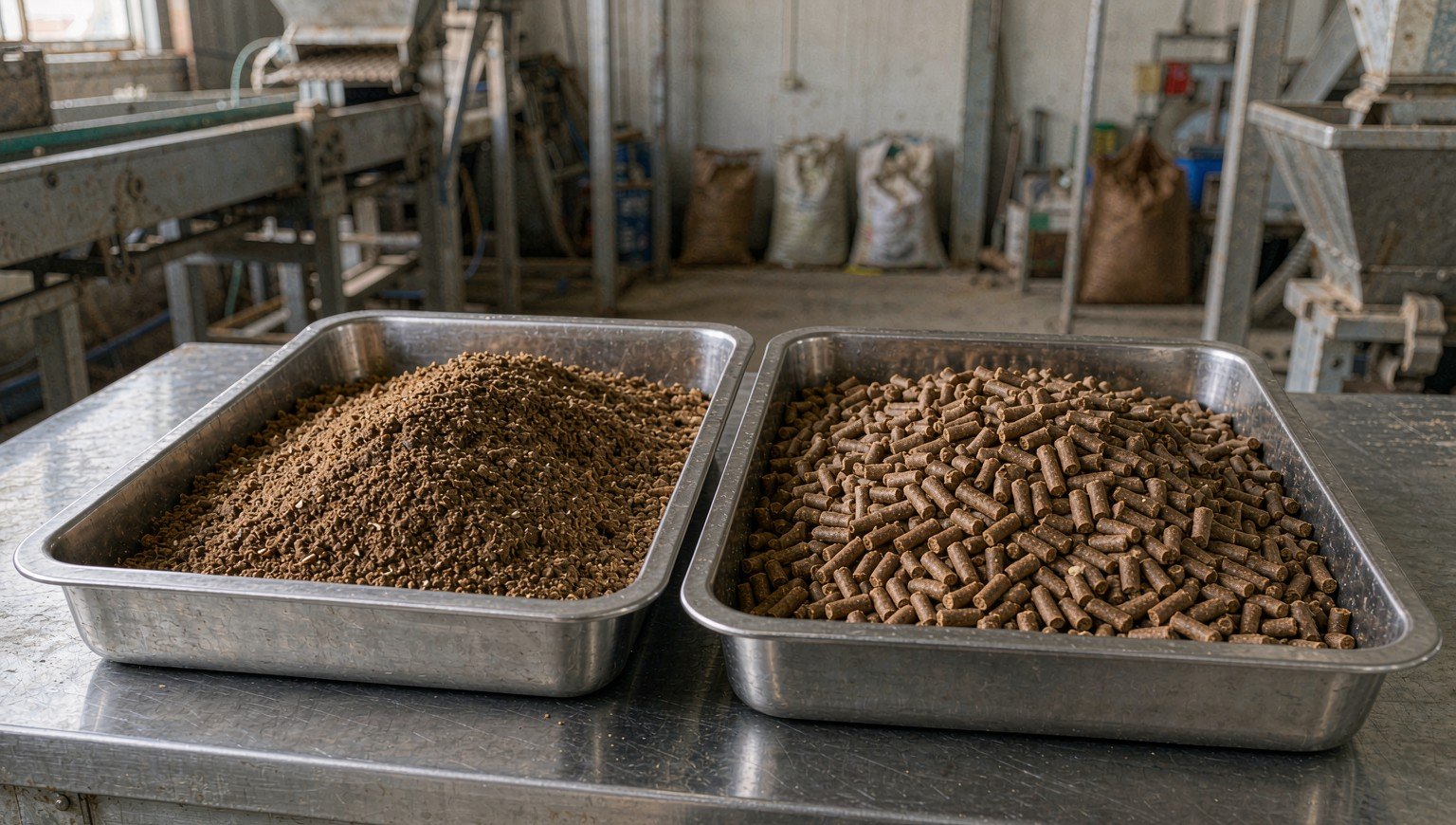
Every feed mill investment conversation reaches the same point: the pelleting section — pellet mill, steam system, cooler, screener — is a large slice of the equipment budget, and someone at the table asks whether selling mash would be cheaper and just as good. The animal performance literature gives a firm answer. Across broiler and swine trials run over five decades, pelleting the same formulation improves feed conversion by roughly 4 to 8 percent, and the advantage holds only as long as the pellets stay intact. This article collects the numbers, explains the mechanisms behind them, and frames what they mean for the payback of a pelleting line.
The Broiler Data: Feed Conversion Tracks Pellet Percentage
Presentations by the late Professor Keith Behnke of Kansas State University, drawing on classic broiler trials, put the dose-response in plain view. As the share of intact pellets in the feed rises from 0 to 100 percent, feed conversion improves step by step; body weight follows the same direction.
| Share of pellets in feed | Feed/gain (broilers) |
|---|---|
| 0% (all mash) | 2.20 |
| 25% | 2.10 |
| 50% | 2.05 |
| 75% | 2.00 |
| 100% | 1.95 |
Source: Behnke, Kansas State University, Pelleting: Factors Affecting Pellet Quality and Feed Value. The same source reports body weight in a fines trial: birds on mash reached 1.88 kg, birds on intact pellets 1.98 kg, and birds on 100% fines 1.86 kg — the full-circle confirmation that fines are, functionally, mash.
Two details from the poultry literature sharpen the picture. First, researchers testing how many pellets must reach the feed pan found that at least 40% intact pellets were required to improve body weight and feed conversion, and that birds on fully pelleted diets spared as much as 187 kcal of metabolizable energy per kg of feed (Poultry Producer, review of pelleting trials). Second, the same review compiled the fines dose-response: Lilly and co-workers (2011) measured a 0.4-point FCR improvement for each 10-percentage-point increase in intact pellets, and Lemons and Moritz (2016) measured a 2.6-point FCR improvement feeding a 70:30 pellets-to-fines blend instead of 40:60 over a 38-day grow-out.
The Swine Data: 4 to 8 Percent, Provided Fines Stay Low
The pattern repeats in pigs, with cleaner experimental controls. Iowa State University’s extension summary states the headline directly: pelleting improves both average daily gain and feed efficiency by 4 to 8 percent compared with the same diets fed as meal (Iowa State University IPIC, Swine Feed Efficiency: Influence of Pelleting). The underlying trials in that summary include Wondra and co-workers, whose finisher comparison showed feed/gain improving from 3.35 on mash to 3.16 on pellets, with a separate AGRIS-indexed record of the same study reporting 5% higher average daily gain, 7% better gain/feed and 5–8% higher digestibility of dry matter, nitrogen and gross energy (Wondra et al. 1995, Journal of Animal Science, via FAO AGRIS).
| Diet form (grow-finish pigs) | Feed/gain | Source |
|---|---|---|
| Mash | 3.35 | Wondra et al., 1995 |
| Pellet | 3.16 | Wondra et al., 1995 |
| Mash | 2.78 | Stark, 1994 |
| Pellet, 0% fines | 2.65 | Stark, 1994 |
| Pellet, 20% fines | 2.78 | Stark, 1994 |
| Pellet, 40% fines | 2.77 | Stark, 1994 |
| Pellet, 60% fines | 2.82 | Stark, 1994 |
Source: both trials compiled in the Iowa State University summary. Read the Stark rows carefully: a pellet diet delivering 20% fines performed no better than mash. The pelleting premium is not paid by pressing feed — it is paid by pressing feed and delivering it intact.
Why the Gap Exists
Three mechanisms, all documented in the sources above, explain where the conversion advantage comes from.
No selective feeding. Mash lets animals sort: birds and pigs pick the large, palatable particles and leave the fine fraction — the part carrying vitamins, minerals and synthetic amino acids — in the feeder. Nutrient intake drifts away from the formulated values and flock or pen uniformity drops. A pellet locks the whole balance into every mouthful.
Lower cost of eating. Animals spend far less time and mechanical effort picking up a pellet than consuming mash. Work going back to the early 1960s showed birds ate similar quantities but spent less energy doing it, and the 187 kcal MEn/kg sparing figure above quantifies the modern version of the same effect. Energy not spent on eating becomes gain.
Hydrothermal treatment and handling. Conditioning and die friction partially gelatinize starch and improve starch and protein digestibility — the 5–8% digestibility gains in the Wondra record — while heat treatment reduces bacterial load. Pellets also cut airborne dust in the house and move cleanly through auger and chain-disk feeding systems, which mash cannot match.
The Catch: Fines Undo the Advantage
Every dataset above converges on the same condition: the premium survives transport and feeding only if the pellets are durable. Stark’s table shows feed efficiency gains evaporating between 0% and 20% fines; the broiler trials put a concrete number on each 10-point improvement in intact pellets (0.4 points of FCR). This is why a mill’s investment case should be written around the pellet durability index it can hold in production, not the pellet mill’s nameplate tonnage.
Practically, durability is bought in three places: the grind (fine, well-distributed particles — see the hammer mill screen size selection guide), the steam system (moisture and heat that plasticize the mash — detailed in our steam conditioning guide), and the die (enough effective thickness to compress the formula — covered in our die compression ratio article). A cooler that cracks hot pellets through careless airflow can undo all three, which is why the counterflow cooler belongs in the same quality budget as the pellet mill itself.
Reading the Numbers Honestly: Why Trials Range from 4 to 8 Percent
Anyone comparing these studies side by side will notice the spread, and it is worth understanding where it comes from rather than quoting whichever number suits the budget meeting.
Pellet quality inside the trial varies. “Pelleted diet” in one study means screened pellets with almost no fines; in another it means die output fed straight to the pan. The Stark rows above show that this single difference can move the measured improvement from 5% to nearly zero. When you read a trial summary, look for the fines percentage before you copy the headline gain.
The base diet matters. Heat treatment lifts digestibility more on fibrous, by-product-heavy formulas than on simple corn–soybean meal diets, so mills serving markets with cassava, rice bran or DDGS-heavy rations see the upper part of the range. Grain particle size interacts too: the Wondra record showed finer grinding improved gain/feed independently of pelleting, and the two effects stack.
Species and phase shift the response. Young animals gain more from pelleting than finishing animals; broilers respond strongly to intact pellets in the finisher period precisely because feed volume is largest there. A single-number industry average hides all of this.
For an investment model, the defensible approach is to take the low end of the published range — 4% — as the base case, run the sensitivity at 6–8%, and treat everything above that as upside dependent on your own durability record. The arithmetic survives conservatism; the credibility of your payback presentation may not survive a 10% claim with no fines data behind it.
What This Means for the Investment Case
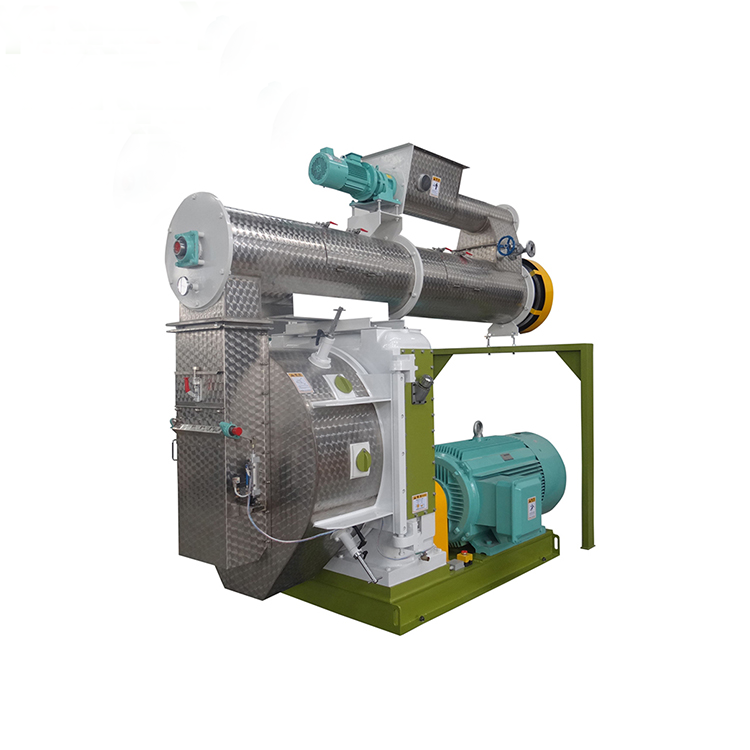
Convert the trial numbers into money with a deliberately conservative example — the assumptions are illustrative inputs, not market forecasts. Take a 5 t/h line selling broiler feed, running 40,000 tonnes of finished feed per year at a feed price of $400 per tonne. Feed represents roughly 65–70% of broiler production cost in most markets, so a 4% feed-conversion improvement lowers the feed cost per kg of liveweight by about 4% as well. On a farm buying 40,000 tonnes of this feed, that is the difference between feeding at FCR 1.60 and FCR 1.67 — worth well over a thousand tonnes of feed across a year of production. Against that, the pelleting section adds steam, power and die wear to the processing cost per ton; the Iowa State summary notes that this arithmetic has become more favorable as ingredient prices rise, which is exactly what feed markets have done.
Two budget realities temper the headline. First, the premium only materializes on farms with feeders and conveying that keep fines in check; a broken auger that crushes pellets quietly cancels the benefit. Second, the improvement depends on the formula: fibrous, high-by-product diets both pellet harder and gain more from pelleting’s digestibility effect, while the machinery must be specced accordingly — the sizing logic for a poultry and livestock feed pellet mill follows the formula, as discussed in our article on cutting feed manufacturing cost per ton.
Checklist: Evidence to Collect Before You Commit to Pelleting
- Confirm the species and phase mix. The 4–8% range covers poultry and swine; ruminant and aqua formulas justify pelleting or extruding on different grounds.
- Write the target durability into the contract. Specify a production PDI (not a lab best-case) with the test method named — Holmen and tumbling can scores are not interchangeable.
- Get the fines budget from the farm side. Ask how feed will be conveyed and what fines percentage reaches the pan; the Stark table is the reference for what that number costs.
- Price the process adders. Steam boiler, power per ton, die and roller wear — these belong in the per-ton economics next to the FCR gain.
- Check the grind and steam headroom. Confirm the hammer mill and conditioner on the quoted line can hit the moisture and particle size your formula needs for durability.
- Plan the verification. Decide now how you will measure FCR improvement after startup — feed dispatch records against farm growth records — so the pelleting investment can be audited, not just assumed.