
By the time pellets reach the cooler, the expensive part of the work is done — grinding, conditioning and compression have all been paid for. The cooler is where that investment is either protected or quietly eroded: too much residual heat or moisture at the bag means mold, sweat and fines, while overly aggressive cooling means cracked pellets and more screenings. Two machines dominate the discharge side of small and mid-size pellet lines, and they look almost identical from the outside. A counterflow cooler empties through a sliding plate or oscillating grid; a pendulum cooler empties through a hydraulically driven swing flap. The thermodynamics are the same. The discharge — and what it does to fragile product — is where they differ, and that difference should decide which one goes into your layout.
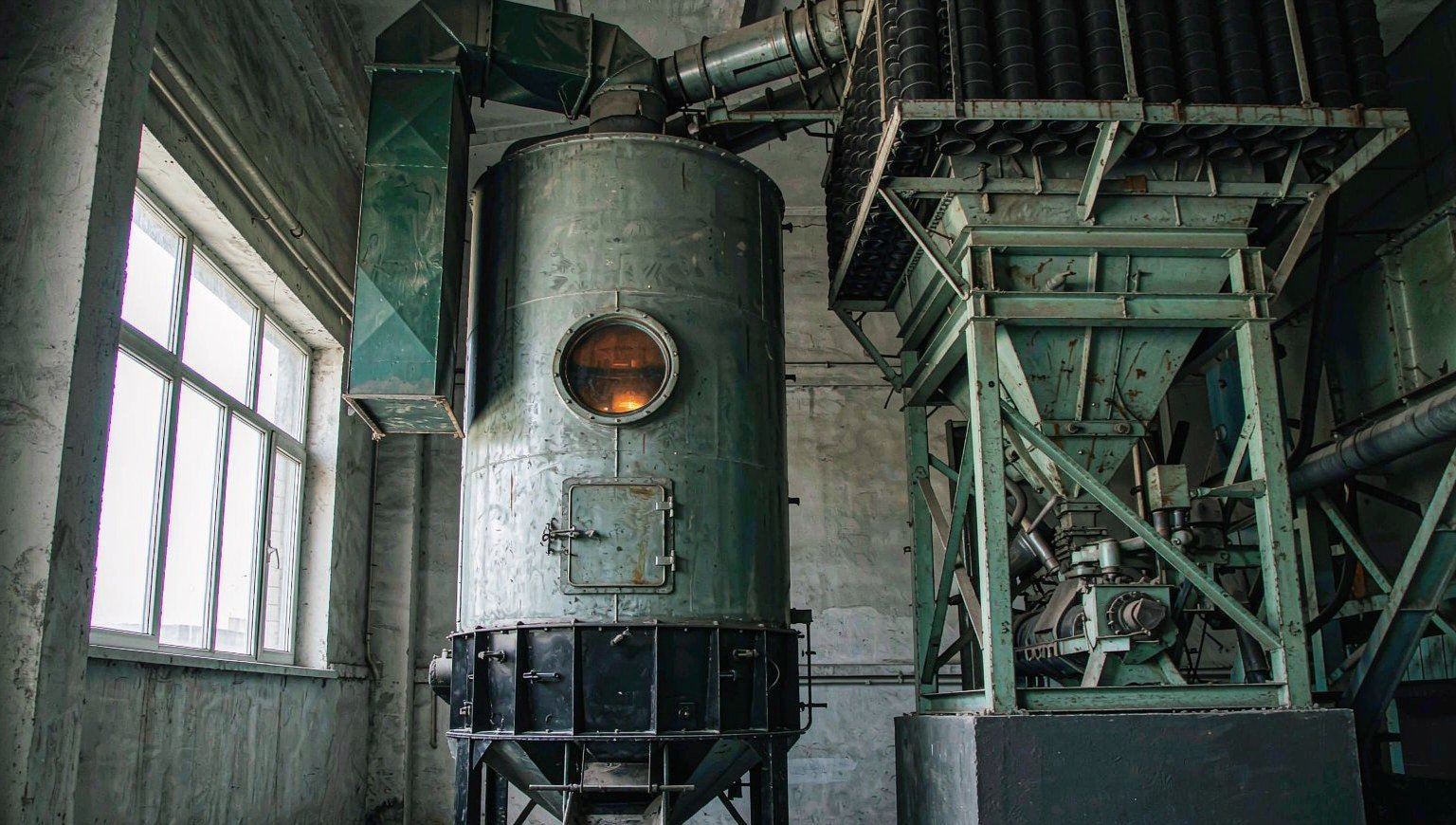
The Shared Job: What Cooling Has to Achieve
Pellets leave the die at 70–90°C and around 15–16% moisture after steam conditioning. Both numbers have to come down before the product can be stored or shipped: the accepted target is a discharge temperature within a few degrees of ambient and a moisture figure stable enough for storage — commonly quoted as 12.5% or lower for compound feed. A research update from Auburn University’s feed mill program illustrates the scale of the moisture change: hot pellet moisture of 12.9–16.3% across test diets fell to 12.0–13.4% after cooling, roughly one to three percentage points of water leaving the bed with the air stream.
Cooling also finishes the pellet mechanically. The Kansas State guide to evaluating pellet quality treats durability as the central quality metric, and fines generated after the press — whether from handling hot pellets too hard or from sweating in storage — are direct losses. This is why the durability discussion in our pellet durability index article keeps returning to the cooling section: the cooler is the last machine that can add fines before the screener, so its gentleness is a quality parameter, not a comfort feature.
Sizing the Air First: The Number Both Machines Share
Whatever the discharge mechanism, the physics is fixed by the airflow. Manufacturer manuals for SKLN-series counterflow coolers publish the reference: aspiration volume per tonne of capacity, scaled by pellet diameter (SKLN cooler operation manual). Smaller pellets present more surface area and need more air per tonne; large pellets and cubic products need less.
| Pellet diameter | Aspiration volume per tonne, m³/(t·min) |
|---|---|
| ≤5 mm | 22 |
| ≤6 mm | 25 |
| ≤10 mm | 28 |
| ≤20 mm | 31 |
| ≤22 mm | 34 |
The worked example makes the number concrete. A 10 t/h line running 6 mm poultry pellets needs about 25 m³/(t·min) × 10 t = 250 m³/min — 15,000 m³/h — pulled through the cooler, through a cyclone, into a filter and out of the building. That fan and its ducting are a real cost item and a real floor-space item, and they belong in the layout from day one. It also explains why the cooler, not the press, often sets the ceiling on a line: the press can be pushed harder, but the air side has a fixed throat. Manufacturers of the SKLN series list cooling times of 10–15 minutes across models from 3 to 20 t/h with 1.5–8 m³ chambers; the same manuals rate outlet temperature at no more than 3–5°C above ambient.
The Counterflow Cooler: Slide-Plate Discharge

In the standard counterflow design, pellets accumulate on a discharge mechanism at the bottom of the column — a reciprocating slide plate or oscillating grid that pushes a controlled layer of product across the outlet on each stroke. Level sensors in the chamber start and stop the discharge motor, so retention time is set by where those sensors sit and how fast the plate cycles. The design is compact, well proven, mechanically simple, and it is the default choice for pressed livestock feed at 3–20 t/h. Our counterflow cooler page carries the model range we supply.
Its weakness is specific: every pellet in the bottom layer is dragged across a steel edge on each stroke. For hard poultry and pig pellets, that shear is negligible. For expanded or extruded aqua feed — floats with a low bulk density and a brittle skin — it converts directly into fines at the bagging scale.
The Pendulum Cooler: Swing-Flap Discharge
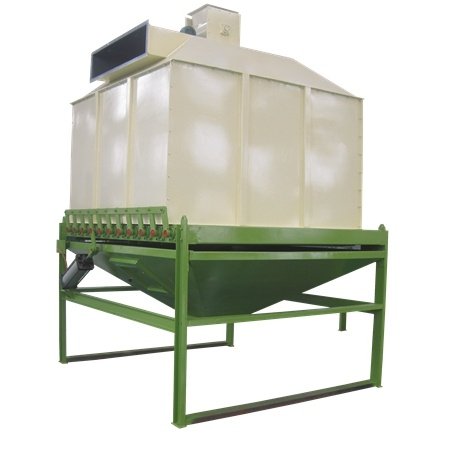
The pendulum cooler keeps the same counter-current air principle but replaces the sliding plate with a pendulum flap driven by a hydraulic system. The flap tilts, releases a portion of the bed, and swings back closed under gravity. Product leaves by falling off a tilting surface instead of being pushed across one, so mechanical stress drops sharply — which is why this design is specified for delicate and irregular products. Because the flap opening is large, shapes that would bridge over a slide plate — flakes, blocks, broken pieces, extrudates — pass without jamming.
Our pendulum cooler range (SKLB1.5 to SKLB10) covers 3–25 t/h with main motor power of 0.55–1.5 kW and a rated cooling time of not less than 6–10 minutes. Discharge speed is adjustable from the panel, and the hydraulic drive gives a smooth, evenly metered emptying cycle.
Side-by-Side Comparison
| Parameter | Counterflow (SKLN) | Pendulum (SKLB) |
|---|---|---|
| Capacity range | 3–20 t/h (1.5–8 m³) | 3–25 t/h (1.5–10 m³) |
| Rated cooling time | 10–15 min | ≥6–10 min |
| Outlet temperature | ≤ ambient +3–5°C | ≤ ambient +3–5°C |
| Discharge mechanism | Reciprocating slide plate / oscillating grid | Hydraulic pendulum flap, adjustable speed |
| Main motor power | 0.75–1.5 kW | 0.55–1.5 kW |
| Product stress at discharge | Shear across a plate edge each stroke | Drop off a tilting flap — lower shear |
| Irregular / fragile product | Requires care; possible fines increase | Passes flakes, blocks and floats without bridging |
Read the cooling-time row carefully. The counterflow machine’s longer rated retention reflects its smaller relative chamber; both machines reach the same temperature and moisture targets on hard pellets. What the row should prompt is a capacity question: can the cooler’s retention absorb your press at peak output, including the moments when the conditioner runs hot and the press surges? Size the chamber against the press, not against a nominal tonnage on a quote sheet.
Matching the Machine to the Product
| Your product range | Better fit | Reason |
|---|---|---|
| Hard pressed poultry / pig / cattle pellets | Counterflow | Pellets tolerate slide-plate discharge; compact and economical |
| Expanded and extruded aqua feed, floats | Pendulum | Swing flap minimizes breakage on fragile skins |
| Frequent recipe changes, multiple species | Pendulum | Flap self-clears; no residual pocket to contaminate the next batch |
| Biomass pellets (wood, PKS, husk) | Counterflow | Hard, regular product; same airflow logic applies |
| Blocks, flakes or mixed shapes in one line | Pendulum | Large flap opening passes irregular geometry |
Details That Decide Long-Term Satisfaction
Three specification points matter more than the brand on the nameplate. Wet-part material: condensation forms inside the chamber as warm moist air meets cool product, so stainless contact surfaces pay for themselves in humid coastal plants within the first season. Sealed feed inlet: both machines feed through an airlock, and a leaking airlock lets air bypass the bed — the most common reason a relocated line cools poorly. Adjustable discharge: stroke frequency and layer thickness on the slide plate, or swing speed on the flap, should be settable from the panel, because the optimum changes with pellet diameter and recipe.
Downstream, whatever machine you choose, the rotary screener after the cooler is the quality gate: it removes the fines that any discharge mechanism produces on a bad day. Our rotary screener handles that separation so recycled fines return to the surge bin rather than the bag.
FAQ
Can I replace a slide-plate cooler with a pendulum cooler later?
Mechanically yes — the column height, air network and ducting are similar, and both machines connect to the same aspiration system. The honest caveat is that chamber volume and discharge timing differ, so the PLC sequence and the level sensor positions need re-tuning, and the building clearance under the press should be checked against the new machine’s drawing before the order.
Do biomass pellet lines need the pendulum design?
Usually not. Wood, palm kernel shell and husk pellets are hard and regular, and the slide-plate discharge adds no meaningful fines. The pendulum premium is only justified when product integrity is the money — which in biomass typically means premium white wood pellets for European heating markets, and even there the counterflow machine with correct settings is generally sufficient.
Why does my cooler discharge pellets warmer than the rated temperature in summer?
The rated target is relative to ambient. In tropical conditions the air itself carries more moisture and less cooling headroom, so a fan sized from the aspiration table in winter conditions can fall short at 35°C and high humidity. Re-check the airflow with an anemometer and verify the airlock seal before assuming the machine is undersized — bypassing air through a leaking inlet is the more common cause.
How much moisture does cooling actually remove?
Across the Auburn University test diets cited above, cooling dropped moisture by roughly one to three percentage points, depending on conditioning water added at the press. The practical implication is that the cooler cannot rescue an over-conditioned mash: if steam addition pushes hot pellet moisture too high, the discharge moisture fails storage limits no matter how the cooler is set.
Which maintenance items should be in the spare parts box from day one?
For both machines: airlock rotor and seals, level sensors, and drive belts or hydraulic seals depending on the design. Add slide-plate wear strips for the counterflow machine and the flap’s pivot seals for the pendulum machine. All are low-cost items whose failure stops the line at the worst possible point — between a hot press and a full bagging hopper.