
Bulk density is the quiet number in a wood pellet contract. Everyone negotiates ash, moisture and calorific value; meanwhile bulk density — the mass that actually fits into a cubic metre of silo, truck tank or container — quietly decides how much steel, road freight and shipping you pay per tonne of product. The ENplus scheme specifies a bulk density of 600–750 kg/m³ for A1 and A2 wood pellets, and that band is not arbitrary: it is the envelope around which storage vessels, blow tankers, auger systems and shipping boxes have all been designed. A plant that drifts below it pays for empty space; a producer who cannot hold the band consistently gets claims, because the customer’s silo and truck were sized around a promise.
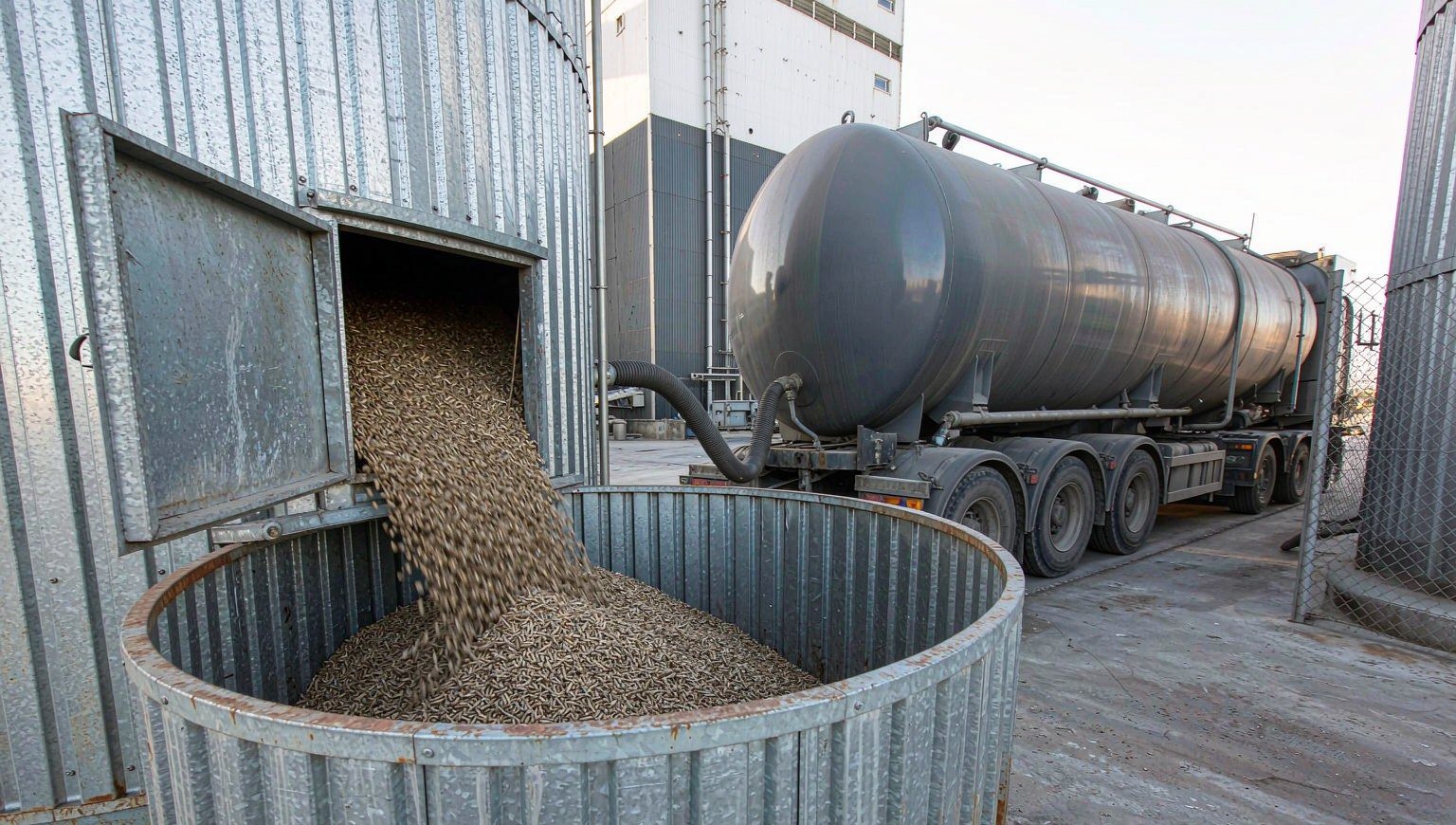
This article works through what bulk density measures, why it varies, and how the number propagates into silo volume, container loading and freight economics — the parts of the business where a 5% density error becomes a 5% margin error.
What the Number Actually Measures
Bulk density is determined by pouring pellets into a calibrated container and dividing mass by volume, as-received — fines, gaps and all. The relevant standard is ISO 17831-2, and it deliberately measures the product as the customer will receive it, not the theoretical density of solid wood. That is why the same pellet plant can ship “650 kg/m³” while the wood itself, as a solid, is far denser: the number includes the air between pellets. Particle density tells an engineer about the pellet’s internal compression; bulk density tells a logistics manager how many tonnes fit in the box. Contracts are written against the second number, which is why our walkthrough of ISO 17225-2 pellet grades treats bulk density as a specification line of its own.
The ENplus band of 600–750 kg/m³ reflects the range that standard handling equipment accommodates. Blow-fill tanker systems, residential storage hoppers and auger feeds are all engineered around this envelope; a product materially outside it either underfills the customer’s tank or surprises the auger motor. The ENplus quality scheme documentation sets the limit alongside net calorific value (at least 16.5 MJ/kg, about 4.6 kWh/kg) — the two numbers combine into energy density, which is what a heating customer is ultimately buying by the cubic metre.
The Arithmetic: What Each 50 kg/m³ Is Worth
Bulk density converts directly into volume per tonne, and volume is what silos, containers and truck bodies sell. The table below shows the volume occupied by one tonne and by a 25 t lot across the ENplus band:
| Bulk density | Volume per tonne | Volume for 25 t | Energy stored per m³ (at 4.6 kWh/kg) |
|---|---|---|---|
| 600 kg/m³ | 1.67 m³ | 41.7 m³ | ≈2.8 MWh |
| 650 kg/m³ | 1.54 m³ | 38.5 m³ | ≈3.0 MWh |
| 700 kg/m³ | 1.43 m³ | 35.7 m³ | ≈3.2 MWh |
| 750 kg/m³ | 1.33 m³ | 33.3 m³ | ≈3.5 MWh |
Read the last column against the first: moving from 600 to 750 kg/m³ stores 25% more energy in the same steel tank. For a heating customer that is a smaller storage building for the same heating season; for a producer it is the difference between selling tank space and filling it. Both sides of the trade care, which is why the number keeps appearing in contracts even when nobody mentions it in the negotiation.
Testing discipline closes the loop between plant and contract. Bulk density should be measured per lot with the same rigor as moisture, using a consistent container size and filling procedure, because the method itself moves the number — a scooped sample and a dropped sample pack differently. The useful practice at load-out is a standing reference: one calibrated test per shift logged beside the shift’s moisture and durability figures, so a drifting density shows up as a trend on the wall chart rather than as a question from the customer’s surveyor three weeks later. Plants that export into the ENplus system will be tested by third parties against ISO 17831-2; an internal method that lands within a few kilograms per cubic metre of that method is what keeps the internal number and the certificate number from telling two different stories.
Why Bulk Density Varies Between Plants and Batches
Four variables move the number in production. Feedstock species comes first: softwood and hardwood compress differently, and resin-rich material packs harder. Die geometry and compression come second — a die with a higher effective compression ratio extrudes a denser pellet, which is the same lever discussed in our article on pellet plant energy consumption, because density is bought with press power. Moisture comes third, since bulk density is measured as received and water adds mass to every pellet without adding volume. Fines content comes fourth: fines settle into the gaps between pellets and can push the measured number up while actually degrading the product — one reason the ENplus scheme caps fines separately at 1% rather than letting high fines inflate the density figure.
For comparison, unprocessed biomass sits far below the pellet band: FAO figures for wood chips list bulk densities around 195–260 kg/m³ depending on species and chip size. That gap — roughly 2.5 to 3 times — is the physical case for pelleting as a logistics business: the same truck, the same container, the same silo moves nearly three times the energy. It is also why pellet producers who sell “green energy” are, operationally, selling cubic metres.
Containers: Where the Limiting Factor Flips
Container shipping is where bulk density produces its most counterintuitive results. Carrier equipment specifications — Maersk publishes theirs for standard dry containers — pair a volume with a maximum payload, and which of the two binds depends entirely on the product density:
| Container | Internal volume | Max payload | Load at 650 kg/m³ | Limiting factor |
|---|---|---|---|---|
| 20′ standard | 33 m³ | 28,200 kg | ≈21.5 t | Volume |
| 40′ standard | 67 m³ | 28,800 kg | 43.5 t → capped at payload | Weight |
| 40′ high cube | 76 m³ | 28,620 kg | 49.4 t → capped at payload | Weight |
The 20-foot box is volume-limited: at 650 kg/m³ it reaches only about 21.5 t against a payload of 28.2 t, leaving roughly a quarter of the permitted weight unused. The 40-foot boxes are the opposite — their volume could hold 43–49 t of pellets, far beyond what the structure or the road laws allow, so they load to the weight cap. In practice the cap is set by road regulations on the receiving side, and European bulk pellet trade quotes full truckloads around 24–27 t, consistent with that reality (one Latvian bulk pellet supplier’s published delivery formats lists exactly that range alongside pneumatic tanker and big-bag options). The commercial conclusion: for 40-foot shipments, bulk density barely changes what you can ship; for 20-foot shipments and for volumetric freight pricing, it changes everything. Our checklist for loading a pellet line into containers covers the equipment side of the same trip.
Silos and Storage: Density Meets Steel
Storage is the quieter version of the same arithmetic. A 500 m³ silo holds about 325 t of pellets at 650 kg/m³ — but only 300 t if the product runs at 600, and 375 t if it runs at 750. A plant that sizes its finished-goods silo against a density promise it cannot hold will either lease overflow storage in peak season or throttle production to fit the tank, and both cost more than the press time spent holding density in band. When we design flat-bottom pellet storage silos, the working volume calculation starts from the measured density of the plant’s own product, not from a catalogue value, because the gap between the two is exactly the gap between the plan and the month-end inventory.
Density also interacts with storage behavior. Denser pellets generally abrade less in handling, which keeps fines out of the silo and keeps the silo’s effective volume from being eaten by compacted fines layers at the walls. Low-density, friable product does the opposite: every transfer adds fines, fines segregate to the silo walls, and discharge patterns suffer. The storage problem and the quality problem are the same problem seen from the control room.
When Density Drifts: Diagnosis and Fixes
| Observation | Likely cause | Response |
|---|---|---|
| Density drifting down over weeks | Die wear opening effective compression; worn rollers | Check die and roller condition against hours; adjust or replace |
| Density low from a recipe change | Softer or resin-poor feedstock, lower compression demand | Re-select die compression for the new material mix |
| Density up but fines complaints up | Fines filling pellet gaps in the test container | Fix fines generation at source; density figure will drop to its true value |
| Density varies between shifts | Inconsistent conditioning moisture or steam supply | Stabilize conditioning; log steam and density together |
The diagnosis habit that pays: record bulk density with the same discipline as moisture and durability, on every lot, against die hours. Density is one of the earliest measurable signals of die wear — it moves before durability does — and a plant that tracks it catches die changes on schedule instead of on customer complaints.
Key Takeaways
- Bulk density (600–750 kg/m³ for ENplus A1/A2) is a logistics and storage specification, not a cosmetic one: it converts directly into silo volume, container load and freight cost per tonne.
- One tonne occupies 1.33–1.67 m³ across the band — a 25% swing in how much steel and shipping each tonne consumes.
- In containers, the limiting factor flips: 20-foot boxes are volume-limited at pellet densities, 40-foot boxes are weight-limited, so density governs the small-box trade far more than the big-box trade.
- Density is bought at the press — feedstock, die compression and conditioning all move it — and measured as received, so fines and moisture contaminate the figure.
- Track bulk density per lot against die hours: it is the earliest cheap indicator of die wear and of a drifting product that will otherwise surface as a freight or storage claim.