

When a wood pellet project gets to the drying stage of the quotation, buyers usually meet two machine names: single-pass drum dryer and triple-pass (three-pass) drum dryer. Both are direct-fired rotating drums that lift wet sawdust through hot gas. The difference is the internal flow path, and that difference cascades into footprint, fuel consumption, fire risk, maintenance access, and which feedstocks each machine tolerates. This article compares them the way we compare them internally when sizing a line — by what the material actually does inside the drum.
How the Two Designs Move Material
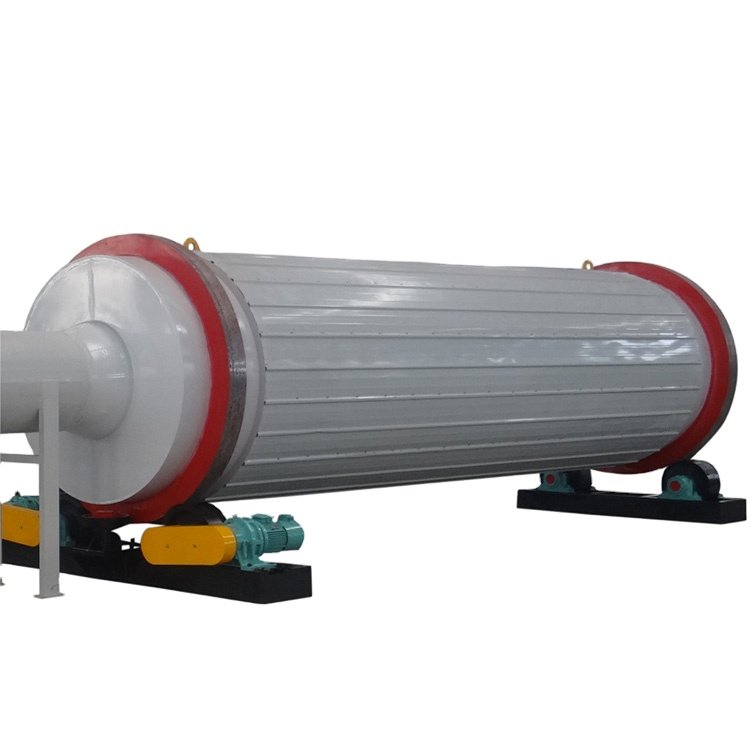
A single-pass dryer is one long cylinder, inclined slightly, rotating on riding rings. Wet material enters at the high end, flights along the shell lift it and drop it through the hot gas stream, and it travels the full shell length once before discharging. Residence time is set by drum length, slope, speed, and flight design — the only way to extend contact is to extend the shell.
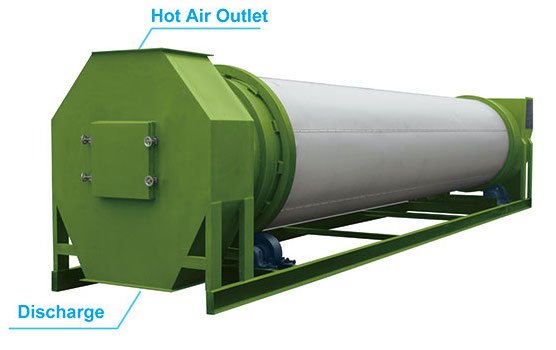
A triple-pass dryer nests three concentric drums. Material and hot gas enter the inner drum first, reverse into the middle drum, reverse again into the outer drum, and only then discharge. The gas and material effectively travel three shell lengths inside a package roughly one-third as long, and the hot inner core radiates heat back through the intermediate annuli, which is why the design is often described as self-insulating.
Everything else in the comparison follows from that structural choice. Table 1 lays out the dimensions side by side.
| Dimension | Single-pass drum | Triple-pass drum |
|---|---|---|
| Internal flow | One straight pass through the shell | Three passes via nested drums, two reversals |
| Footprint for the same duty | Long shell; the layout driver in tight plants | Roughly one-third the length; compact |
| Residence time | Shorter per unit length | Longer — contact path triples inside the same envelope |
| Heat economy | More shell surface to lose heat from; hotter exhaust | Self-insulating core; cooler exhaust, better heat use |
| Feedstock tolerance | Forgiving of sticky, coarse, oversized material | Best for light, free-flowing biomass: sawdust, chips |
| Fines carryover | Lower — straight path, one separation point | Higher with friable material; two reversals abrade particles |
| Cleaning and inspection | Open shell, direct access, simple | Nested surfaces; more area to inspect, tighter access |
| Fire risk profile | Present, as with all direct-fired drums | Present; dust accumulation zones need disciplined cleaning |
| Mechanical complexity | Lower — one shell, one drive arrangement | Higher — nested drums, more seals and internal guides |
| Typical fit | Large-capacity plants, coarse or mixed feed, long sites | Sawdust pellet lines where floor space and fuel cost dominate |
Peer-market technical guides for dryer buyers converge on the same mapping — light biomass like sawdust and chips to triple-pass, sticky coarse feeds to single-pass (TCPEL industrial rotary dryer guide).
The Energy Arithmetic
Drying is the dominant energy consumer in a pellet plant fed wet sawdust — roughly 83% of total process energy in one engineering consultancy’s calculation for 50% moisture feed (Rinke Engineering). So the comparison between dryer configurations is mostly a fuel-cost comparison, and it starts from physics.
Evaporating water takes at minimum about 2.6 MJ per kg: 0.33 MJ to heat it to boiling point, 2.26 MJ to vaporize it. Real direct-fired drums lose heat to exhaust and shell, so delivered energy runs around 3.2 MJ/kg — Rinke’s figure for a directly-fired drum dryer is about 0.9 MWh of fuel per tonne of water evaporated. A triple-pass design attacks the two loss channels: the nested drums cut shell heat loss by shortening the envelope, and the reversed flow path cools the exhaust before it leaves, putting more of the fuel’s heat into the material. Triple-pass fuel savings against an equivalent single-pass are commonly quoted in the 15–35% range by manufacturers; treat any specific figure as unverified until it is demonstrated on your own material, because inlet moisture, gas temperature, and insulation dominate the outcome.
Table 2 works the example that matters for a small pellet line.
| Step | Value | Basis |
|---|---|---|
| Pellet output target | 2.5 t/h at 12% moisture | Product spec |
| Wet sawdust feed required (50% moisture) | ≈4.4 t/h | 2.5 × 0.88 ÷ 0.50 — dry matter balance |
| Water to evaporate | ≈1.9 t/h | Feed minus product mass |
| Fuel energy at 0.9 MWh/t water | ≈1.71 MW thermal | Rinke Engineering, direct-fired drum dryer |
| Wood fuel burned (net 15 MJ/kg) | ≈410 kg/h ≈ 2.9 t per 7-h shift | 1.71 MW ÷ 15 MJ/kg |
| Fuel at 25% better heat economy (triple-pass) | ≈310 kg/h — saves ≈0.7 t per shift | Illustrative; verify on your material |
That last row is the business case in one line: a fraction of a tonne of fuel per shift, every shift, for the life of the plant. At sawmill-residue fuel prices the saving is modest; at purchased-fuel prices it compounds fast. If surplus heat is available from a CHP plant or boiler exhaust instead, the calculus changes again — low-temperature belt dryers become the option to price, which we cover in our comparison of rotary drum dryers versus belt dryers for biomass.
Fire Risk: The Pine Problem
Direct-fired drying of softwood carries a specific hazard set that the configuration choice does not remove, only reshapes. Resin vapors released from pine condense on cooler duct walls and collector surfaces, gluing wood dust into a flammable crust. Overdried fine material in a hot drum is the classic ignition scenario, and rotary dryers of both types run the longest material residence times of any dryer family. Management is equipment and procedure, not luck: outlet temperature control, insulated ducts, spark detection with fuel and air shut-off, deluge or steam suppression, and fire dumps that divert smoldering material away from stockpiles. IEA Bioenergy’s drying work documents these measures and the underlying ignition mechanisms for biomass drying systems (IEA Task 32). In a triple-pass unit, add one discipline: schedule cleaning of the nested internal surfaces, because dust accumulation zones there are less visible than a straight shell’s.
Whichever configuration you buy, insist that the fire protection package — detection, shut-off, suppression, dumps — appears as line items in the quotation, not as an afterthought in the operations manual. Our wood pellet moisture control guide covers the overdrying side of this problem in depth.
Decision Scenarios
Three situations from the project files, generalized:
Scenario A — a 2–3 t/h sawdust pellet line on a compact site in Vietnam, feeding purchased wet sawdust. Floor space is the binding constraint and fuel is the biggest running cost. Triple-pass wins on both counts; the higher fines carryover is manageable because sawmill sawdust is already fine and the screener follows the cooler anyway.
Scenario B — a 10 t/h line fed mixed forest residue with bark, chunks, and occasional wet slabs. Coarse, sticky, variable material, a long site, and a maintenance team that values access. Single-pass wins: nothing bridges or fouls in a straight shell, inspection is simple, and the layout has room for the length.
Scenario C — a plant that will later switch feedstock between sawdust and crushed palm kernel shell. Abrasive, dense material punishes the extra internal surface area and reversals of a triple-pass unit; the single-pass shell tolerates the duty better and re-lines more cheaply. The switching plan should be part of the dryer specification, not discovered after commissioning.
Match the decision to the material, not the catalog. When the same plant quotes both configurations, the spread in quoted price is usually smaller than the spread in lifetime fuel cost — which is exactly why the question deserves the arithmetic above before the purchase order. Project-level economics — payback, energy prices, and sensitivity — are worked through in our biomass pellet plant payback guide.
Next Steps
Five actions that move the decision from opinion to specification:
1. Test your own material. Ask both dryer suppliers to run a drying test on a representative sample of your sawdust — moisture in, moisture out, fuel consumed. Manufacturer claims of fuel savings only count when reproduced on your feedstock.
2. Fix the moisture boundary conditions in writing. State worst-month inlet moisture and required outlet moisture (10–12% to the die) in the specification. Every number in Table 2 changes if these two values change.
3. Size the fuel system for the dryer, not the boiler room. The worked example shows a 2.5 t/h line burning roughly 410 kg/h of wood fuel at the dryer. Combustion chamber, fuel feed, and ash handling must be quoted for that duty.
4. Measure the site. Length available for a single-pass shell versus the compact triple-pass envelope, plus access for the longest shipping section. Footprint decides as often as fuel does.
5. Compare both configurations on one quotation basis. Same evaporation duty, same outlet moisture, same fuel, with fire protection and drive systems itemized. If you would like both options priced for your material and site, send us the feedstock data through our single-pass drum dryer and triple-pass drum dryer pages — the specification forms there capture exactly the inputs we need to run the comparison.