
Drying is the most expensive step in a biomass pellet plant, and the machine you pick for it shapes your fuel bill, your product quality and your fire risk for the next decade. Bioenergy continues to expand globally as boilers and power stations convert away from fossil fuels (IRENA), which keeps pushing pellet plants toward ever-cheaper drying. Engineering analysis of pellet production from wet sawdust (50% moisture) puts about 83% of the process energy input into drying alone — everything else combined, including the pellet press, accounts for the remainder (Rinke Engineering). So the rotary drum dryer vs belt dryer question is worth settling on evidence, not on whichever brochure reached you first.
We build and install both technologies, and the honest answer is that each one wins in a different plant. This article compares them on working principle, energy, heat source compatibility, product quality and safety, then shows the actual model ranges we supply and the project profiles where we recommend each.
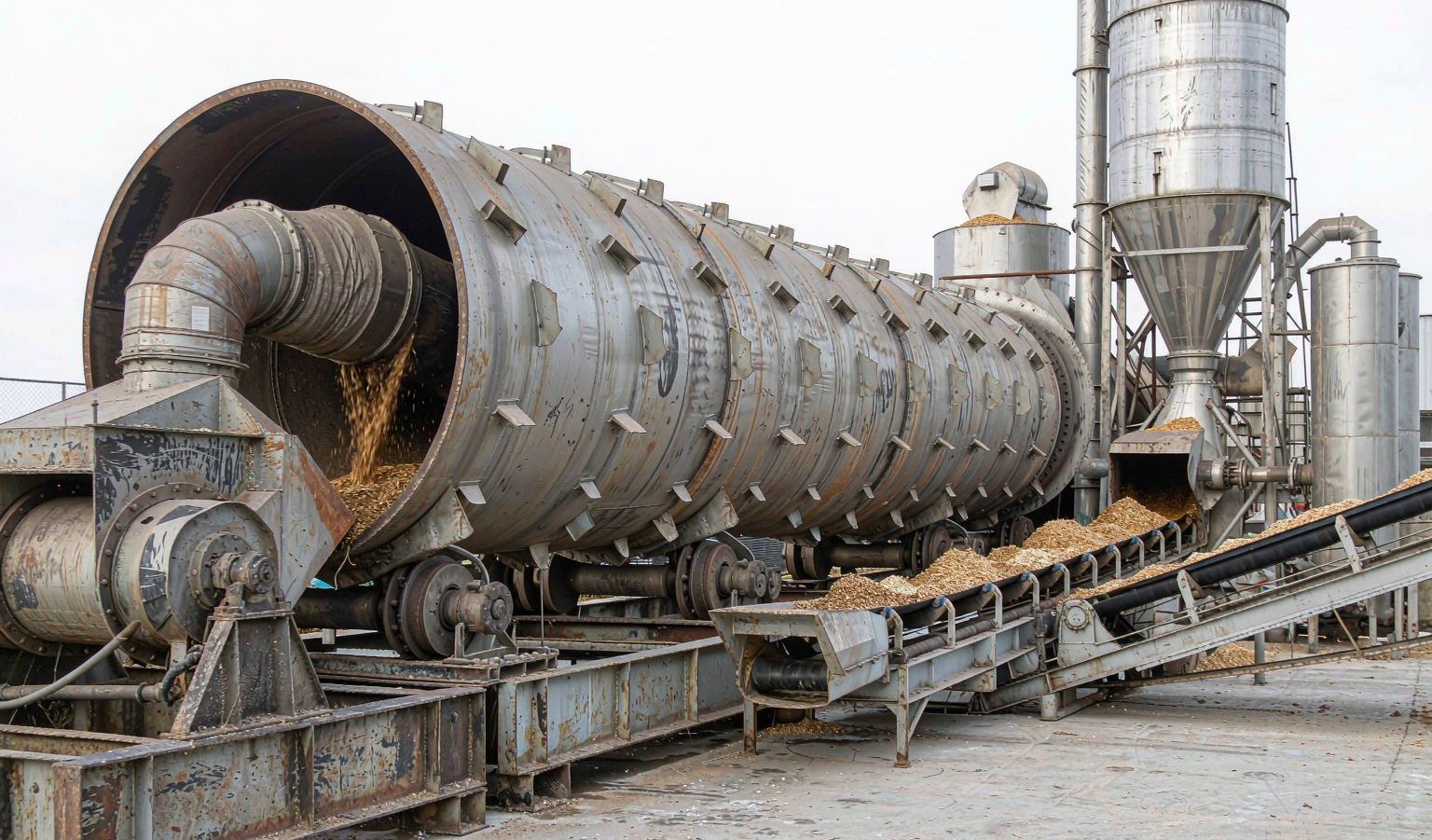
What Each Machine Actually Does to the Material
A rotary drum dryer is a direct-contact machine. Wet biomass — sawdust, chips, ground bark — is fed into a rotating cylinder together with hot air, commonly at inlet temperatures up to around 500 °C in our designs. Lifting plates inside the drum throw the material through the gas stream, so heat and mass transfer happen while the material tumbles. Residence time is minutes. In our multi-pass (three-layer) version, the material zigzags through three concentric chambers before discharge, which stretches residence time inside a shorter shell.
A belt dryer is an indirect-style, low-temperature machine. Material is spread in an even layer on a perforated mesh belt, and heated air — usually steam or hot water from a heat exchanger — passes gently through the layer as the belt advances. Our belt dryer models run on steam at 0.4–0.6 MPa. Temperatures are far lower than in a drum, air volumes are larger, and the material is never lifted or abraded. Drying is slower and more uniform across the bed.
That single difference — violent direct contact versus gentle cross-flow — cascades into every comparison point that follows.
Energy: Where the Numbers Land
The comparison data most worth trusting comes from an engineering consultancy that sells neither machine. Rinke Engineering’s evaluation of pellet plant drying puts a directly-fired drum dryer at roughly 0.9 MWh of heat per tonne of water evaporated, with the belt dryer ranging from about 0.7 to 1.5 MWh per tonne depending strongly on outside climate and available heat source temperature. At first glance the belt dryer looks worse than the drum; in practice the number depends on whether low-grade heat is available to feed it.
That is the key subtlety: belt dryers run on 60–90 °C-class heat that would otherwise be wasted. Where a plant has a combined heat and power (CHP) unit, surplus steam or waste heat from a neighbouring process, the belt dryer converts near-free heat into dry product, and its apparent energy disadvantage disappears or reverses. A drum dryer needs high-temperature air, which means burning fuel specifically for drying — biomass furnace gas, natural gas or diesel — every hour the plant runs. Our own belt dryer specification reflects this logic: the YHGJ series is steam-driven precisely because it is meant to sit downstream of a boiler or CHP that already exists.
Electrical energy tells a related story. Drum systems need large induced-draft fans moving enormous air volumes at high temperature; belt systems move even more air but at low temperature, and their conveyor drives add power draw. Neither technology “wins” on electricity in a universal way — the fan sizing on the specific design matters more than the category name. Ask each supplier for the connected power per tonne of evaporation and compare those numbers, not adjectives.

Side-by-Side Comparison
| Criterion | Rotary drum dryer | Belt dryer |
|---|---|---|
| Heat transfer mode | Direct contact, hot gas + tumbling material | Cross-flow air through fixed bed on mesh belt |
| Typical inlet air temperature | Up to ~500 °C (our designs) | Low temperature, steam/hot-water heated |
| Heat demand per t water evaporated | ~0.9 MWh (direct-fired) | ~0.7–1.5 MWh, climate- and heat-source-dependent |
| Heat source | Dedicated burner: biomass furnace, gas, diesel | Surplus steam or waste heat; economical mainly with CHP |
| Best feed material | High-moisture, mixed, fibrous or lumpy biomass | Shape-sensitive, fragile or premium-grade material |
| Product temperature stress | High — risk of discoloration and quality loss | Low — colour and fibre preserved |
| Fire risk inside dryer | Higher (hot gas, dust, direct contact) | Lower, so dryer availability is higher |
| Exhaust air cleaning | High air volumes make cleaning difficult; combustion pollutants can contact product | WESP/RTO cleaning possible; no combustion gases in product |
| Floor space | Compact in multi-pass design (our three-pass needs ~30% less floor area than a single drum at equal capacity) | Larger footprint per tonne; multi-storey layouts possible |
| Capital cost | Lower | Higher |
| Maintenance character | Lifters, roller rings, seals; simple but abrasive duty | Belt tracking, mesh wear, more moving parts |
The comparison rows trace directly to Rinke Engineering’s published evaluation of both technologies for pellet production and to the specifications of our own machine range below. For the trade context behind pellet demand — and the trade flows that quality rules like colour and ash shape — IEA Bioenergy’s Task 40 on sustainable international bioenergy trade remains the standard reference body (IEA Bioenergy Task 40).
How We Apply Both: Three Machines in Our Range
We supply both technologies as standard products, which is why this article reads as “which one fits” rather than “buy ours”. The parameters below are first-hand, from our product documentation.
| Machine | Key parameters | Designed for |
|---|---|---|
| Three-layer (three-pass) drum dryer | Models YLHG1–YLHG5, 1–5 t/h, inlet temperature <500 °C, sawdust at 45% feed moisture, insulated outer shell, container-friendly drum sections | High-moisture sawdust for pellet lines; compact sites |
| Single-layer drum dryer | Cast steel roller ring and retainer wheel support, handling fibrous and bulky powder biomass | Coarser, higher-tonnage feed material; simple layouts |
| Belt dryer (YHGJ series) | 5 t/h class, steam 1300 kg/h at 0.4–0.6 MPa, water evaporation 850 kg/h, on-line moisture automatic testing, heat-insulated enclosure | Plants with steam/CHP surplus; grain and shape-sensitive material |
Two design details in that table deserve a sentence each. The three-pass drum’s ~30% floor-space saving against a single drum of equal capacity matters a great deal in retrofit projects and container-based plants — the drum sections are dimensioned to ship in standard containers. And the on-line moisture measurement on our belt dryer removes the operator-dependent element from drying control: the dryer regulates itself against a moisture setpoint instead of an operator watching the discharge.
Which One Fits Your Project
Match the machine to your heat situation first, your material second:
- No steam source, no CHP — stand-alone pellet plant on bought-in or site-generated waste. The rotary drum wins. You need high-temperature heat anyway, so extract full use from it, and the lower capital cost keeps the project bankable. This is the configuration behind most of the pellet lines we build in Southeast Asia and Eastern Europe, and the cost logic is the same one we walked through in our sawdust pellet plant cost-per-ton analysis.
- CHP plant or free steam available. The belt dryer wins. Feeding it waste heat turns its climate sensitivity into a rounding error, and you avoid burning premium fuel at 500 °C to do what 90 °C steam can do. Rinke’s evaluation is explicit that low-temperature belt drying is only economical where CHP or equivalent surplus heat exists — take that as the boundary condition, not a suggestion.
- Premium or shape-sensitive products — white pellets for EU retail, animal bedding, food-grade drying. Belt drying at low temperature avoids discoloration and fibre damage; contact with combustion gas is also eliminated, which simplifies your quality story to European buyers.
- Erratic feedstock with wide moisture swings — mixed chips, bark, seasonally wet material. The drum tolerates it; a belt bed wants a reasonably homogeneous layer. If your yard receives whatever the forest gives, lean drum.
If you want a second opinion on a specific material, send a moisture analysis and a capacity target through the biomass dryer category page contact and we will tell you which technology the numbers support — including when the honest answer is neither.
Key Takeaways
- Drying consumes the large majority of process energy in pellet production — roughly 83% for wet sawdust — so the dryer choice is an operating-cost decision before it is an equipment decision.
- Direct-fired rotary drum dryers run near 0.9 MWh of heat per tonne of water evaporated; belt dryers range 0.7–1.5 MWh depending on climate and heat source, and only make economic sense where CHP or surplus steam exists.
- Drums take abuse: high moisture, mixed and lumpy feed, up to ~500 °C inlet air — at the cost of higher fire risk and some product temperature stress.
- Belt dryers deliver gentle, uniform, low-temperature drying with lower fire risk and cleaner exhaust options — at higher capital cost and a larger footprint.
- Our three-pass drum saves ~30% floor area versus a single drum at equal capacity, and our steam-heated belt dryer adds on-line moisture control; both ship in standard containers.
- Decide by heat source first, material sensitivity second: stand-alone plant → drum; CHP plant → belt; premium white product → belt; erratic forest feedstock → drum.