
Ask two feed mill managers why their pellet durability differs by eight points on the same formula and you will usually hear about the die, the roller gap, or the hammer mill screen. Conditioning comes up last, even though it is the only stage where you can change pellet quality in a few seconds without touching a single mechanical part. It is also the stage where most plants have the least instrumentation: one temperature probe at the discharge, a pressure gauge on the steam line, and an operator who learns by ear when the mash sounds right.
That is a poor way to run the cheapest quality lever in the plant. Conditioning is a heat and mass transfer step with measurable inputs and measurable outputs. The published research on it is unusually clear about where the gains are, where they stop, and what you pay for pushing further. This article walks through that evidence, then translates it into setpoints, steam system details and failure modes you can check on a real line.
What the conditioner actually does to a mash particle
Three things happen in the conditioner, and they happen at different rates.
The first is condensation. Dry saturated steam entering the mash hits particles that are at 20 to 30 °C and condenses on the surface, releasing latent heat. FAO’s feed milling chapter describes the mechanism plainly: a high volume of water vapour condenses on the surface of feed particles, wetting and softening them for better compression, while the temperature of that steam gelatinizes part of the raw starch, which supplies the adhesion that holds a pellet together (FAO, Feed Milling Processes). Note the sequence: water arrives first as condensate, heat arrives with it, and the softening is a surface effect before it is a bulk effect.
The second is equalisation. Moisture that sits on the outside of a particle needs time to migrate inward, and heat needs time to penetrate. A 30-second pass through a single-shaft conditioner does not fully equalise a 2 mm mash particle; it starts the process and lets the die finish it. This is why retention time and temperature are not interchangeable, a point the research below makes repeatedly.
The third is compression and friction heating in the die itself, which is where most starch gelatinisation actually occurs. In the Kansas State University pelleting guide, the die is treated as the place where the real work happens: conditioned mash enters at 17 to 18 % total moisture and 82 to 93 °C, and the pressure and shear inside the die holes complete the cooking (Dunmire, Stark and Paulk, 2021). FAO puts the pressure range inside a ring die at 75 to 600 kg/cm². That is a lot of work being done after the conditioner has finished.
The practical consequence: conditioning is a preparation step, not a cooking step. Its job is to deliver mash to the die at the right temperature, the right moisture, and with a surface that will bond. Mills that expect the conditioner alone to gelatinise starch usually over-steam, and then pay for it at the die and in the nutritionist’s office.
The temperature–durability curve, measured rather than assumed
The cleanest published dataset on this comes from a 2020 trial at Kansas State University published in Translational Animal Science. Truelock and co-workers pelleted corn-soy diets at three conditioning temperatures (74, 79 and 85 °C), with a fixed 30-second retention time, two die thicknesses (length-to-diameter ratios of 5.6 and 8), and a production rate held at the mill’s rated output. Pellet durability index (PDI) was measured by the standard tumbler method.
| Treatment | PDI at 74 °C | PDI at 79 °C | PDI at 85 °C | Mill energy, 74 → 85 °C |
|---|---|---|---|---|
| Conventional corn, die L:D 5.6 | 81.2 % | 83.7 % | 87.9 % | 13.4 → 13.1 kWh/t |
| Conventional corn, die L:D 8 | 87.9 % | 89.0 % | 92.0 % | 14.1 → 13.7 kWh/t |
| High-amylase corn, die L:D 5.6 | 78.8 % | 78.1 % | 81.4 % | 14.0 → 14.0 kWh/t |
| High-amylase corn, die L:D 8 | 89.1 % | 88.9 % | 91.4 % | 14.2 → 14.0 kWh/t |
Read the table in two directions. Across a row, 11 °C of extra conditioning temperature bought 4.1 to 6.7 points of PDI on the conventional corn diet, and it did not cost energy — mill specific energy stayed flat or fell slightly. Down a column, a thicker die (L:D 8 instead of 5.6) bought 4.1 to 10.8 points across the two corn types, but cost 0.2 to 0.8 kWh/t. The conditioning lever is the one that comes with a smaller bill.
The trial also explains why. Starch gelatinisation measured in the conditioned mash was only 3.9 to 5.6 %, but in the finished pellets it was 10.7 to 15.0 %. Most of the cooking happened in the die, driven by the moisture and heat the conditioner had delivered. Conditioning was not doing the gelatinising; it was setting up the conditions for the die to do it.
Where the moisture comes from, and why that number matters more than temperature
Temperature is the number operators watch because it is on the display. Moisture is the number that decides whether the mill runs or plugs.
The Kansas State guide gives the working relationship: for every 25 °F (14 °C) of temperature rise in the conditioner, roughly 1 % moisture is added to the feed. The example in the guide is worth repeating because it shows how much ambient conditions move the result. A mill targeting 190 °F (88 °C) with winter mash entering at 40 °F (4 °C) needs a 150 °F rise, which adds about 6 % moisture; the same mill in summer with mash at 90 °F (32 °C) needs a 100 °F rise and adds about 4 %. Starting from 12 % mash moisture, that is 18 % at the die in winter and 16 % in summer. Total moisture above about 18 % can plug the mill, depending on configuration.
This is the single most common cause of “the mill runs fine in July and chokes in January” complaints. The recipe did not change. The steam valve setting did not change. The incoming mash temperature changed, and with it the amount of condensate the mill is actually injecting. A plant without a mash moisture reading before the conditioner, and without a mass-balance check on steam flow, is running blind on the variable that matters most.
Industry bodies have published guidance on this for years — the International Feed Industry Federation coordinates feed safety work across national associations, and the American Feed Industry Association maintains manufacturing reference material for its members — but none of it can tell you what your conditioner is doing at 3 a.m. on a cold shift. That number has to come from your own instruments.
Our own conditioner specifications cover 3 to 8 % steam addition by weight at 2 to 6 bar, which matches that physics: the low end suits a warm, high-moisture mash, the high end suits a dry, cold one. The number is not a setpoint, it is an outcome. Set the steam flow that delivers the target moisture at the die, and let the temperature follow.
The ceiling: what high temperature costs you
If 85 °C is better than 74 °C for durability, why not run 95 °C? Because PDI is not the only output of the process, and the nutrition literature has been fairly consistent about the trade.
Abdollahi and co-workers (Poultry Science, 2020) pelleted wheat-based broiler diets at 60 °C and 90 °C. PDI rose from 80.8 % to 89.1 %, a gain of 10.3 points. In the same trial, conditioning at 90 °C reduced the apparent ileal digestibility of starch, fat and calcium, and the earlier work by the same group measured an apparent metabolisable energy penalty that works out at roughly 24 kcal/kg of diet for every 10 °C increase in conditioning temperature. A separate 2010 study in British Poultry Science, testing 60, 75 and 90 °C, found that PDI improved with temperature in wheat-based diets but not in maize-based ones, while feed conversion ratio worsened at the higher temperatures in both.
Two lessons follow. First, the durability gain from temperature is real but diet-specific: a corn-soy diet with plenty of starch responds, a wheat-based diet responds differently, and a high-whey nursery diet cannot be pushed at all. Second, above roughly 85 to 90 °C you are trading digestible energy for durability, and at some point the trade stops being worth it. A mill running 95 °C to hit a durability target is usually covering for a formulation or grind problem that would be cheaper to fix upstream.
There is a useful side effect in the data: the 2020 trial found that a liquid acidifier changed the size of the temperature gain. Without acidifier, moving from 60 °C to 90 °C gained 17.2 points of PDI; with 7 g/kg of acidifier the gain fell to 6.6 points. Additives that improve binding at low temperature reduce how much heat you need. That is a cheaper route to durability than another 10 °C of steam.
Retention time is a separate decision from temperature
Retention time gets treated as a quality dial, and it is one, but a slow one. The Kansas State guide puts the target for a typical corn-soy diet at about 30 to 45 seconds, and notes that longer retention can improve quality by increasing heat and moisture absorption while reducing mill throughput. It also notes the cases where longer is right: drier formulations benefit, high-moisture diets need shorter retention, and longer retention at lower temperature lets particles absorb moisture more evenly.
That last point is the one worth designing around. A 90-second pass at 75 °C and a 30-second pass at 88 °C can both deliver acceptable mash to the die, but they do different things to nutrients. The long, cooler pass is gentler on heat-sensitive ingredients — whey, enzymes, probiotics, vitamin premixes — while still giving moisture time to penetrate. This is why long-term conditioners and hygienisers exist as separate machines rather than as a bigger single-shaft unit: they decouple residence time from temperature, which a single short conditioner cannot do.
Our conditioner range is built in single, double and triple shaft configurations with 30 to 240 seconds of adjustable retention, controlled by paddle speed and internal baffles. The 240-second end is for aqua feed and high-fibre formulations; a poultry grower diet should never be run there. If you are specifying a line, decide retention time from the diet list, not from the tonnage.
Measuring retention time is straightforward and rarely done. The three accepted methods are the amp-load method (stop the feeder, time the drop in mill load), the whole-corn or dye tracer method (add a marker at the feeder, sample at the inspection door), and weighing the conditioner contents at steady state. Any of them takes under an hour and will usually reveal that the nameplate figure and the actual figure differ by 30 % or more.
The steam system decides the result more than the conditioner does
A conditioner is a vessel with a shaft and some nozzles. What makes it work or fail is upstream: the quality of the steam arriving at the injection point.
Wet steam is the most common defect. Steam carrying entrained water droplets delivers moisture without the corresponding latent heat, so the mash gets wet and cold, the die slips, and the operator opens the valve further to compensate, which makes it worse. Superheated steam fails in the opposite direction: it has to lose superheat before it condenses, so it heats the mash unevenly and under-delivers moisture at the particle surface. What the process needs is dry saturated steam, and the way to get it is a properly sized header, a separator close to the mill, trapped drip legs at low points, and insulated lines long enough to be a problem if left bare.
Pressure control matters as much as quality. Conditioning temperature should be set with a steam regulator upstream and a flow control valve at the conditioner, so that header pressure fluctuations do not translate directly into steam flow changes. Our conditioners are specified for 2 to 6 bar at the injection point, and every nozzle is individually adjustable so that distribution along the shaft can be trimmed rather than guessed.
The three measurements that make the system controllable are mash temperature and moisture before the conditioner, conditioned mash temperature at the discharge, and steam flow. Add a fourth — motor load on the pellet press — and you can see the lubrication effect in real time. Mills that run on discharge temperature alone are controlling an outcome with a one-variable view of a two-variable process.
Setpoints by feed type
| Feed type | Conditioning temperature | Mash moisture at die | Retention | Typical PDI target |
|---|---|---|---|---|
| Poultry grower / finisher (corn-soy) | 82–93 °C (180–200 °F) | 17–18 % | 30–45 s | 90–95 % |
| Nursery / high-whey diets | 60–65 °C (140–150 °F) | 15–17 % | 20–30 s | 88–93 % |
| Ruminant, high-fibre | 70–80 °C | 15–17 % | 45–90 s | 85–92 % |
| Aqua feed (sinking, extruded-pelleted) | 85–95 °C | 18–22 % | 90–180 s | 96–98 % (water stability) |
How to read this table: the temperatures for the first two rows come from the Kansas State guide; the aqua and ruminant ranges reflect our own commissioning data from lines we have built, and they are starting points, not limits. The column that should drive your specification is retention, not temperature, because retention is where the equipment cost sits. A mill that lists four species will need either a long conditioner with adjustable speed or two conditioners.
One caution on PDI targets: a 96 % target on aqua feed is not the same specification as a 96 % target on poultry feed, because the test method and the failure mechanism differ. Water stability in aqua feed is a separate test from the ISO 17831-1 tumbler, and a pellet that passes one can fail the other. Write the test method into the purchase specification, not just the number.
Failure modes you can diagnose from the control room
| Symptom | Most likely cause | What to check first |
|---|---|---|
| Discharge temperature reached, pellets soft and crumbly | Wet steam: moisture without latent heat | Steam separator and drip legs; boiler carry-over; line insulation |
| Mill plugs in cold weather only | Condensate load rises as mash temperature falls | Mash moisture before conditioning; steam flow per tonne |
| PDI varies between shifts on one formula | Retention time drifting with feed rate | Paddle speed against feeder rate; conditioner build-up |
| Die wear rising, amps high, durability flat | Under-conditioning; steam not reaching the die face | Nozzle blockage; distribution along the shaft; steam pressure at the mill |
| Dark pellets, scorched smell, feed intake drop | Over-conditioning or over-long retention | Actual (measured) retention time; temperature setpoint against diet |
These five cover most of what we see during commissioning. None of them require new equipment. All of them require that someone knows the actual moisture, the actual retention time and the actual steam quality, which is why a mill that instruments the conditioner properly tends to solve its own problems faster than a mill that buys a bigger press.
What to specify when you buy a conditioner
If you are adding conditioning capacity or replacing a unit, the specification that gets you a good machine is not the vessel diameter. It is these items, in this order:
Diet list and target retention range, per species. Steam addition range in percent by weight at your expected mash moisture. Steam pressure available at the mill, and whether the boiler can hold it. Conditioner type (single, double, triple shaft) and whether the shaft speed is on a VFD. Nozzle count, placement and adjustability. Insulation and cladding on the vessel and the steam line. Instrumentation included: discharge temperature, mash moisture, steam flow, and motor load signals wired to the PLC. Access for cleaning, because a conditioner that cannot be opened will be cleaned twice a year and will drift the rest of the time.
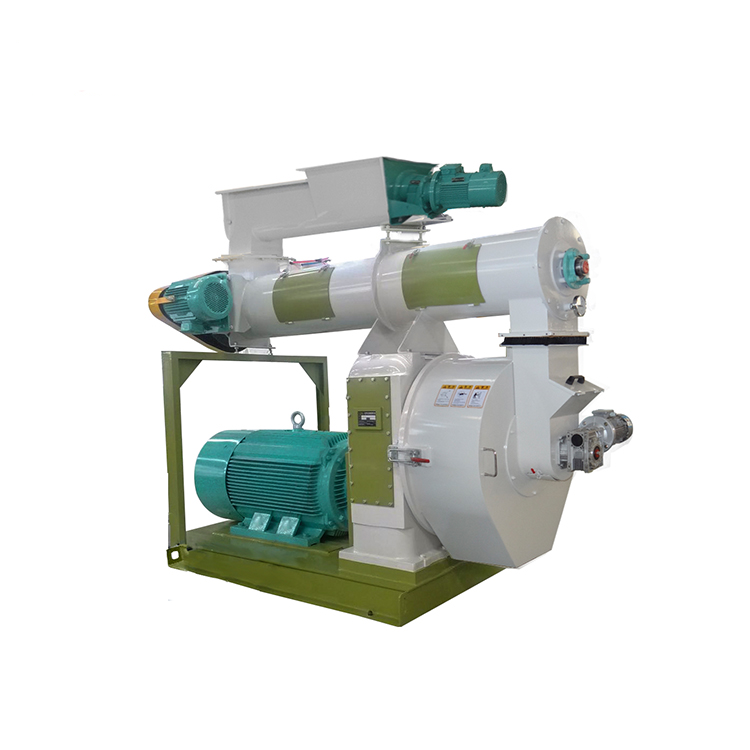
Two more decisions matter downstream. First, the pellet press behind the conditioner has to be able to use the conditioned mash: a press with a worn die and a badly set roller gap will waste good conditioning. Second, the cooler after the press determines the final moisture and the fines level, and a cooler that pulls too much moisture will undo part of the durability gain. Our pellet mill with conditioner is specified as a matched feeder-conditioner-press package for exactly this reason; the wider feed pellet machine range covers the 5 to 15 t/h compound feed duty this article is about, and the counterflow cooler that follows it should be sized on the same throughput and moisture balance.
For a new line, the conditioning section cannot be sized in isolation from grinding. A hammer mill producing a wide particle size distribution will deliver mash that conditions unevenly, and no amount of steam fixes that. This is the same matching problem we describe in the line design guide for biomass, where dryer capacity and press capacity have to be balanced stage by stage. Feed lines fail in the same way, just with moisture instead of heat as the coupling variable.
Key Takeaways
Conditioning is a preparation step. The die does most of the starch gelatinisation; the conditioner’s job is to deliver mash at the right temperature and moisture with a softened surface.
Published data shows 11 °C of extra conditioning temperature adding 4 to 7 points of PDI at essentially no energy cost, while a thicker die adds 4 to 11 points but costs 0.2 to 0.8 kWh/t. Temperature is the cheaper lever, up to a point.
That point is around 85 to 90 °C. Beyond it, PDI gains come with measurable losses in starch, fat and calcium digestibility, and an energy penalty of roughly 24 kcal/kg per 10 °C in the published work. Diet type changes the size of both effects.
Moisture, not temperature, is the variable that plugs mills. Every 14 °C of temperature rise adds about 1 % moisture, so a winter start at 4 °C mash and a summer start at 32 °C mash produce very different moisture at the die from the same setpoint. Total moisture above about 18 % risks plugging.
Retention time is a separate decision from temperature and should be chosen from the diet list: 30 to 45 seconds for a typical corn-soy diet, longer at lower temperatures for heat-sensitive or high-fibre formulations. Measure it once with a tracer; nameplate figures are often wrong.
Most conditioning problems are steam system problems. Dry saturated steam, a separator close to the mill, trapped drip legs, insulated lines, and a regulator-plus-flow-control arrangement will do more for durability than a larger conditioner.