
In most feed mills, particle size problems trace back to one wear part: the screen. Change the screen and the same hammer mill produces a different product, a different energy bill and a different animal performance outcome. Yet screen selection is usually treated as a maintenance afterthought rather than a process decision. This guide explains how screen aperture actually maps to output particle size, what the published research says about the pairing, and how to pick a screen that hits your nutritionist’s target without wasting kilowatt-hours.
How the Screen Actually Works
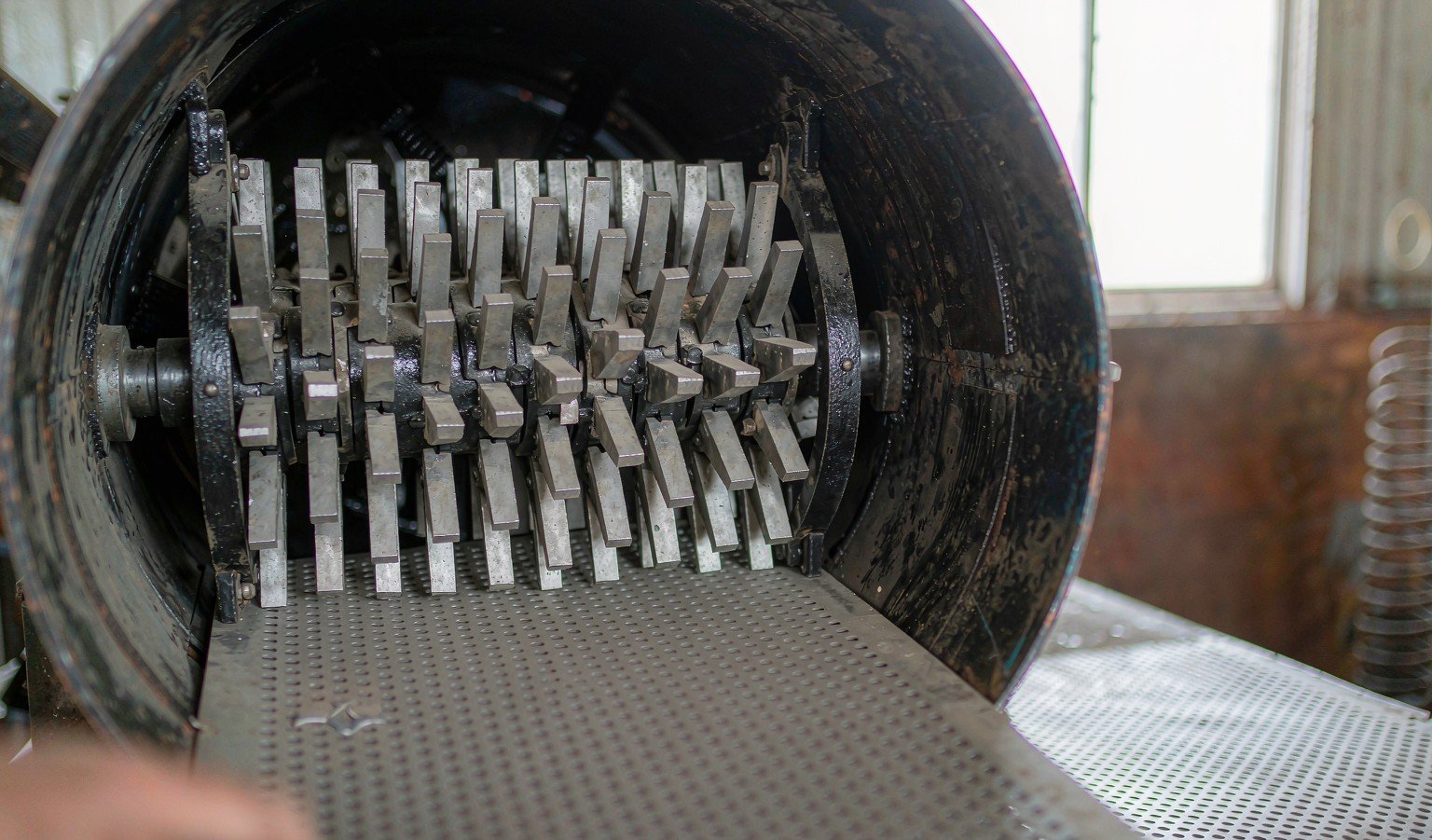
A hammer mill reduces grain by impact. Free-swinging hammers on a high-speed rotor strike material until the fragments are small enough to pass through the perforated screen that lines the grinding chamber. That last clause is the important one: the screen is a barrier, not a cutting edge. A particle escapes when it is small enough and when its trajectory lines up with a hole — which is why the mean particle size (geometric mean diameter, dgw) that comes out is always considerably smaller than the hole diameter, and why two variables govern the result:
- Screen aperture sets the ceiling on particle size and controls how long material stays in the chamber.
- Hammer tip speed controls how hard and how often each particle is struck before it escapes.
Kansas State University researchers (Saensukjaroenphon et al.) tested these two variables together on whole corn, grinding through 6/64, 10/64 and 16/64 inch screens at three tip speeds from 10,250 to 20,500 ft/min. Raising tip speed reduced dgw by 233, 258 and 305 µm on the three screens respectively — meaning tip speed buys you more fineness on a coarse screen than on a fine one, and a variable frequency drive on the mill motor lets operators adjust output particle size without stopping to change screens. The study is summarized in the Engormix feed-machinery library.
Know Your Target Before You Pick a Screen
Screen selection only makes sense against a particle size target, and the target comes from animal nutrition, not from the mill. The numbers below are the ones with the strongest published backing:
| Diet | Target dgw (µm) | Why |
|---|---|---|
| Swine grow-finish (corn-based) | 650–750 | Best balance of digestibility, ulcer risk and grinding cost (USDA NRCS; KSU extension) |
| Swine and poultry, general recommendation | 650–750 | USDA NRCS feed management technical note |
| Nursery/starter swine | 500–700 | Young pigs benefit from finer grind; watch ulcer and bridging risk |
| Floor below all swine diets | ~500 | Gastric ulcer and keratinization risk rises; energy cost climbs steeply |
| Ruminant rations | Coarser, by ration design | Rumen function needs effective fiber; fine grinding is counterproductive |
Sources: USDA NRCS Nutrient Management Technical Note 190-NM-8 (PDF) and the Kansas State University particle size fact sheet (PDF).
The economics of hitting the target are well documented. USDA NRCS summarizes the digestibility work (Wondra et al., 1995): reducing particle size from 1,000 to 400 µm raises dry matter and nitrogen digestibility by roughly 5 to 6 percentage points. KSU extension puts the same relationship in money terms: every 100 µm your average particle size runs above the 700 µm recommendation costs about $0.65 per finishing pig — close to $2 per head if the mill has drifted to 1,000 µm. For a 10,000-head finishing operation, a worn screen nobody replaced is a five-figure annual loss.
Screen Hole to Micron: What Field Data Shows
The practical question is which hole diameter produces which dgw. The KSU starter-pig trials (Ohh et al., 1983) remain the clearest published pairing of screen size to output:
| Screen hole | Resulting dgw (µm) | Where it fits |
|---|---|---|
| 1/8 in (3.2 mm) | 539–624 | Fine grinds for starter diets and pellet mill feed |
| 1/4 in (6.4 mm) | 722–877 | Standard grow-finish grinding near the 700–750 target |
| 3/8 in (9.5 mm) | >900 (coarser end) | Coarse grinding, high-throughput pre-grinding |
Corn ground on a hammer mill in the KSU trials cited above; exact dgw also depends on grain, moisture, hammer wear and tip speed. Verify with a sieve analysis (ANSI/ASAE S319.4) rather than assuming.
Two cautions when using this table. First, the mapping is material-specific: sorghum, barley and fibrous by-products produce different dgw through the same screen. Second, always compare particle sizes measured by the same sieve method — sieve count, agitation time and dispersion agents all shift the number, so a supplier’s “600 micron” and your lab’s 600 may not match.

The Cost Side: Energy, Wear and Throughput
Grinding is one of the largest single electrical loads in a feed mill — industry-compiled extension data places grinding energy between roughly 3 and 16 kWh/t, rising steeply as the target fineness drops. Three practical consequences:
- Fine grind costs real money. Halving particle size does not halve screen aperture proportionally; energy per ton climbs faster than fineness improves feed conversion. Stop at the target.
- Worn hammers masquerade as screen problems. As hammer corners wear, effective tip speed and cutting action fall, and operators compensate by moving to finer screens — paying more energy for worse uniformity. Rotate or replace hammers before changing screens.
- Throughput drops with aperture. A finer screen passes less material per hour. If the mill was sized to a coarse screen, a switch to fine grinding can leave the mixer starved.
Open area matters as much as hole size. A screen with a higher percentage of open area passes particles faster and runs cooler, reducing energy per ton at the same fineness; the trade-off is that high-open-area, thin-gauge screens distort and wear faster on abrasive materials. Match the gauge to the material, not just the hole.
Grind Size and Pellet Quality: The Downstream Half
Screen selection also reaches past the grinder into the pellet mill. Finer grinding increases the surface area available for steam conditioning, which is why mills making high-durability pellets usually grind finer than mills selling mash. The trade-off is real, though: over-fine grind can make pellets brittle if conditioning is marginal, and the extra grinding energy has to be paid for regardless of what happens downstream. The conditioning side of that balance — how steam, moisture and retention time convert a given grind into pellet durability — is covered in our steam conditioning article. The practical rule for the grinding room: match the screen to the die and recipe you run most, and verify the pairing with pellet durability data, not just sieve results.
Worked Scenario: Two Screens, One Target
Consider a mid-size mill whose nutritionist specifies 700 µm for a corn-based grow-finish diet. The mill currently runs a 1/4 in screen, and a recent sieve check shows 790 µm — hammers have 900 hours on them. The KSU mapping says a fresh 1/4 in screen on corn lands at 722–877 µm depending on tip speed and hammer condition, so the correct first move is not a screen change at all: rotate the hammers, re-sieve, and only drop to a 1/8 in screen (539–624 µm) if the nutritionist actually wants a finer diet or the pellets need more surface for conditioning.
The cost logic runs the same way. KSU extension prices each 100 µm above the 700 µm target at roughly $0.65 per finishing pig — so a drift from 790 to 700 µm is worth about $0.60/head. A 1/8 in screen that lands at 600 µm captures a little more feed efficiency but pays for it in grinding energy, throughput and a narrower margin against the 500 µm ulcer floor. The data-backed move is the cheapest one that hits the band: hammer maintenance first, screen second, tip speed third. Mills that skip the sequence usually buy fineness they did not need with kilowatts they did not budget.
Common Selection Mistakes
These are the errors we see most often when auditing underperforming grinding systems:
- Selecting by habit. The screen that shipped with the mill stays in for years while the formulation and animal targets change. Particle size should be verified by sieve test quarterly, and the screen chosen deliberately against the result.
- Chasing digestibility past 500 µm. Below roughly 500 µm, swine ulcer risk and feed bridging rise, and grinding energy more than doubles for a shrinking return. KSU’s fact sheet is explicit that ~700 µm with a 600–800 µm acceptable band is the economic optimum for swine.
- Ignoring screen condition. Worn, bellied or punctured screens let whole grains through, showing up later as coarse specks in the finished feed and unstable pellet quality.
- One screen for every recipe. Mills running both fine aqua feeds and coarse ruminant rations need a screen program — change time built into the schedule — or a second grinder.
If your current mill cannot hold particle size economically, or you are sizing grinding for a new line, our hammer mill range covers models from compact YHM56 units to the YHM112 series for high-throughput precision grinding, and our engineers can help match screen programs to your recipes. For the grinding-versus-rolling question, see our hammer mill vs roller mill comparison; for how grind size feeds into pelleting outcomes, our steam conditioning article covers the downstream half of the equation.
Screen Selection Checklist
- ☐ Define the target dgw by species and growth phase, in writing, with the nutritionist.
- ☐ Choose screen hole diameter against the target using a sieve-verified mapping for your grain.
- ☐ Confirm tip speed suits the screen; consider a VFD for in-run adjustability.
- ☐ Check open area and gauge against material abrasiveness.
- ☐ Schedule hammer rotation/replacement so it never competes with screen changes as a diagnosis.
- ☐ Verify output with a 13-sieve analysis (ANSI/ASAE S319.4) at least quarterly and after every screen or hammer change.
- ☐ Log dgw, energy per ton and throughput for each screen so the next selection is a data decision, not a guess.