

Pine sawdust is the raw material most wood pellet plants are built around, and for good reason. It binds well, it burns hot, and a mill set up correctly for it produces some of the highest durability pellets in the industry. But “pine sawdust” covers a wide range of material: wet sawmill residues at 50% moisture, kiln-dried planer shavings at 12%, sawdust with bark mixed in, sawdust blended with flooring waste. The process works when the plant is designed around the actual material arriving at the gate, not around an average number in a brochure.
This article walks through the process stage by stage, with the parameters that matter at each step and the failure modes we see most often when a line runs pine. The numbers come from published wood science, from the ENplus quality scheme requirements, and from our own equipment specifications.
Before the stages, one framing note. Every number in this article assumes the feedstock question has been answered first. A pellet line is a chain of unit operations — screen, grind, dry, condition, press, cool, screen, pack — and each stage is designed to hold one variable inside a window the next stage can tolerate. When a pine line disappoints, the cause is almost never a single broken machine; it is two stages whose windows do not meet, such as a dryer that delivers 16% moisture into a die specified for 11%. Read the stages below with that in mind, and treat each parameter target as a contract between neighboring machines.
Why Pine Is the Easiest Wood to Pelletize
Softwood and hardwood are not interchangeable at a pellet die. The chemistry differs in two ways that matter for binding, and both favor pine.
The first difference is lignin. Published wood chemistry data (Thomas, 1977) puts softwood lignin at 25–31% of dry mass against 17–23% for hardwoods, and pine specifically runs around 28% lignin with roughly 4% extractives. Lignin softens at die operating temperatures and re-glues the particle matrix as the pellet cools. More lignin means the same compression produces a harder pellet with less added heat. Resin and other extractives act as a secondary binder, flow under pressure, and fill the micro-gaps between fibers.
The second difference is heating value, which is where extractives earn their keep. A USDA Forest Products Laboratory analysis of eight species (White, 1987) measured average higher heating value at 8,890 Btu/lb — about 20.7 MJ/kg — for the four softwoods against 8,529 Btu/lb (19.8 MJ/kg) for the four hardwoods. The regression in that study attributes the difference mainly to lignin and extractive content; extractives carry roughly 33–38 GJ per tonne, nearly double the value of cellulose. Resinous pine sawdust is literally the highest-energy fraction of the tree.
This is the opposite of what many first-time buyers assume. Hardwood is denser as raw wood, but as pellet feedstock the softwood runs faster, binds easier, and burns hotter. The market reflects it: premium residential pellets in Europe and North America are predominantly spruce-pine-fir. If your supply is softwood sawdust, you are working with the easier feedstock, not the inferior one.
Know Your Sawdust Before You Price the Line
Three properties decide how much processing your pine sawdust needs, and all three vary by source. Table 1 summarizes the ranges we design around.
| Property | Typical pine value | What it means for the line |
|---|---|---|
| Moisture, fresh trunk wood | 45–60% (up to ~65% in summer-felled timber) | Primary drying duty; sets dryer size and fuel consumption |
| Moisture, dry kiln residue | 10–15% | May skip drying or only condition; storage matters more than drying |
| Lignin content | ~28% of dry mass (softwood range 25–31%) | Strong natural binding; moderate die L/D works |
| Extractives (resin) | ~4% of dry mass; higher in heartwood | Raises heating value; raises dryer fire risk and resin fouling in ducts |
| Ash, debarked sawdust | ~0.3–0.5% of dry mass | Comfortably clears ENplus A1 ash limits; bark inclusion breaks this |
| Particle size, sawmill sawdust | Mostly 1–4 mm | Light grinding or screening only; saves a full grinding stage |
| Particle size, shavings and chips | 5–30 mm | Full hammer mill stage required before the die |
The moisture line in that table deserves emphasis. Freshly felled pine trunk wood carries 45–60% moisture depending on season, while the die wants 10–14%. Sawmill “wet” sawdust sits near the fresh-wood value; “dry” sawdust from kiln-dried lumber is already close to the die window. A plant fed dry residue may not need a dryer at all, while a plant fed green sawdust spends more energy evaporating water than pressing pellets — drying accounts for roughly 83% of the process energy in pellet production from 50% moisture sawdust, by one engineering consultancy’s calculation (Rinke Engineering). Feedstock moisture is therefore the first and largest driver of plant economics, before any machine is chosen.
Bark is the other variable that quietly decides which grade you can sell. Debarked softwood sawdust clears the ENplus A1 ash ceiling of 0.7% easily. Bark carries several times the ash of stem wood, so every percentage point of bark contamination pushes the blend toward the A2 or B ceilings. The grading rules are covered in detail in our article on ENplus A1 requirements for pellet producers, and they are worth reading before signing sawdust supply contracts.
Stage 1: Screening and Size Reduction
Wet sawdust from a sawmill usually arrives with slabs, knots, stones, and tramp metal. A scalping screen and an overhead magnet protect everything downstream; a stone that reaches a die becomes a broken die. This stage is cheap and unglamorous, and skipping it is the most common root cause we find behind “unexplained” die breakage.
Particle size targets then split by feedstock. True sawdust — the 1–4 mm fraction — needs only light grinding, and often just screening to remove oversize. Shavings and chips need a full pass through a hammer mill to bring everything under roughly 4 mm. The screen inside the hammer mill, not the die, is what sets the particle size; a 4 mm screen on softwood sawdust typically delivers a grind in the 1.5–3 mm range that presses well in 6 mm dies. Matching screen to target grind is its own subject, covered with a worked example in our hammer mill screen size selection guide.
Do not over-grind. Excessive fines beyond what the die needs cost electricity, raise dust load, and can actually reduce output because ultra-fine material feeds inconsistently. Grind to the die’s requirement, not finer.
Stage 2: Drying to the Die Window
The pellet die wants material at roughly 10–14% moisture, with most pine lines running 10–12%. Above about 15%, steam flashes in the die channels, pellets come out cracked, and the die plugs. Below about 8–9%, lignin does not soften properly, binding fails, and the mill grinds powder at full motor load. The window is narrow, and the dryer is what holds you inside it.
The arithmetic is worth doing for your own material. One tonne of sawdust at 50% moisture contains 500 kg of dry matter. To reach 12% moisture, total mass must fall to 500/0.88 ≈ 568 kg, so about 432 kg of water must be evaporated per tonne of feed. Evaporating that water takes real fuel: physics puts the minimum at about 2.6 MJ per kg of water (0.33 MJ to heat it to 100°C, 2.26 MJ to vaporize it), and a direct-fired drum dryer runs near 3.2 MJ/kg in practice. For a 2.5 t/h pellet output from 50% sawdust, the evaporation duty is roughly 1.9 tonnes of water per hour — the single largest energy consumer in the plant. Our note on wood pellet moisture control works through the full water balance.
Pine adds a hazard that hardwood lines manage less often: resin. Resin vapors released during drying condense on cold duct walls and in the dust collector, where they glue wood dust into an inflammable crust. Overdried fine material in a hot drum is the classic ignition scenario. Direct-fired dryers running pine need proper outlet temperature control, insulated ducts, spark detection, and fire suppression — this is equipment selection territory, not operator training territory, and it belongs in the quotation discussion. Dryer configuration (single-pass versus multi-pass, direct versus indirect firing) changes both the fire risk profile and the fuel bill; we compare drum dryer options in detail in a separate article.
Blending Wet and Dry Streams Without Surprising the Die
Most real plants do not receive one sawdust. They receive a wet stream from the green chain and a dry stream from the planer and moulder lines, and the blend drifts with production schedules on both sides. The die does not care what the weekly average moisture is — it cares what arrives in the next sixty seconds. Two practices keep the blend honest.
The first is a day bin or blending silo ahead of the dryer, sized to hold several hours of feed. Mixing wet and dry sawdust in a bin averages out the peaks, and a simple screw reclaimer feeding the dryer at a controlled rate turns a bimodal moisture problem into a narrow distribution the dryer can follow. Without the bin, the dryer chases alternating wet and dry slugs, the outlet moisture oscillates, and the die sees the consequences downstream of everything that was supposed to be controlled.
The second is an inline moisture measurement at the dryer outlet, feeding either an operator display or, better, a closed loop that trims feed rate or inlet temperature. Spot checks with a hand-held meter catch drift eventually; an inline meter catches it in minutes. The cost of the meter is recovered quickly in avoided die plugging alone — a single plugged die and restart costs more operator hours than the meter’s annual calibration.
Species blending follows similar logic. Pine blended with spruce or fir changes little; pine blended with hardwood shifts the binding behavior toward the hardwood’s, which means a higher die L/D and slightly more conditioning heat. Keep the hardwood fraction below roughly 30% unless the die was specified for the blend, and re-test durability whenever a new supplier’s material enters the mix. Mills that log durability per feedstock batch find these shifts in the data room; mills that do not find them in the customer’s complaint email.
Stage 3: Conditioning
Conditioning adds low-pressure steam to preheat the sawdust and nudge moisture upward before the die. For softwood sawdust, published feedstock-die testing points at a conditioning temperature of roughly 75–85°C with material in the 10–14% moisture window (TCPEL feedstock-die matrix). The steam does two things: softens the lignin so it flows at lower mechanical work, and lubricates the die channels so the roller can compress instead of friction-grind.
Retention time matters as much as temperature. Steam contact of 20–40 seconds in a conditioning conditioner is typical for wood; there is no benefit to dumping extra steam in at the last second, because unabsorbed surface water flashes in the die. If pellets leave the die steaming and cracked, back off the steam rate before touching anything else.
One caution specific to very resinous heartwood: resin already acts as a plasticizer, so a conditioning recipe tuned on hardwood or on low-resin softwood can be too aggressive for pine. Start at the low end of the temperature window and step up while watching pellet exit temperature and fines.
Stage 4: Pelletizing — Die Selection Does the Work
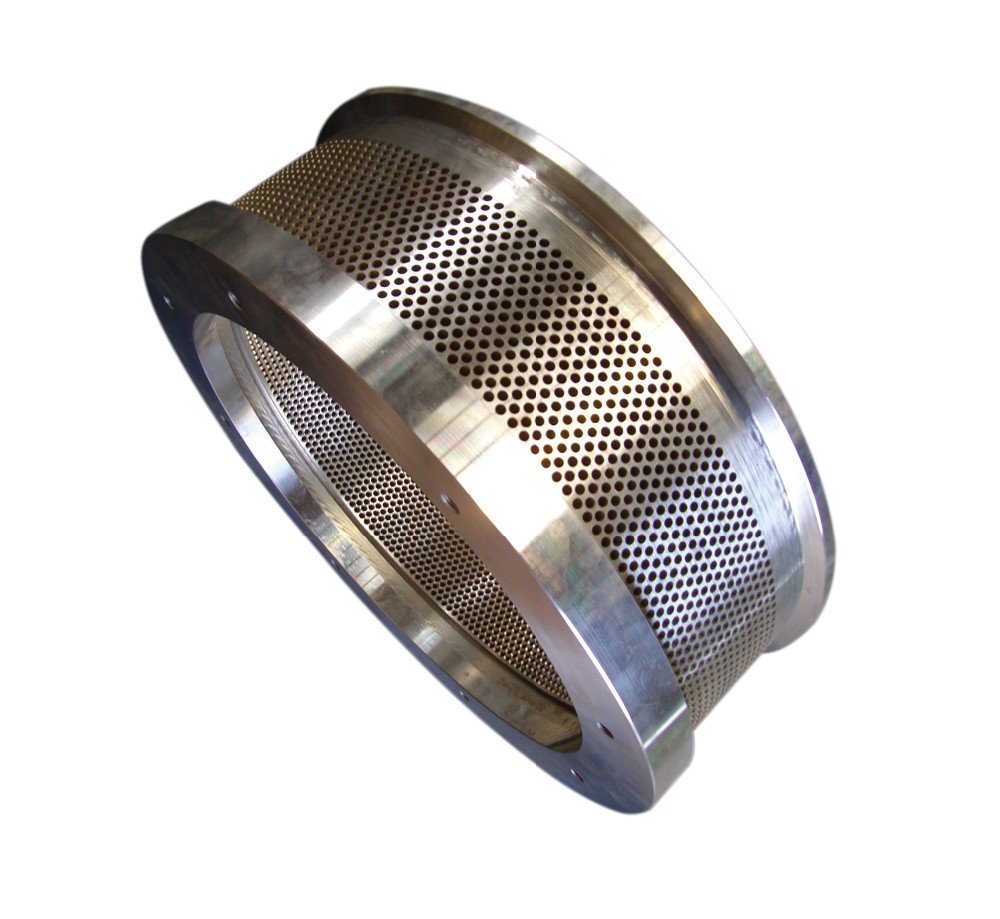
Pine sawdust presses well, which is exactly why die selection still matters: an easy feedstock tempts buyers into whatever die is on the shelf. The compression ratio — the length of the die channel divided by its diameter — determines how long the material stays compressed on its way through the hole. Testing and industry data for softwood sawdust converge on an L/D of 5:1 to 6:1 for 6 mm and 8 mm dies, with 8 mm typically wanting the higher end (TCPEL). A lower ratio lets softwood slip through half-bound; a higher ratio burns motor power and die life without a durability gain, because pine’s lignin does not need the persuasion that straw does.
Operating points worth watching at the die: die temperature in the 80–110°C range, motor load steady at 85–95% of rated, and a pellet exit temperature that tracks the die temperature without spiking. Feed rate control is the main lever — a pellet mill wants a full but not flooded press chamber, and chasing tonnage by pushing amperage past rating produces soft pellets now and a damaged die later. Our article on pellet mill die compression ratio covers the evidence and the failure symptoms in depth, and our biomass pellet mill page lists the die options we supply for wood duty.
Table 2 collects the stage parameters in one view.
| Stage | Parameter | Target for pine sawdust | Warning sign if off-spec |
|---|---|---|---|
| Screening | Stones and metal removal | Magnet + scalper upstream of grinding | Unexplained die breakage, torn screens |
| Grinding | Particle size after hammer mill | Mostly 1.5–3 mm (4–6 mm screen) | Oversize flakes in pellets; uneven die flow |
| Drying | Moisture to the die | 10–12% | Cracked or steaming pellets above 14%; powder below 9% |
| Conditioning | Temperature / retention | 75–85°C / 20–40 s | Wet flash at the die; fines rising |
| Pelletizing | Die L/D, hole size | 5:1–6:1, 6 or 8 mm | Crumbling pellets (too low) or hot motor, fast wear (too high) |
| Pelletizing | Motor load | 85–95% of rated | Breaker trips or soft, low-density pellets |
| Cooling | Pellet exit temperature | Within a few °C of ambient, below ~40°C to storage | Sweating, clumping, mold in bags or silo |
Stage 5: Cooling, Screening and Storage
Pellets leave the die hot, soft, and at 2–3 percentage points more moisture than they entered — friction and flash steam move water around. A counterflow cooler brings them back to near ambient temperature and pulls off that surface moisture; the air moves against the pellet flow so the coldest air meets the coldest pellets and the product leaves evenly cooled. The working principle and its operating variables are laid out in our counterflow cooler article.
After cooling, a screener removes fines and oversize. Fines content is a graded specification — ENplus limits fines to 1% at the point of bagging for A1 — so this screen is a quality gate, not a housekeeping step. Recycle the fines back to the conditioning inlet; they re-press fine.
Storage then decides whether yesterday’s quality survives to shipping day. Pellets are hygroscopic, and pine’s high resin content does not protect them from re-absorbing moisture. Dry covered storage, dry bagging air, and palletized bag storage with the moisture barrier intact are the requirements; the European Pellet Council’s certification handbook treats storage humidity as part of the certification audit, not an optional habit (pellet.org).
The Failure Modes We See Most Often on Pine Lines
Most pine pellet problems trace back to four or five recurring causes. Table 3 is the diagnostic list we hand to new operators.
| Symptom | Most likely cause | First response |
|---|---|---|
| Pellets crumble; durability below spec | Moisture too low, or die L/D too low for the material | Check die inlet moisture; step up steam; consider a higher-ratio die |
| Die plugs, output drops to zero | Moisture spike above ~15%, or oversize particles bridging the feed | Stop, clean die, verify dryer outlet moisture and screen condition |
| Motor trips at rated load | Die L/D too high, worn rollers slipping on a worn die, or overfeeding | Back off feed rate, check roller-die gap, review die spec |
| Fines above 1% at bagging | Weak binding upstream or worn screener mesh | Test durability, inspect screener, check cooling outlet temperature |
| Ash creeping toward 0.7% | Bark or dirt contamination in the sawdust supply | Test per supplier lot; tighten purchase spec or add washing/debarking |
| Dryer fire or glowing material in collector | Overdried fines, resin deposits igniting, or upset temperatures | Shut fuel and air, trigger suppression, inspect for duct resin crust |
What a Pine Line Costs to Run — Briefly
We keep full cost models in separate articles — the per-tonne breakdown in our sawdust pellet plant cost analysis and the investment arithmetic in our payback guide. The pine-specific point is shorter: pine’s low drying tolerance is a cost advantage only if the dryer matches the wet feed. A line fed dry kiln residue at 12% moisture can skip most of the evaporation duty and its fuel bill shrinks accordingly; a line fed green sawdust must size the dryer for the worst month of the year, not the average. Getting that sizing right at the quotation stage, with your actual moisture data, is the single most consequential decision in the whole project. Export demand supports the effort — global wood pellet trade remains anchored on European and East Asian import markets tracked by the IEA Bioenergy Task 40 network (IEA Task 40).
Checklist: Before You Commit to a Pine Sawdust Pellet Project
Use this list as the pre-quotation gate. Every “no” is a design question that is cheaper to answer now than after commissioning.
Feedstock: moisture measured monthly across a full year (not one sample)? bark fraction quantified by supplier lot? ash tested on at least three representative lots? particle size distribution known for every source?
Process: dryer sized for worst-case feed moisture, not average? spark detection, fire suppression, and fire dumps specified on the dryer train? die compression ratio and hole diameter matched to the dominant feedstock in writing? cooler and screener capacity checked against the mill’s hourly output?
Quality and market: target grade (A1, A2, B or industrial) decided before equipment is specified? durability and fines test methods agreed with buyers? storage plan keeps pellets dry from cooler to bag to customer?
Spares and support: one die and one roller set on the shelf per mill? screens and belts stocked? commissioning support and die re-supply lead times confirmed with the supplier in the contract?
If all four groups check out, pine sawdust is a genuinely easy feedstock to build a business on — the chemistry does half the work, and the rest is disciplined process control.